Stocked with high-end assets, the Joffrey Ballet’s Midsummer Night’s Dream experience was like being set free to plunder a Neiman Marcus big box shop. Opening April 17 for its West Coast premiere, which ran through April 19, the two-hour performance at Cal Performances’ Zellerbach Hall featured maximalist choreography and set design by Sweden’s Alexander Ekman, a brilliant original score by Mikael Karlsson, meticulously casual yet astute costumes by Bregje van Balen, the can-sing-anything Swedish indie rock vocalist Anna von Hausswolff wandering amidst the dancers, six exemplary musicians forming an onstage band, and without question, some of the finest contemporary ballet dancers this side of the planet, if not worldwide.
From the get-go, Ekman placed his official stamp on the terms “fling, flaunt, skew, tilt, dance porn, pas de pun, and have fun“ as part of ballet lexicon. The score featured a heady blend of classical, contemporary, experimental, pop, and traditional Swedish folk music. The content and themes of Ekman’s Midsummer were equally dense; a raucous Scandinavian Midsommar holiday—food, drink, flagpoles, dancing, leafy crowns, celestial sun and moon, flying fish. With no discernible links to famous versions by Shakespeare or Mendelssohn, this was Ekman’s chariot to command.
The ballet began with a dancer (Dylan Gutierrez as The Dreamer) covered by a white sheet and “asleep” on a hospital-style bed placed downstage of the main curtain. Text displayed on the curtain (some words hard to decipher due to fabric folds) signaled kisses, storms, deception, false promises, and other mischievousness were coming.
The Sleeper, wakened by an alarm jangling, then an intensely bright spotlight—eliciting the first of many chuckles from the audience—was eventually roused by another dancer (Victoria Jaiani as The Hostess). Waving handfuls of hay and singing an indecipherable ditty, she skipped down an aisle, mounted the stage, and handed him pants and a shirt. He dressed, they kissed, they slipped behind the curtain.
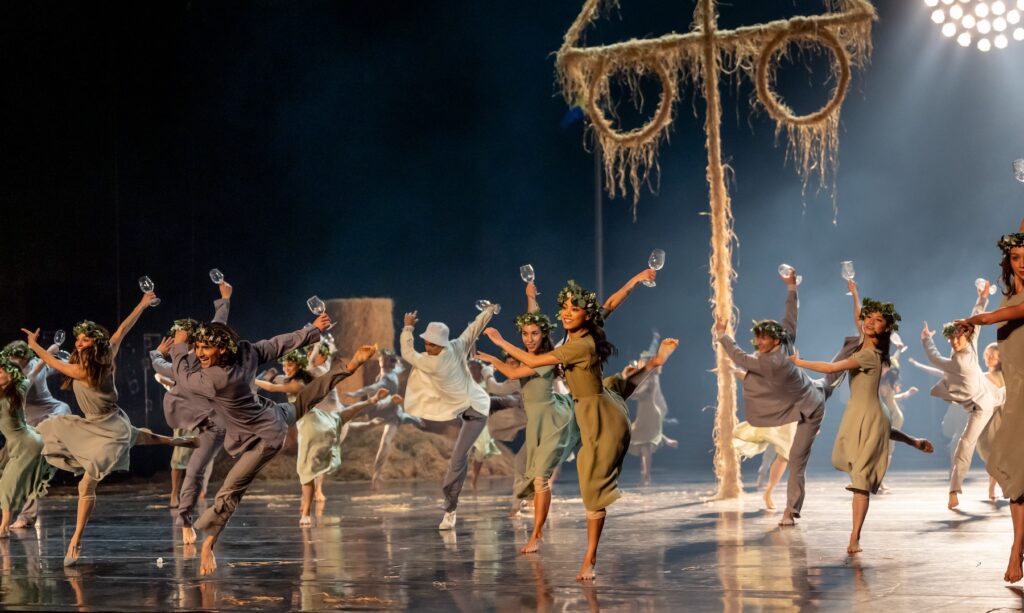
When the curtain rose and for the next two hours, mayhem, mystery, Machiavellian plotting, graceful craft, great glee, humanity in its multiple manifestations, and glorious literal and metaphorical abandonment reigned.
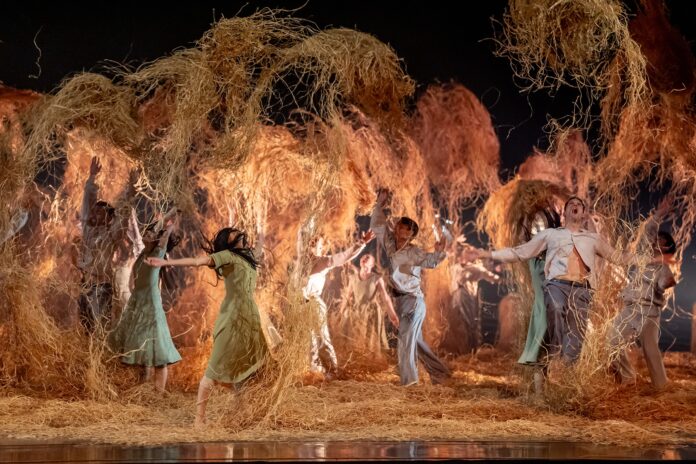
One high point of the performance arrived immediately, with the 40-plus dancers filling the stage to bursting and flinging great armfuls of hay illuminated to blazing gold tones by Linus Fellbom’s original lighting, recreated from the 2014 premiere by Chris Maravich. The hay caught on their heads and toes, covered the floor, served as skirts, headdresses, a terrifically slide-able surface, and more. The energy was celebratory; resulting in vigorous collapse and recovery. The opening scene’s frenzied dancing accompanied by the string instruments’ furiously paced playing were perfect pairing.
It was, in essence, a marvelous literal romp in the hay, full of carnality and linguistic play. From the “pop, pop, pop” vocalized by dancers playfully poking their limbs and torsos as if bursting party balloons to a stuffed fish lowered by a cable and scooped up by Jaiani, who was held by her partner (Stefan Gonçalve) in what in classical ballet is called “a fish,” the jokes ranged from blatant to obscure to curious.
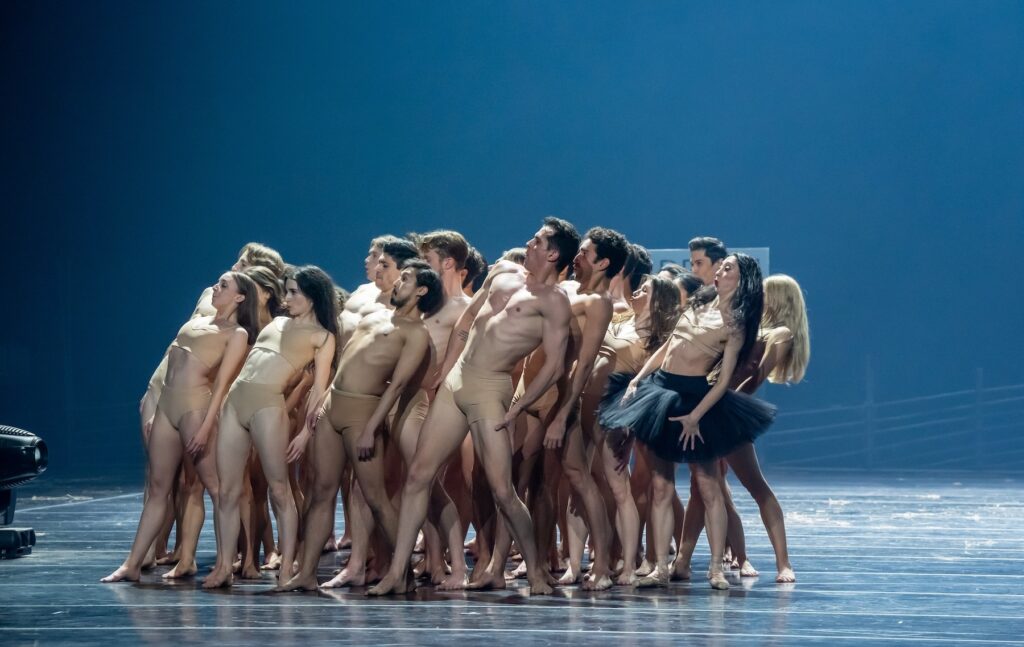
In one extended episode, the dancers posed in a long line at the front edge of the stage, simpering and silently gazing out into the audience. One wondered if it suggested a tedious family reunion photo opp, a queue at a subway stop, a demand for a specific reaction from clueless viewers. Or, maybe it was simply Ekman allowing people to think, WTF? On opening night, the audience repeatedly chose to applaud, hesitate, endure more staring, applaud, hesitate, etc. (In other cities, do they shout, “Get on with it!” “Dance again!” “This is too long!” or an unprintable expletive?)
Wordless visual humor added to the mishmash. Roughly one dozen dancers sandwiched themselves chest-to-back and skittered like human centipedes in one example; in another, the marvelous Chef en pointe (Fernando Duarte) dashed around bare bottom in his apron while wielding grill tongs and executing perfect ballet technique. During the second act’s nightmarish dream sequences in which surrealism took over, life-size human puppets became the partners of live dancers, who did not hesitate to nearly behead them by tossing, dropping, throwing, and otherwise molesting them. Speaking of beheading; the two Headless Men (Edson Barbosa and Aaron Renteria) were superb and proved even bodies lacking faces were capable of infinite expression.
Lest it seem this was a ballet of only trite and trivial gags, the Joffrey dancers and Hausswolff achieved profundity repeatedly throughout the evening. Making her way through the chaos or calmness of the dancers, her incredibly fluid, flexible voice was magnificent and the way she looked at the dancers held vast implications. It was as if they were exotic plants, or foggy apparitions of children who died too early, or artifacts come to life, characters stepping straight out of paintings in a museum.
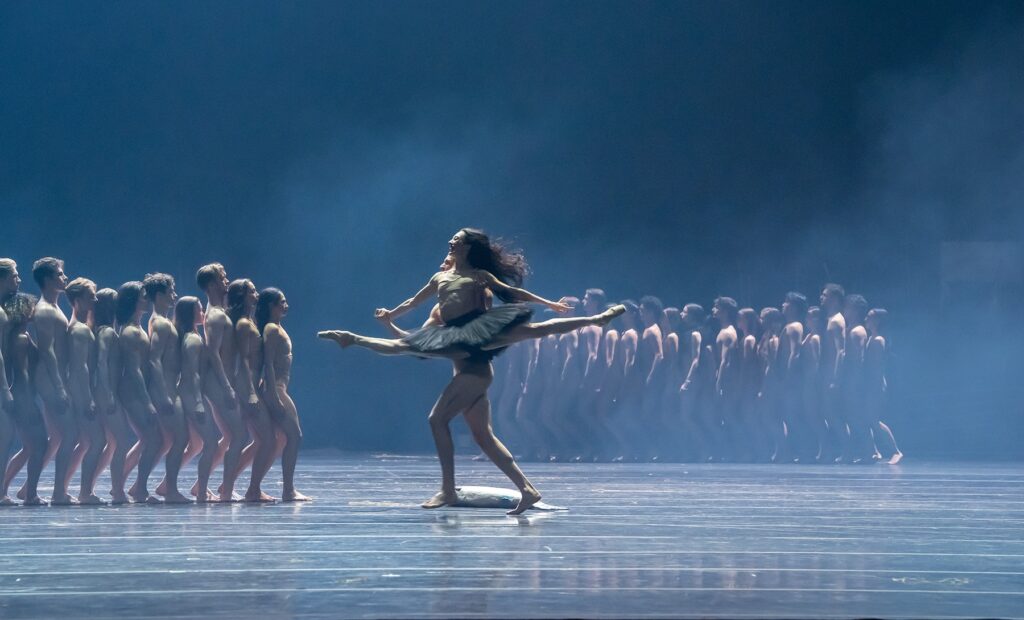
And although a later slow pas performed in canon by three couples could be described as highbrow dance porn, it was not simply sexy, but sensual, suspenseful, and a demonstration of the dancers’ superior physical skill and control. A Nightmare Pas (Jaiani and Gonçalve) was flawless; every pitched 180-degree penché, partnered pirouette, overhead press lift marking the couple as prince and princess of the ballet.
There was more worth mentioning—the banquet table with candelabras and wine glasses tipped at a 45-degree angle and shedding (puppet) dancers from precarious heights, a stormy umbrella section with fantastic timpani thrashing like rain in a downpour, upside down trees as tall as three-story buildings descending from the sky, verbal shouting to encourage or call an end to group mayhem or malarky. Not all things in the second half made sense, which seemed true to dreams and entirely intentional.
Near the end, lyrics Hausswolff had sung earlier—“This one has barely begun/Has barely begun”—returned. Was it meant to be haunting or hopeful? The Joffrey, it seems, left that up to Midsummer Night’s beholders.
Two personal postmark quibbles: a section danced wonderfully by female dancers in nightshirts lacked anything other than seen-before contemporary ballet choreography and went on far too long, and surprisingly, the intermission. For me, 20-minutes watching people stand in restroom lines or nibble snacks and share drinks broke the flow and shattered or greatly hindered the ability to easily slide into Ekman’s otherworldly weirdness in the second half. I had to work hard to submit, smother the logical mind, enter dreamland. Preferable would have been to suffer the squirm-urges of a poor sitter and receive the entire package in one swoop.