
When Tyler Taylor got the phone call in 2024 that he had won the Michael Morgan Prize—aka the Emerging Black Composers Project Prize—he admits he lost it a bit. “I was shocked, I was overwhelmed, I definitely was weak in the knees a bit,” he said over Zoom from his hometown Louisville, Kentucky.
The prize, named after the late Oakland Symphony maestro and announced by the San Francisco Conservatory of Music and the San Francisco Symphony—came with a $15,000 commission fee for a new piece called “Embers,” which was workshopped at the Conservatory and will premiere this weekend at the Symphony, Fri/22-Sun/24, by visionary conductor Cristian Măcelaru, alongside works by Rachmaninoff and Dvořák.
For Taylor, the announcement came at just the right time. “I was just on the other side of a residency with the Louisville Orchestra, and things were really ambiguous in terms of what was gonna happen next—how this freelance career was going to continue, in terms of direction and sustainability. So to have an escalation like that was really intense, and definitely quite welcome in that moment.”
The cash promised to come in handy, too, for the horn player and educator. At the time of the announcement, he told the Chronicle that it would be instrumental in helping him replace the 1995 Toyota Camry he’d been driving since 2017.
Taylor’s compositions are dense, virtuosic, full of unexpected, eerie flights—and often contain irresistibly relevant inspirations. Many are dedicated to “creating abstract musical analogies for social-political happenings both present and past.” Like other composers of the 33-year-old’s generation, his comments about his work, and occasional blockages and redirections, on social media are refreshingly candid, and he’s not afraid to let his music be about actual things.
“Recollections for Saxophone and Piano” (2024) is his attempt to reconnect to the 1990s-2000s R&B and hip-hop of his youth; “Permissions for Large Symphony Orchestra” (2020) was composed as “a reaction to hierarchical traditions that still permeate orchestral culture and compositions”; “Out of Dust for Chamber Orchestra” (2024) explores “how memories can transform as they cycle back and forth between the conscious and subconscious mind,” perhaps spurring feelings of déja vu.
“Embers” is a 16-minute piece, for triple wind orchestra and a tenor saxophone. “I’m kind of on a secret, or maybe not-so-secret, mission to reintroduce the saxophone back into symphonic forces, knowing that I will meet some—what’s the word?—resistance,” he said with a mischievous laugh.
“But part of that has to do with the fact that I perceive the saxophone’s deletion from the symphony orchestra as a reflection of classical institutions removing blackness from themselves—like, ‘that’s associated with jazz, and that’s associated with blackness, we don’t want that here.’
“It’s such a weird idea that the saxophone doesn’t belong in the symphony orchestra for reasons pertaining to associations with the instrument’s sound, because if you do some digging, you find that the saxophone was designed specifically to be in an orchestra,” Taylor said. “And the way that saxophone playing has evolved in the last 50 years, or even specifically the last 25 years—it’s come a long way. The players, the performers, their abilities.
“So, I’m kind of tired of hearing that the saxophone doesn’t ‘blend.’ I think that’s kind of silly. A previous piece of mine, “Revisions,” uses a full section of saxophones. When you have composers that have the imagination and ability to, bring it back into the symphony orchestra in a way that fully embeds it back into the sound. I think that’s really interesting. I’m trying to do that.”
Besides its name evoking a certain foreboding as NorCal enters fire season, “Embers” also come freighted with other significance. “I came out to San Francisco for the first time in 2024. It was amazing. I had never experienced that kind of belonging before. There were many reasons for that. But once I got back home to Louisville, I was informed that the prize was being put on hold, because of the executive order around DEI. Institutions and organizations were pausing things to evaluate how they could move forward.
“I really didn’t know what to do or say, I couldn’t really do much about it, so I laid low and waited for the update. All of that had an influence on the piece. I started thinking about embers, and how in a poetic sense, they can be thought of as memories or things that echo from the past into the future. But also from a very literal sense, the aftermath of a fire, or something that can be rekindled into something very powerful,” Taylor said.
The music embodies that idea. “The very first thing that we hear in the piece is the first violins, with practice mutes. They’re being asked to play in a very overt and romantic way, but the composite sound is very hushed and quiet and muted. Perhaps it’s a little heavy-handed, but you know, sometimes I think you have to be a little heavy-handed to get your point across.”
“The idea is that over the course of this piece, this bit of music that’s being played by the first violins echoes and reasserts itself in various ways, and ultimately becomes a very strong and powerful statement. ‘Embers’ deals with a lot of the emotional context that was given to me in that moment. It builds on this concept of what can happen if we dwell too much in the past, but also when something small—even if it seems like it doesn’t have any substantive power—over time can build into something very powerful. That’s where the saxophones come in later, near the end.”
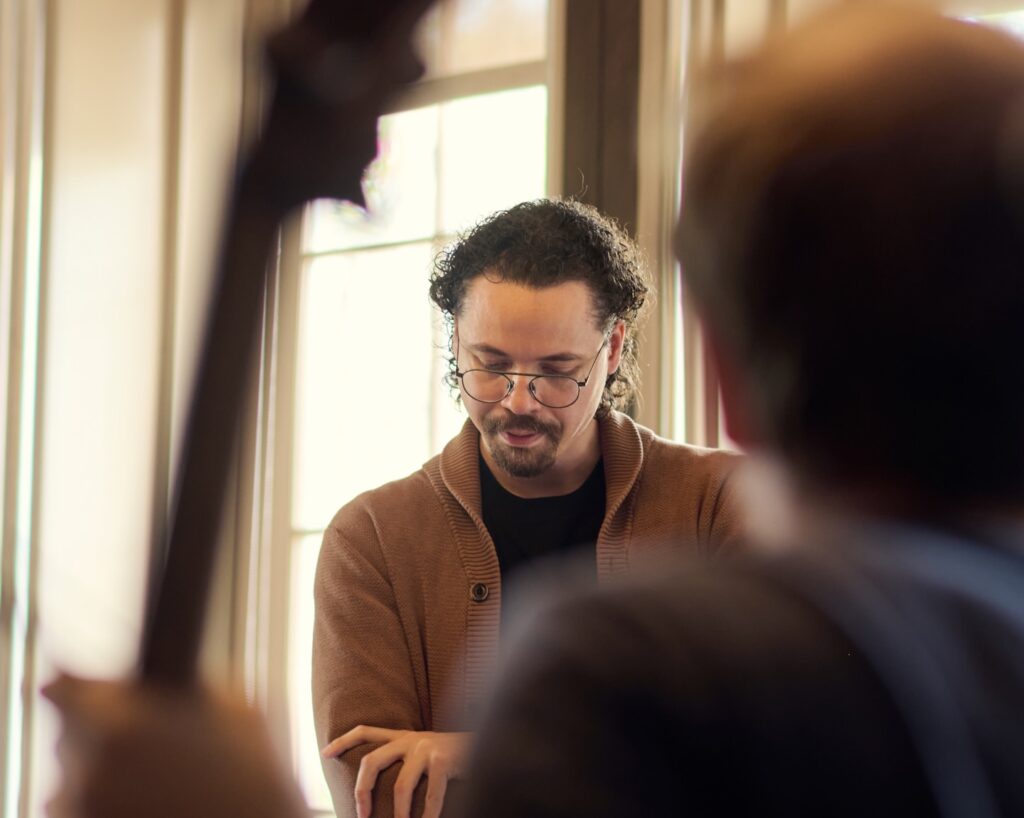
Taylor claims to not draw on direct influences. “I do everything I can while I’m composing to let my authentic self come through directly,” he says. But he does reveal how his actual physical position in the orchestra as a horn player gives him a unique view on how things work.
“You’re literally the center of the orchestra, in terms of range and even placement. There’s generally four horns, we are a harmonic pillar of the orchestra. Composers generally use us for four-part harmony, or to hone a soaring melody. We’re also a little further back, so you get an opportunity as a horn player to look out over the rest of the orchestra when you play in an orchestra. You can literally see the music that your colleagues are playing, you’re embedded right in the texture.
“It’s a truly intimate look at how your colleagues like, say, the woodwinds, are performing these very nimble, facile, technical things. You can see those idioms and be in conversation with that aspect. Or, you can subvert those expectations. That viewpoint has definitely helped my orchestration.”
When I spoke with Taylor, he had yet to hear “Embers” performed in full by the Symphony, calling it “a leap of faith that’s actually quite easy to make. It’s the San Francisco Symphony. And developing the piece with the Conservatory, I’ve been in very good hands.”
Ok, but has he updated that ’95 Camry? “As things have moved forward, I’ve finally been able to upgrade some things in my life,” he laughs.
SAN FRANCISCO SYMPHONY: MĂCELARU CONDUCTS DVOŘÁK, RACHMANINOFF, AND TYLER TAYLOR’S “EMBERS,” Fri/22-Sun/24, Davies Hall, SF. More info here