As a social documentarian working in analog photography, Norma I. Quintana is deeply interested in the way memory inhabits the body, faces, and places of a community. Her formal studies are reflective of this, as she has completed a BFA at John Carroll University and a master’s degree in social sciences from Case Western Reserve University.
With photographic series that span years at a time—her seminal project documenting a one-ring American circus took over a decade—Quintana strives for a humanistic recording of life, through enduring portraits of posed figures in their natural habitat or with artificial backdrops.
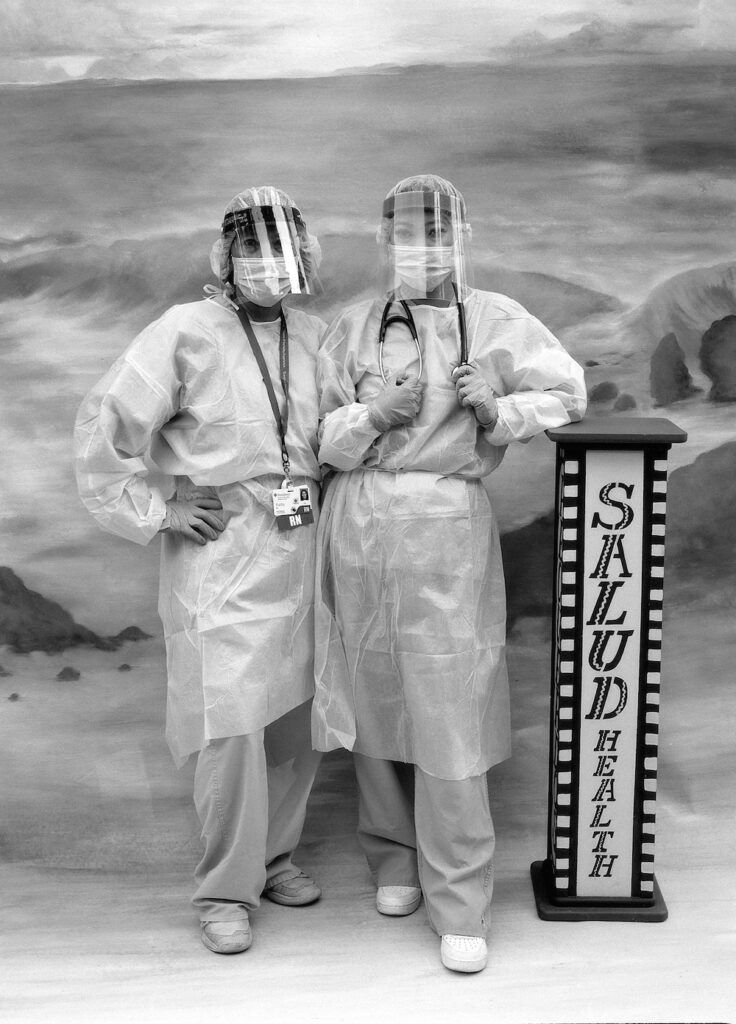
“Having a background in sociology, my work has always been social in nature, and in a way the process of documenting, or memory making, is political. It’s a sociological territory where the photobooth imagery I create is a form of democratic self-representation and allows everyday people to tell their stories,” Quintana told 48hills.
Though she was born in Cleveland, Ohio, Quintana’s family moved back to Puerto Rico when she was a toddler, and she attended elementary school on the island. Her family then returned to Cleveland, where she attended a Catholic junior high and an all-girls high school.
“After graduating college, I worked in Cleveland and met my husband, Sergio M. Manubens, MD. We moved to San Francisco in the late 1980s where he did his internship, residency, and fellowship at UCSF through the end of that decade,” Quintana said.
Quintana currently lives in the Napa Valley, but regularly drives into the city to attend lectures, museum exhibitions, concerts, and even to buy groceries.
“When I cross either bridge, and particularly the Golden Gate Bridge, I feel such a connection! I love the possibilities, diversity, and uniqueness of the Bay Area and I know from my travels that it is a special place. I am always pleasantly surprised by what it offers,” she said.
Specifically, the Bay Area art scene captivates Quintana with its assortment of voices and venues. The depth of her engagement with the photography community here includes being a founding Board Member of Photo Alliance and exhibiting photographer at SF Camerawork at Fort Mason and the Harvey Milk Photography Center in Duboce Park. Her inspirations draw from the work of other women photographers and her own developed experience as an essentially self-taught artist.
“Some of the most formative instances for my work have been through workshops I’ve attended, working closely with Graciela Iturbide and Mary Ellen Mark. Lectures by Sally Mann, Linda Connor, Bruce Davidson, Susan Meiselas, Lonnie Graham, and so many others have also been influential,” Quintana said.
She adds that the San Francisco Ballet production of Broken Wings in 2016, based on the tumultuous relationship of Frida Kahlo and Diego Rivera and choreographed by Anabelle Lopez Ochoa, took her breath away: “We went to see it twice!”
Quintana is surprised with the arc of her creative life, having come from a working-class home where the arts were not part of her family experience. Growing up, however, she says she was always drawn to creative outsiders and activists like David Bowie, Angela Davis, Gloria Steinem, and Cat Stevens (aka Yusuf Islam.)
“I had never considered myself an artist, but by impulse I found myself to be creative through my everyday experiences. In a way, making the most of what I had, and taking ownership of how I dressed and expressed myself was an act of choosing personal power and resistance to social expectations for women and people of color, especially at that time,” Quintana said.
Creating silver gelatin prints in black and white to preserve a timeless quality, Quintana is drawn to the physicality of film and the way it mirrors the process of remembering. She has also discovered that the film camera can create a closer relationship with her subjects.
“People have a positive reaction to being photographed in film, they start to talk about how they remember taking pictures or having their picture taken. And memory is especially important to me,” Quintana said.
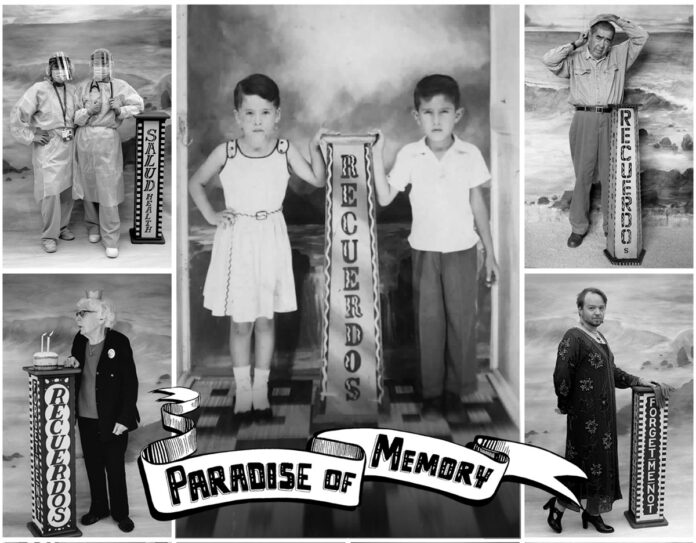
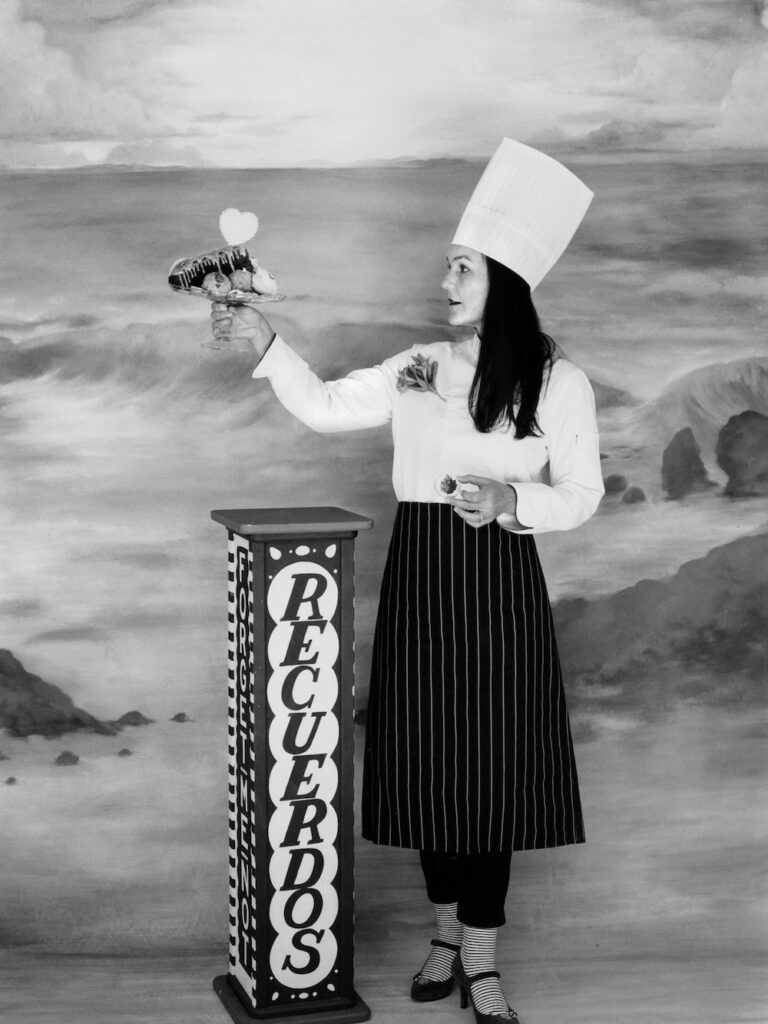
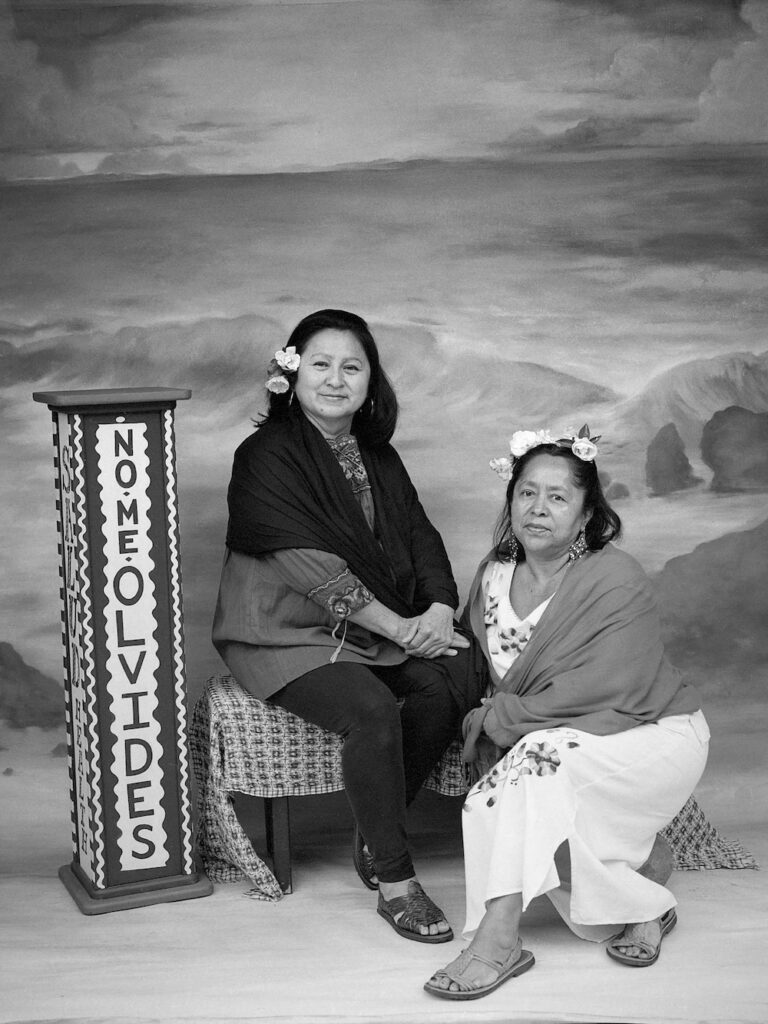
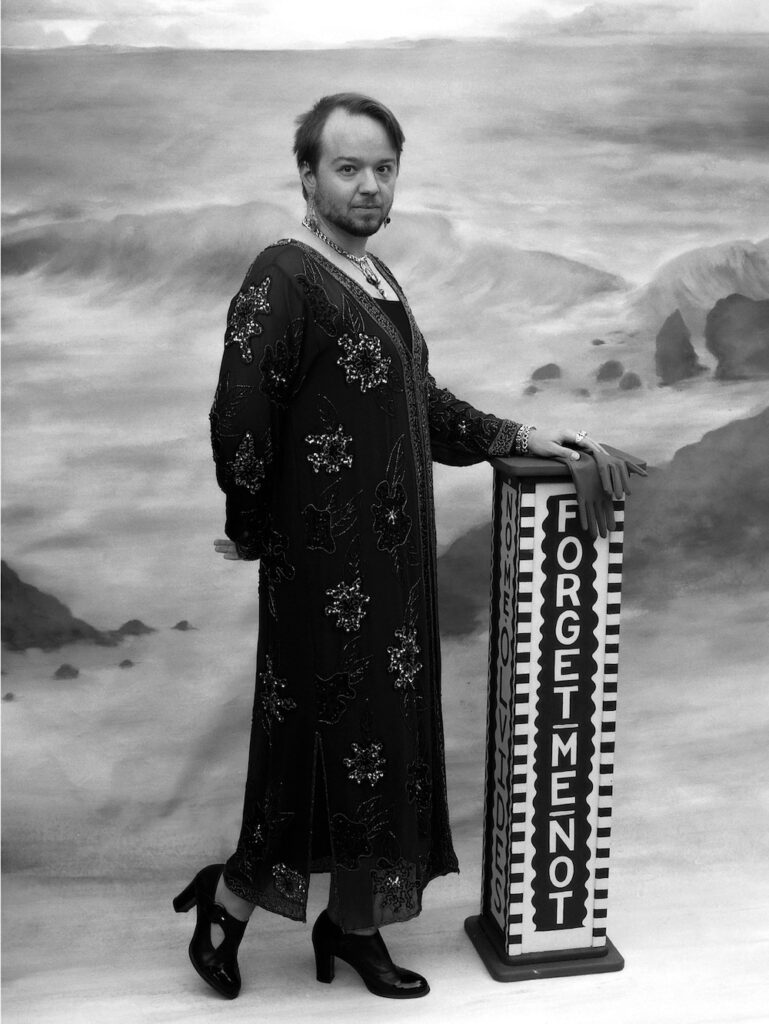
Her most recent portrait project has been central to her work since 2004 and is ongoing. Inspired by family photos and photobooth photography from the 1940s to ’60s in Puerto Rico, Quintana researched photo albums from across Latin America and the Caribbean and recreated the backdrop and four-sided stand that appeared in those images.
She explains further how itinerant photographers in Puerto Rico adapted studio conventions into portable setups to create portraits as recuerdos [memories or souvenirs], which were often mailed to relatives on the mainland to say, “I’m thinking of you, I miss you.” In embracing this method for her project, what motivates Quintana is an enduring fascination with how photography can bear witness to both presence and absence. Through sentiments of the emotional language of memory, longing, and the fear of being forgotten, she explores meaning through different registers and forms.
“Memory isn’t just preservation here—it becomes a place, a sanctuary, somewhere you can return to and dwell. When I have members of my community stand in front of the backdrop, I’m trying to talk about how a community is created across barriers, and how we all fundamentally want to be remembered,” she said.
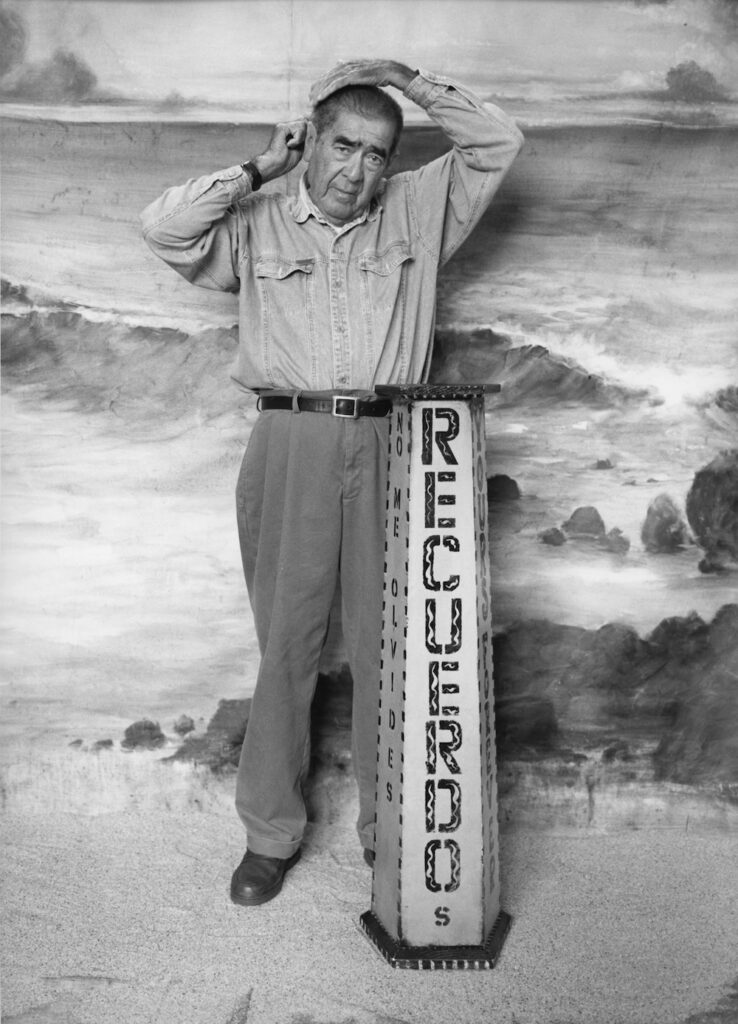
The resulting exhibition, Paradise of Memory / Paraíso de la Memoria, which runs through September 6 at the Sonoma Valley Museum of Art, is a culmination of the project thus far. As part of the exhibition, Quintana collaborated on a short film with director Leanna Creel and will be in conversation with journalist Steven Cuevas on June 6. And because only 30 of her 100-plus photographs will be exhibited, Quintana is putting together a book featuring the complete collection.
“Designed by the amazing Yolanda Cuomo, the book allows me to embrace the totality of my series,” she said.
In addition to the photographs, the volume will include testimonials, history, and ephemera from Puerto Rico.
“I see the camera as a tool for empathy, a way to honor what endures after change and to transform personal experience into something universal,” Quintana said.
Her own experiences cut close to this perception. After losing her home and studio in the 2017 Atlas Peak Firestorm in Napa, Quintana worked on her series, Forage From Fire, at the kitchen table of a friend’s house.
“I would sift through the ashes and locate the fragments of our life, bring them home, and photograph them on a black glove.”
Since that time, she’s worked from a new home studio with glass doors, which allows her privacy without feeling closed in. When she invites subjects to her home, Quintana photographs outside, using available light in open shade, saying it provides a chance to talk and connect. Her interior studio is devoted not only to her practice and the storage of equipment, but is also home to an ever-growing collection of vintage and analog cameras.
Quintana says that the great loss of her home and studio in the fire continues to have a major impact on her work. An avid collector of vintage and antique curiosities sourced from local non-profits and charity shops who lost all her prints, books, artworks, and ephemera, she recognizes the importance of archives. She feels determined, now more than ever, to continue her work in documenting while rebuilding her collection.
“As a collector, I’m drawn to objects with a story, and everything I collect is woven into the fabric of how I create. My studio is a sanctuary for experimentation and the quiet work of seeing.”
Within a thoughtful process, Norma I. Quintana has many questions at this juncture of her career about where to go next with her work. As for how viewers experience her photographs, she has a straightforward answer.
“I hope my work provides a prompt to remember. And to recognize the humanity in others. I also hope viewers feel an experience of connection to something larger than the individual portrait they are viewing.”
For more information, visit her website at normaiquintana.com and on Instagram, Facebook, and LinkedIn.