The big noise this week as far as special film events go is the 25th edition of SF DocFest (see our preview here). But offering further proof that San Francisco isn’t quite done yet as a cineaste center are several other, overlapping series, two of them honoring stellar careers.
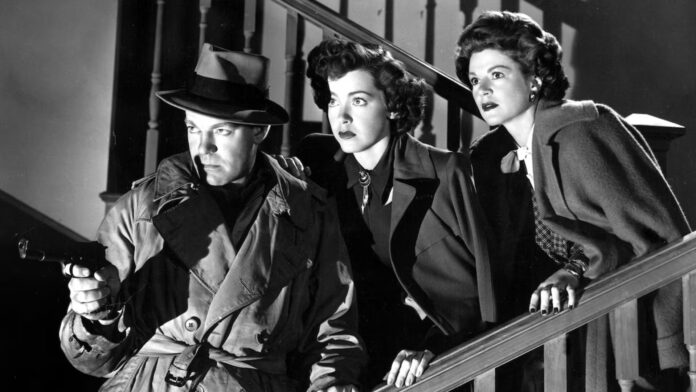
One is, like DocFest, also at the Roxie—as is fitting, since Elliot Lavine was a programmer there for many years, doing a great deal to drum up interest in vintage film noir. Though he’s now based in the Pacific Northwest, he’ll be back for the two-night retrospective “Film Noir’s Visionary Genius: John Alton” this Mon/1 and Tues/2. While the subgenre of moody postwar crime dramas was often considered a showcase for directorial style, cinematographer Alton was as important a contributor to them as any. He lent remarkable visual atmospherics to myriad B&W titles that were mostly regarded as disposable “B-movies” at the time—but which now are cherished classics and cult items.
Three of the four films on tap here are from 1948, a pinnacle of Stateside noir activity: Anthony Mann’s violent Raw Deal, Bernard Vorhaus’ horror-adjacent The Amazing Mr. X, and the magnificently named Hollow Triumph, whose director Steve Sekely was a Hungarian emigre like Alton) retained onscreen credit but was reportedly replaced mid-shoot by star Paul Henreid. All were relatively low-budget independent productions distributed by the shortlived company Eagle-Lion. They attracted little critical attention then, only to slowly become revered for their triumphs of ornate style over dime-novel content.
Seven years later, after Alton worked on such expensive mainstream productions as the original Father of the Bride and prestige musical An American in Paris, Alton returned to the scene of the crimes with The Big Combo, one of the most famous noirs. Directed by Gun Crazy’s Joseph H. Lewis, it’s a brutal melodrama with Cornel Wilde as a cop who grows a little too obsessed with bringing down sadistic gangster Richard Conte.
It was just one among four features Alton made that year—a pace relaxed from 1947 (when he did 10), yet one can understand why he retired not long after. This program is part of the Roxie’s ongoing “Arthouse 50” series celebrating its half-century of repertory cinema. Lavine will be present for each show, details here.
Moving from pulp fatalism to puckish optimism, this weekend the 4-Star will mount a “Spotlight on Agnes Varda,” commemorating what would have been that Brussels-born lady’s 98th birthday—she passed away in 2019 at 90. The “Godmother of French New Wave” had a remarkable, unpredictable career, pretty much kicking off the nouvelle vague with 1955’s La pointe courte (though it was seen by very few at the time), riding its peak with the “real time” narrative of 1962’s Cleo from 5 to 7, personifying eccentric Sixties arthouse cinema in Le Bonheur and Lions Love, popularizing a feminist sensibility via 1977’s One Sings, the Other Doesn’t, then pulling an about-face with the stark 1985 homelessness drama Vagabond.
Afterward, she surprised everyone by building a significant following for documentaries in which she was a frequent onscreen presence, intrepidly poking into other people’s lives, vocations and arts. These constitute some of the most delightful nonfiction features ever made. Two of them–The Gleaners and I (2000), in which she explores the world of collecting leftover crops post-harvest, and Jane B. Par Agnes V., about her longterm friendship with English-French actress Jane Birkin—will be shown at the 4-Star, along with the quasi-verite drama Cleo. The latter has Corinne Marchand as a pop star anxiously awaiting the results of a medical test, with such nouvelle vague legends as Michel Legrand, Anna Karina, Sami Frey, Eddie Constantine and Jean-Luc Godard making appearances. For showtime, ticket and other info, go here.
It was the French who invented the term film noir to raise up a category of entertainments whose Hollywood studios had thought of them as routine commercial product. But actually the French themselves had anticipated that style—equally indebted to silent German Expressionism and a newfangled pseudo-documentary realism—in some movies made before the Yanks got there. BAMPFA’s expansive “French Noir: From the Shadows Into the Light” series, running next Thurs/4 through August 28, provides a whole summer’s worth of Gallic darkness, from as early as 1938 (Marcel Carne’s Port of Shadows, with the star triangle of Jean Gabin, Michele Morgan and Michel Simon) to as late as 1974 (Bertrand Tavernier’s debut feature The Clockmaker of St. Paul, based on a novel by the incredibly prolific Georges Simenon).
The series is occasioned by the release of a new book by SF-based critic-historian David Thomson, who will introduce some films. It’s a rangy selection, some of which (like Renoir’s 1939 Rules of the Game) only faintly echo some of the characteristics that would come to be associated with noir, while others (such as Melville’s 1956 Bob le Flambeur, which commences the series this Thursday, or Louis Malle’s Miles Davis-scored Elevator to the Gallows two years later) are considered exemplars of its typically less-brassy French form.
There are familiar classics like Carne’s 1939 Le jour se leve (perhaps the ultimate Gabin vehicle), Jules Dassin’s 1955 heist tale Rififi,Diabolique director Henri-Georges Clouzot’s wartime Le corbeau, Julien Duvivier’s 1946 Panique and Jacques Becker’s excellent 1960 prison-break chronicle Le trou. Rene Clement’s same-year Patricia Highsmith adaptation Purple Noon made a star of Alain Delon; Melville’s stripped-down 1967 hitman portrait Le samourai made him something of a god. That director made a crime epic three years later of Le Cercle Rouge, whose serpentine progress required the star quartet of Delon again, Yves Montand, Andre Bourvil and Gian Maria Volonte.
With the advent of the nouvelle vague and rapidly changing audience tastes, some of these directors found themselves dismissed as relics from another era. But the new-style auteurs were very much interested in utilizing and commenting on noir conventions, notably Godard (Breathless, Pierrot le fou) and Truffaut (Shoot the Piano Player, Mississippi Mermaid). Those last-named films will be attended by Laura Truffaut, the late director’s Berkeley-based daughter, who will participate in post-screening discussions. For info on the entire French Noir series, go here.
Both noir and Varda’s early years were much shaped by World War II, an epoch more directly addressed by the new wide-release historical piece Pressure. It’s the kind of military drama whose OKness would have been good enough six decades ago or so, when such things were acceptable by the lower standards for B-movies. Now, though, the genre has fallen out of popular favor, so its revivals must be cloaked in an aura of Importance that this film doesn’t actually satisfy in either writing or execution. It’s a formulaic mediocrity that has to pretend it’s a prestigious major statement.
The basic concept is intriguing enough: D-Day, which many consider as having firmly turned WW2 in the Allies’ favor, was a gamble dependent on the vagaries of weather predictions. Col. Stagg (Andrew Scott) is a Scots meteorologist called in to determine if the timing is right for that invasion of Normandy planned by General Dwight D. Eisenhower (Brendan Fraser) and his American troops, as well as various British leaders and forces gathered on a commandeered English country estate in June of 1944. Stagg is nervous because he’s left a very pregnant wife alone while on this top-secret mission. But he’s steely in contradicting the faulty wisdoms of his US equivalent Krick (Chris Messina), a cocky braggart who predicts a calm, clear day based on historical weather patterns—which Stagg has no faith in. Alas, the warnings of impending storm conditions he must deliver are not what anyone wants to hear.
With combat footage (incorporating some archival clips) occupying only climactic minutes, Pressure has to develop tension from the clash of egos over interpreting rather dry data. But the characters are too one-dimensional for that to generate real suspense—we know from the moment we meet them that Stagg’s incredibly stiff upper lip will prevail in quiet triumph, that smug Krick will have to eat crow, and so forth. Kerry Condon has the thankless role of Captain Kay Summersby, an all-seeing, all-knowing Irish assistant to the General who, being a woman, naturally seems to intuit everyone else’s repressed emotions.
It’s a part seemingly written for Deborah Kerr or Greer Garson 75 years ago, and likely even they would have found a tad hokey. MacArthur is meant to be terrifically forceful and imposing… but because he’s played by Fraser, he isn’t. The actor is miscast, in that peculiar way which often happens when an Oscar suddenly makes a performer hot (in this case, hot again), drawing a host of offers that are flattering but wrong for them. (That might describe the entire post-Bohemian Rhapsody career of Rami Malek.)
Adapting David Haig’s stage play, director and co-scenarist Anthony Maras is making just his second feature, following the much more urgently effective Hotel Mumbai eight years ago. He allows obvious cues and points to be hammered home repeatedly, as if weather effecting warfare would otherwise be impossible for viewers to understand. Otherwise, his workmanlike competency would have been fine for an era of big-screen “programmers” rehashing moments of then-recent WW2 history in the pre-New Hollywood era. But these days, a film like this needs to better than just adequate.