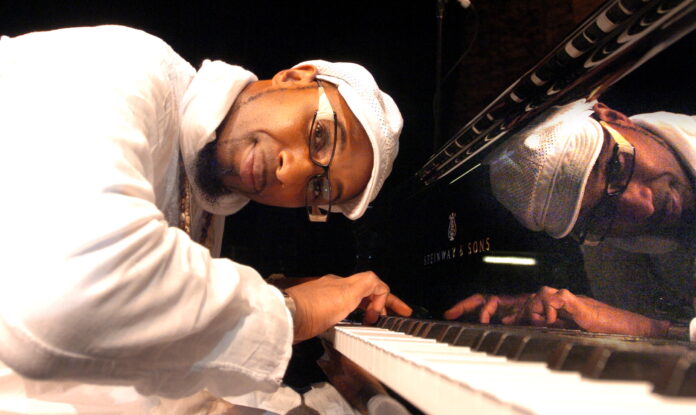
When Cuban pianist, composer, and bandleader Omar Sosa touched down in San Francisco in 1995, it was a revelation. Speaking to 48 Hills from Barcelona while touring the world for the release of his new Omar Sosa Quarteto Americanos album, We Are Not the Headliner—which he will celebrate at The Freight in Berkeley, Sun/19—the seven-time Grammy nominated musician says, “I discovered this fantasy of what I’d been looking for all my life.”
He counted himself lucky: The diversity of the region’s Latin jazz scene meant Sosa was soon playing up to three different gigs in one day. Appearing as an in-demand sideman with different bands, the daily schedule might be a stop at Pier 23 for an early afternoon show, a second show in Los Brunos, and an evening concert with percussionist Josh Jones’ band.
“I need to say thank you for San Francisco. After that, I went back to Cuba to do my music, but everything started in San Francisco,” he says. “Here, you can feel the community in a different way than New York, Chicago, Boston. It’s like a big family. It’s not just San Francisco, it’s Berkeley, Oakland, Richmond, Santa Cruz. There are different traditions and cultures. I discovered Moroccan music in Berkeley, not Morocco. I discovered African American jazz playing with saxophonist Richard Howell. Later, I was (performing with) Asian bands. I’m not a Latin jazz musician; I’m a world citizen.”
He is especially pleased by the full circle of the new album and the return to the Bay Area, now with his band. Featured with Sosa on the record are the other members of Quarteto Americanos: the aforementioned Jones, multi-reed and flutist Sheldon Brown, and bass player Ernesto Mazar Kindelán. In addition to fine musicianship, the four artists bring decades of friendship, fluid improvisational skills, and a generous selection of tunes from the 11-track album.
Standing out among 30-plus recordings Sosa has made during his three-decade-plus career, the new album was recorded live at Studio 9 in North Adams, MA. Back in the Bay Area for post-production work at Greg Landau’s Alameda studio, the recording required finesse to engineer. In live concert recordings of artists of the past, such as Coltrane or Miles, the energy of the performance is audible in the ambient sounds and audience response.
Even with 40 people in the studio during the recording session, however, Sosa says that capturing the same feeling “was not very easy.” Landau is a friend and a record producer he respects above all others in the business. “We worked for months and I’m so happy with the results.”
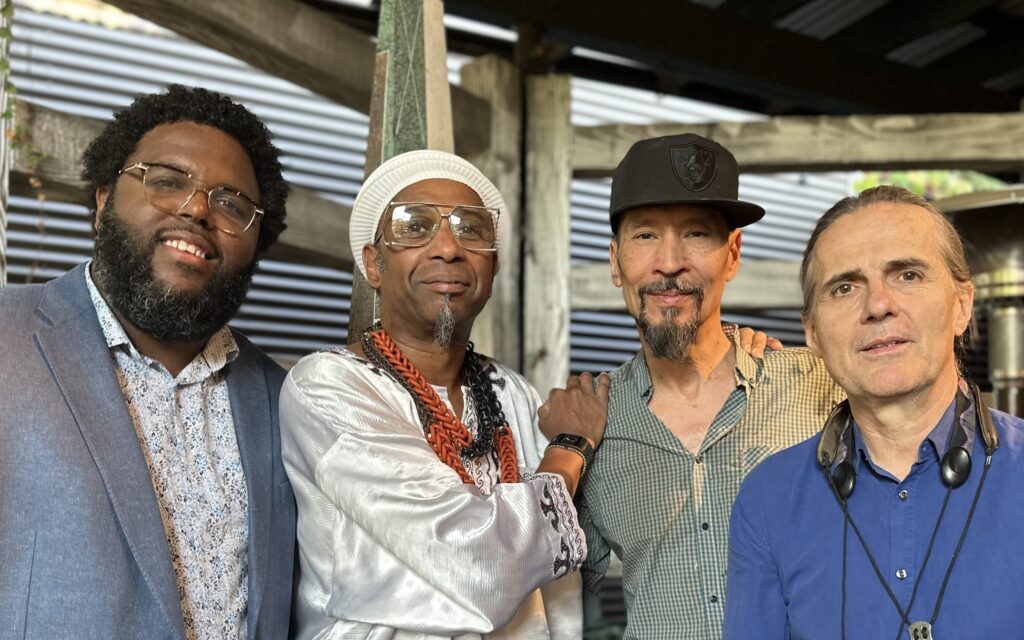
Equally pleased with his bandmates, Sosa sings their praises. “Sheldon is one of these musicians who’s always going to make you better. I played with him and listened to his records because he inspired me. After playing together many years, one beautiful thing is we don’t need to talk.” The album’s first track, “Meditative,” is a complete improvisation. “The notes, vibe, rhythm and spirit are always there,” he insists.
Sosa believes the bass player for any quartet is the backbone, the foundation upon which the other musicians move. Kindelán is able to play bonafide Latin jazz, then shift with the same force and vibration in any direction. Even so, the structure, colors, and delivery remains firm. “That’s why we’re called Quarteto Americanos. We are not just a Latin band. We are a band that plays with freedom and love that starts on the first note and continues to the last one.”

Jones, the multi-percussionist, is the Sosa’s change agent. Asking Sosa to stretch beyond salsa when they first met in the 1990s, Jones told him, “You ought to play different music.” And it was at Jones suggestion that the new album was recorded live in the studio. Sosa pays tribute to Jones as a master of groove and textures. “He has his own voice and knows how to play Cuban, African American, and world music. You hear it, and you know, that’s Josh Jones.”
Highlighting three of the songs on the album, Sosa speaks about “Hella Changui.” “This is an old song and finally, I recorded it with my band. I first recorded it as a duet with John Santos in 1995. I love the rhythm that comes from the East side of Cuba. It’s complex, a dance vibe with the parts not arranged in the usual way. After engineering with Greg, I said, “Wow, interesting. It’s the vibe of Oakland with traditions from Cuba. With improvisation by Sheldon underneath, almost a constant solo, you feel it.”
“Africa in My Fingers” reflects the intentionally diverse atmosphere surrounding Sosa today. In his daily listening program and spiritual life, the music of Africa plays an essential part. Found among the more than 2000 CDs in his studio in Barcelona there is classical music—Ravel, Debussy, Satie, and others. There is hip-hop, and jazz, but these days, traditional music from Africa is primary. Recording “Africa In My Fingers” with the band, Sosa channeled hours of his peaceful discovery from a diaspora of African street sounds and music to produce the song’s contemporary style.
“The Prologue,” a 54-second piece that precedes the two-part “We Say,” was, like all the tracks, made in one-take. Finding the original “We Say” quite long, Sosa determined it needed to be condensed and separated into three parts to remain soulful.
If soulfulness rides throughout the album—it does—it is as much the result of acute listening as it is articulate playing by the quartet. “If we don’t listen to each other, what is the reason to be together? The idea is to have a conversation. There is no way to create community, to create music, if you don’t listen to the person sharing energy and vibration on the same frequency with you. The music we do, we don’t read the paper. We just need to love and listen to each other. This is the basic thing.”
He goes on to say that this philosophy holds true in life. “The world has problems because we don’t listen to each other. Somebody imposes what he wants and everyone else has to be quiet. But this is justice: When conversations come with love, unity, peace, and express what the spirit tries to tell us.”
As streaming subscriptions and people’s private, headset-only listening habits increasing influence and undervalue the vibrancy of experiencing a live performance in community, Sosa worries. “You need to pay for everything. Before, you bought the CD and listened whenever you liked. This album is the answer to everything happening and there’s more activism on it.
“The words we use on the record have meaning about the climate we live in today. Art is always the reality of the community, not the reality of the profit-makers. That is why the record is called what it is. The headliner is the community, not one person or one band.”
OMAR SOSA QUARTETO AMERICANOS Sun/19, 7pm, The Freight, Berkeley. More info here.