Pride Month is already in full swing cinematically, even if the Big Kahuna (i.e. Frameline) doesn’t start until next week. This weekend features two separate events, both running Fri/12 through Sun/14. The International Queer Women of Color Film Festival is returning for its 22nd edition, offering nearly 50 works by queer women, transgender, and nonbinary artists around the world. The majority are shorts (many of them world premieres) grouped into programs with a particular thematic focus on Black, Asian, Indigenous, activist, and diverse family expressions, among others.
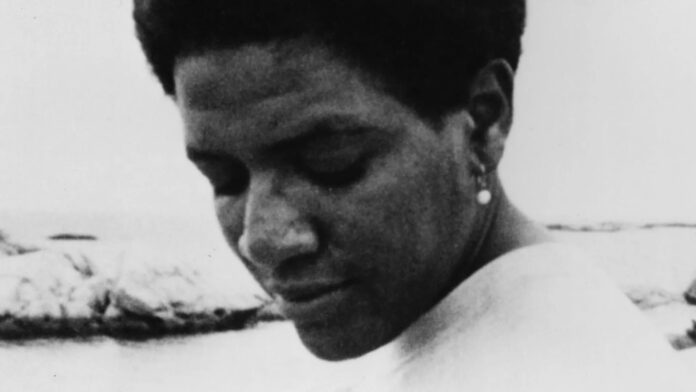
Features include a revival of the award-winning 1995 A Litany for Survival: The Life and Work of Audre Lorde, a portrait of the late (in her words) “Black, lesbian, feminist, mother, warrior poet” whose principle subject was social injustice in all forms; and a new documentary, Quba!, which looks at the oppressive past history and improving current state of LGBTQ rights in Cuba. Some filmmakers will be present at the Presidio Theater’s on-site screenings in SF, and the festival is not just free (though online ticket registration is required), but takes pains to be accessible for a full range of patrons with disability issues. For full info, go here.
A relative local newbie at just four years’ age, CAFILM Pride offers Marin County its own advance taste of Frameline, which is the short series’ co-presenter. The Smith Rafael Film Center will host showings of three new features over three three days’ course, all with directors in attendance. Fri/12 brings Fire Within, about diverse unhoused persons in SF’s Tenderloin. Sat/13 it’s the Brazilian Gugu’s World, a coming-of-age drama set in a remote area whose town was submerged by a now-drying-up reservoir. On Sun/14 there’s The Dads, a nonfiction study of fathers battling increasingly hostile legislation in seeking gender-affirming care for trans offspring. Full info is here.
Other events of general note this weekend include the start of “A Complete Stanley Kubrick” at Berkeley’s BAMPFA encompassing every screen work from the legendary filmmaker some consider the greatest of all time. It runs all the way from his documentary shorts and low-budget independent features of the early 1950s to 1999’s posthumously released Eyes Wide Shut (which will be seen in an “imported uncensored 35mm archival print”).
In between, of course, there are all the famous classics, including 2001: A Space Odyssey (which kicks things off this Fri/12), Dr. Strangelove, A Clockwork Orange, The Shining, Spartacus and more, plus a couple tangential inclusions: One-Eyed Jacks, the 1961 western star Marlon Brando took over (his sole directorial credit) when Kubrick quit; and A.I. Artificial Intelligence (2001), a project Steven Spielberg adopted after its originator Kubrick passed away. Many of these titles will be shown in recent 4K digital restorations. The series runs through August 30, full info is here.
Another leading contributor to sci-fi cinema, among other things, is still with us, and will be at the Vogue Theater this Sat/13 for an in-person tribute featuring two career highlights. Nicholas Meyer was a successful novelist and screenwriter who made his directorial debut in 1979 with Time After Time, an inventive seriocomic fantasy in which H.G. Wells (Malcolm McDowell) travels to modern-day San Francisco in hot pursuit of Jack the Ripper (David Warner).
That got Meyer hired to do Star Trek II: The Wrath of Khan, the likewise SF-set franchise entry many fans still consider the best of the big-screen spinoffs. He’ll discuss those films and his wide-ranging later doings at both shows, joined by producer Steven-Charles Jaffe after Time, which plays at 2:30. Trek follows at 6:30, with a dinner break between. Ticket and other info is here.
Summer With Monica Vitti

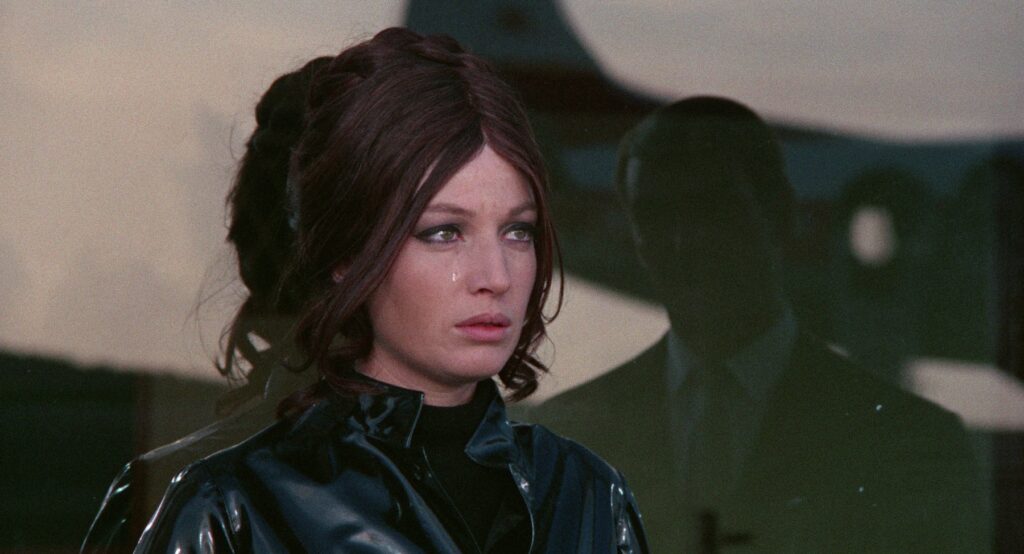
The title of this BAMPFA series makes playful reference to an early Ingmar Bergman film—but its subject remains famous abroad primarily for her work with another titan of European “foreign cinema” in its peak era of public awareness. Vitti and director Michalangelo Antonioni both exploded into international fame with 1960’s L’avventura (playing this Thurs/11), the cryptic drama about a woman’s disappearance that became one of the most influential films of its time. They remained entwined professionally and otherwise though his subsequent features La Notte, L’Eclisse and Red Desert, then parted ways by each making a separate English-language debut in 1966: He with the worldwide sensation Blow-Up, she with the equally hip if less successful Modesty Blaise.
With her striking blonde looks and unconventional glamour, the actress was an intellectual pinup par excellance, able to navigate the long dialogue-free passages, enigmatic narratives and psychological/sociological mysteries of Antonioni’s films with intelligent aplomb. She seemed to personify the disillusion and uncertainty of many spectators in a period of too-rapid change. Yet Antonioni himself allowed that such “neurotic” parts were “a long way from her own character.” So it came as a surprise to nearly everyone save the two of them when Vitti emerged from his very serious shadow to become a hugely popular star at the Italian box-office—and as a comedienne.
Though she’d done comedy before, that shift was cemented with 1968’s The Girl With a Pistol, a big hit which won her the first of five Donatello Awards (Italy’s oscars) for Best Actress. Commedia all’italiana master Mario Monicelli’s film was also nominated for the Best Foreign Language Feature Oscar, though regrettably it seems to be little-remembered outside Italy today.
Vitti is hilarious as a stone-faced, perpetually black-clad Sicilian woman who is seduced by the village lothario (Carlo Giuffre). When he refuses to marry her, honor demands she kill him in revenge—a quest that leads this humorless monochrome dame to the bewildering psychedelic color-riot of Swinging England, to which he’s fled. There, she experiences some drastic changes—realizing in that liberated atmosphere that no man need be the master of her fate. Playing July 5 in a new 4K restoration (like many films in the series), this movie is a very funny gem, and its star couldn’t be better.
The next year she was paired with Italy’s comedy king Alberto Sordi as a married couple in Help Me, My Love, which he also directed and co-wrote. That combination clicked, resulting in several other shared vehicles including 1982’s I Know That You Know That I Know, an even twistier tale of bourgeoise domestic strife. Other films the Archive is showing are I Married You For Fun (1967), a screwball odd-couple romance, and the more bittersweet 1973 Theresa the Thief.
The latter provided a directorial debut for Carlo Di Palma, who shot many of her films (as well as those for Antonioni and later on Woody Allen), and was also her offscreen partner for some years. Vitti retired three decades before her 2022 death, and Alzheimer’s kept her entirely out of public view for much of that stretch. But the BAMPFA series underlines her enduring appeal as one star whose luster hasn’t dimmed a whit. Full info on the series, which runs through Aug. 13, is here.
Surrealities: Some Eccentric New Releases (& Re-Releases)
A few miscellaneous newcomers to local and home screens offer very different examples of cinema on the wild side. Ryuya Suzuki’s Jinsei, which opens Fri/1 at SF’s Roxie, is almost entirely a one-man show: He directed, wrote, edited, and hand-drew this crowdfunded Japanese animation by himself.
That would be remarkable in itself, but in imaginative terms the crowdfunded first feature is also a considerable leap of faith. It offers the life story of an orphaned misfit (voiced by rapper Ace Cool) whose “real” name we never learn, but whose adopted and insult-thrown ones mark the episodic chapters here. He goes from bullied teen to boy-band trainee to…well, a sort of cosmic immortality, as the cryptic story moves into the future and acquires a 2001-like fantastical mysticism. Not exactly “anime,” and not for kids, this is an ambiguous parable with some extreme content eerily muffled by deadpan execution and a minimalist if inventive aesthetic. It’s very much worth a look for ‘toon, sci-fi and cult-movie fans. More info here.
Also taking an alienated hero through increasingly surreal adventures is Davis Simanis’ The Year Before the War, a five-year-old Latvian film (in co-production with other Eastern European nations) that’s like a picaresque novel from the original Surrealist movement’s era. Its “genre-defying fantasia” follows a protagonist named Hans (Petr Buchta) who goes from being an impoverished doorman at a ritzy Riga hotel to an anarchistic assassin, a Siberian convict, a WWI soldier, and more. People keep thinking they recognize him, calling him Peter, or Pyotr, or Pierre as he drifts across most of Europe—resenting yet passively accepting the roles they cast him in, always running into the same terminally ill bohemian temptress (Inga Silina). En route, he meets caricatured figures we duly recognize as Lenin, Stalin, Trotsky, Kafka, Freud, and an irate young Hitler.
Year is an elaborate yet whimsical construct, with plenty of eye-catching widescreen imagery. The acting is in all kinds of different styles, adding to a sense that the film never fully gels as a unified whole. Yet its ambition as well as craft are always intriguing—this is one of those movies so odd on a rather lavish scale that you can’t quite believe it got made (or rather, funded). And lead Buchta is very good as a sort of blank-slate Everyman the actor manages to make vivid and poignant. The film is currently available on the streaming platform Indiepix Unlimited.
Equally singular is The Devil Queen, a 1974 obscurity (at least to me) that is improbable on every level: A combination of The Boys In the Band and Scarface made during Brazil’s military dictatorship, full of out-and-proud drag camp, purportedly inspired by a true story (that of the same figure later dramatized in 2002’s Madame Sata). It has Milton Goncalves as “La Rainha Diaba,” an effete yet deadly (his voice drops about two octaves whenever shit gets real) queenpin in Rio’s criminal underworld.
Surrounded by a coterie of adoring fellow “flamboyant” gays, “Devil” nonetheless relies on a mixed lot of mostly-straight male minions to run his drug-dealing and other operations. They begin plotting to usurp their authoritarian boss’ territory, even as they recruit a hapless young pimp (Stepan Nercessian) as a patsy for those and other schemes. Meanwhile he’s using a long-suffering girlfriend (Odete Lara, who sings and sometimes wears a green wig) as his patsy. It all ends in a bloodbath that’s like a grade-Z Titus Andronicus.
Despite garishly colorful period decor and fashions, Antonio Carlos da Fontoura’s film is pretty basic in many respects—it’s got a sort of near-amateur non-style you similar to that of Paul Morrissey’s early “commercial” Warhol films (Trash, Heat), or concurrent Blaxploitation “classic” The Mack. There’s a lot of violence all the more memorable for being so unconvincing, with several wildly hammy death throes.
Still, there’s an undeniable conviction to the whole enterprise, which in tandem with its amusingly baroque elements makes it hard to turn away from. This is hardly a “gay-positive” portrayal, yet Devil & co. are treated with just the same level of bemused and aghast regard as everyone else here—and their hermetically sealed community in many ways seems more mutually supportive than the dog-eat-dog mechanizations of hetero characters. The Devil Queen plays Alamo Drafthouse New Mission on Wed/17 only (more info here).