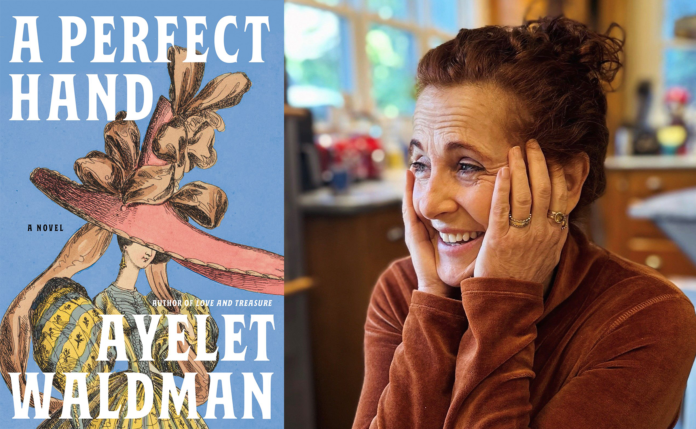
Instead of attending the Iowa Writers’ Workshop or another prestigious graduate-level creative writing program, all aspiring novelists should from now on write a Hollywood television series.
Or so it seems, upon reading Ayelet Waldman’s new book, A Perfect Hand (Knopf). Recently chatting with Waldman about maintaining a character’s voice in a novel, she tells me, “I got derailed by Hollywood and wrote a buncha, buncha, bunch of TV and stuff. What that meant is that it had been 12 years since my last novel—and I kept starting on this one but it wouldn’t work. Catching the voice is the work of a book. I was trying to write a comedy of manners with that witty, Jane Austen tone. But waiting in a part of my brain was a failed novel I tried to write a decade ago.”
During my conversation with the successful longtime Berkeley novelist and nonfiction writer, I began to wonder, was pumping out scripts for television a viable method for freeing an incarcerated story? Because after her stint co-creating Netflix’s Unbelievable, which earned a Peabody Award and nominations for an Emmy, a Golden Globe, and other honors, Waldman has produced a story that starts in one place, toys with genre, kicks convention in the face, runs wild, and winds up somewhere unexpected, but perfect.
A Perfect Hand is the story of two 19th century English servants and, for two-thirds of the book, concerns itself with their constricted lives and work duties. Protagonist Alice Lockey is maid to Lady Jemima Alderwick; Charlie Wells is valet to Jemima’s suitor, Viscount Nigel Wynstowe. They spend their days eradicating high-class effluvia (the real nasty smelling feet and soiled undergarments underneath all that crinoline, silk, and lace), or sewing on and then removing 37 buttons, or measuring men’s head sizes—those last two on the whim of their employers.
Juggling gowns, hairdos, medicinal ointments, dinner menus, hunting outfits, and insults from the “nobility,” they endure the humiliations of life as a servant with humor, impish rebellion, and shear determination to accept it without giving up hope and dreams for escape.
When Lord Wynstowe visits the Alderwick estate, the two Victorian servants meet and fall in love. Seeking to guarantee they will marry and work in the same household, Alice and Charlie mastermind a plot to ensure their employers themselves enter matrimony. Unfortunately, Lady Alderwick prefers Thomas Smythe-Roberts, a far-from-noble con man, and the Viscount is a slippery fish to net.
Multiple plots go awry in locations from intimate boudoirs to men’s clubs to London boulevards during scenes so cinematic you can imagine this one hitting Netflix, too. Relatable characters also include Emmeline, an administrator for the Society for the Promotion of Employment for Women and Lady Jemima’s spinster aunt, Miss Sarah Bennett. Woven throughout are the voices of Mary Wollstonecraft, John Stuart Mill, and other early suffragists.
Waldman’s sense of humor is sly, silly, edgy, and fun. The “serious” themes relating to class and privilege arrive around a blind corner or under a well-scrubbed floorboard without jarring the flow. The pacing surges, hovers, supersedes conventional delineations of time. Without spoiling it all by uncoiling how the story of two Victorian servants hoping to marry and someday run their own shop in a tidy, small village takes a different turn, suffice it to say, it does.

What remains with the reader, however, is the subversive element. Despite the detailed Victorian setting, A Perfect Hand is a contemporary-feeling novel calling for equality of the sexes, the rights of the working class to receive decent wages and healthy working conditions, and always, a demand that truth be told by any means possible.