If the polls are accurate, and I think they’re pretty close, state Sen. Scott Wiener and Sup. Connie Chan are essentially tied in the race for Congress—and at this point, the undecided voters are generally limited.
That’s no surprise: Both candidates are well known in the city, and both have different positions on key issues that are no secret.
That means the race will be decided by two groups of voters: The ones who didn’t vote in the primary, but will likely vote in November—and the ones who supported Saikat Chakrabarti in June and are not going to sit out the general election. Chakrabarti got almost 18 percent of the June vote.

If Tom Steyer were on the ballot for governor, Chan would have a much easier time: Steyer would drive turnout among younger, more progressive voters. Nobody is going to be all that excited about Xavier Beccera.
The billionaire tax may spur some reluctant progressive voters to the polls. The campaign against it may get some Wiener voters out.
But Wiener will have problems if a clear majority of the Chakrabarti voters go with Chan. That’s why the endorsement of Rep. Ro Khanna is a pretty big deal for her campaign.
Khanna is immensely popular with the young, left-leaning voters who supported Chakrabarti.
At a campaign event last week, Khanna praised Chan, and talked about working with Sen. Bernie Sanders on a bill to tax billionaires at 5 percent. He supports the state billionaire tax (so does Chan); Wiener opposes it. He said the US should send “no more dollars to Israel” for its war on Gaza, and called for a Constitutional convention to overturn Citizens United.
Those are all exceptionally popular positions among the Chakrabarti supporters.
If the Chan campaign can get the word out to those voters that she’s the candidate of Ro Khanna, it could be very significant.
The San Francisco Democratic Party generally doesn’t endorse on statewide ballot measures. That’s state party turf, and it looks bad if every local county central committee issues its own recommendations that might be at odds with the state.
But the San Francisco Democratic County Central Committee has voted to change those rules—and that’s happening entirely because the billionaires who put the current majority in power want the local party to oppose the billionaire tax, Prop. 40 on the November ballot.
The state party has endorsed the measure.
On the agenda for the meeting of Wednesday/26 is a proposal to issue an endorsement on Prop. 40. This will be a key moment for the local party: Chair Nancy Tung is against the tax, but will need a majority to defy the state party and side with the very rich.
It would be, to put it mildly, a bit of an embarrassment for the party in San Francisco, one of the most progressive cities in the California, to side with the billionaires over the rest of the state party.
The DCCC will also consider endorsements for the Board of Supes in D8, where the candidate who was clearly the party front-runner has been accused to sexual assault, as well as the Great Highway, the Public Bank, and the affordable housing measure, Prop. I, which the mayor opposes but almost every affordable housing group supports.
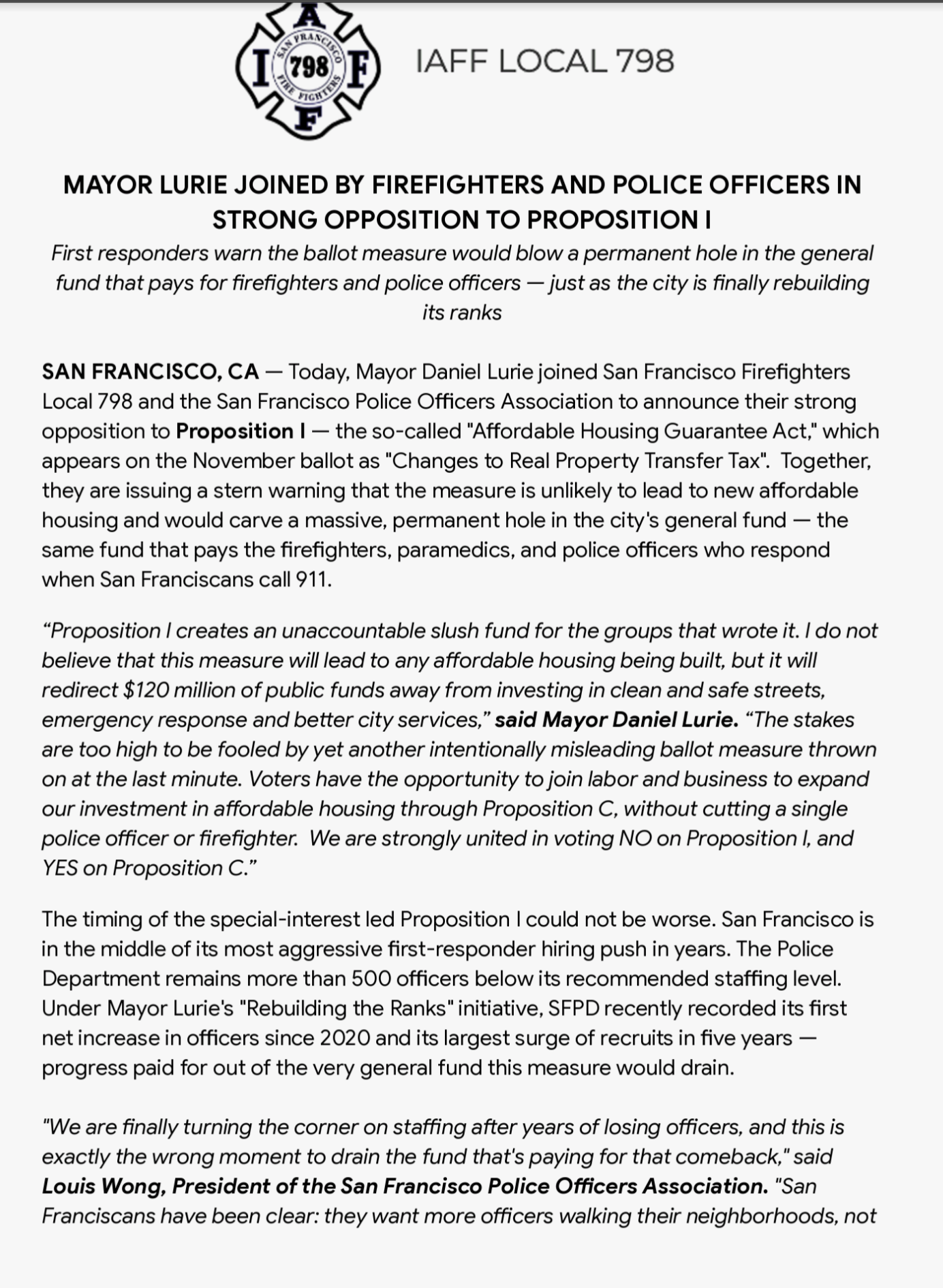
The mayor’s opposition to Prop. I could end up hurting his own affordable housing trust fund measure. Lurie, in a joint press release with the cops and the firefighters, said the measure, which like the mayor’s guarantees funding for affordable housing, would create an “unaccountable slush fund” and would take money away from public safety.
As Joe Eskenazi notes in Mission Local, the “slush fund” would be controlled by the Mayor’s Office. So there’s that.
But Lurie wants to voters to approve a City Charter amendment that would create a permanent affordable housing fund of as much as $125 million a year. And that would, of course, divert money that could be used for the cops and firefighters into a special fund that can’t be used for anything else except housing.
The plan is to use what used to be called “tax-increment financing,” which means some of the extra money that comes in from property taxes from development in the new upzoning areas will be set aside for affordable housing. That’s a fine idea. It’s also money that could go somewhere else, like more cops. The idea of putting it in the charter is precisely to prevent the mayor and the supes from diverting it, the way Lurie and his predecessor have done with other affordable housing money.
Prop. I, sponsored by the Democratic Socialists of America, is not in any way contradictory to the mayor’s charter amendment. They can both pass, and the city will have more affordable housing money.
Prop. I does exactly what the mayor’s plan does: It guarantees that money the voters approved for affordable housing goes into affordable housing.
But if the mayor is saying that funding housing means less money for the cops, why would the voters approve his measure?
It makes no sense—except for one thing.
The original Prop. I, in 2020, raised the real-estate transfer tax on properties that sold for more than $10 million. This version, also called Prop. I, makes that tax permanent and guarantees that all the money go for affordable housing.
Earlier this year, Lurie and Sup. Bilal Mahmood tried to eliminate that tax, saying it discouraged new housing, which makes little sense: The seller, not the buyer, typically pays the transfer tax.
That plan faced opposition from a majority of the supes, who didn’t want to lose a source of revenue that comes entirely from big investors and very rich people. So they backed down.
Instead, they have a plan to tax foreclosed properties, which could bring in almost as much money—and if that passes, they may again try to repeal the Prop. I tax, which the supes could do unless the current measure passes.
So maybe this is all about doing a favor for the rich, which would be nothing new for Lurie.
In the meantime, he’s hurting his own agenda.
Full disclosure: My independent adult daughter works for Connie Chan for Congress.