Can there be complexity in simplicity—and vice versa for that matter?
That seems to be the question at the heart of the work of artist Kate Razo. Within an agile methodology, Razo aims to infuse her work with honesty, self-reflection, and a sense of humor. Razo refers to herself as a self-taught and self-directed artist. Primarily a portrait painter, she extends that definition to include objects, such as typewriters, and “situational intrigues” among people and animals.
Razo grew up on a farm north of Milwaukee, Wisconsin. She came to California in 1982 by way of Tucson where she worked at a dude ranch. Landing in Comptche, California, she was a professional jockey in 50-mile endurance horse races.
“Next came farrier school in Watsonville, then Oakland where I was a failed shoe store clerk. I had a job at Half-Price Books in Berkeley then I moved to San Francisco in 1985 and opened my first bookshop, Phoenix Books,” Razo said.
Razo lives in the Bernal Heights neighborhood of San Francisco for about six months of the year. The remainder of the year she alternates between the Pacific coast of Mexico and Wisconsin where she cares for her elderly mother on the family farm. Razo says she likes being in the Bay Area for all the multiple perspectives that people, particularly artists, express.
“There are still a lot of interesting people here that are trying to make a difference in this mixed-up, crazy world that we live in. I love chatting with people about their lives and experiences, and what they choose to portray in their art. I like listening to artist’s stories, the tales they tell,” Razo told 48hills.
She attributes the cultivation of this perspective to having met two unusual people when she first arrived in the Bay Area.
“The first was Jimmy Friedman. He painted portraits and then shot them with a BB gun in his living room. (I slept on that couch.) The second person is Hawley Hussey, a dear friend to this day who is a marvelous artist and art educator. We lived together around the time that I opened my second bookshop, Dog Eared Books on Valencia. I was going through a terrible break-up and she took me in,” Razo said.

Her time with Hawley opened her eyes to the possibilities of being an artist and the importance of making art for art’s sake.
“Hawley painted everything. Walls, windows, and large pieces of paper tacked to the wall. Gorgeous canvases. Living with Hawley, I realized that I could paint and make stuff just because I wanted to,” Razo said.
As for a specific piece of art that has particularly moved her in recent years, Razo cites the painting The Flagellants by Carl Von Marr at the Museum of Wisconsin Art in West Bend, painted in the late 1800s.
“This painting explains all that is wrong with religion—that type of religion, at that time—which seems to still have a bearing on the here and now. Somehow. And the arguments among religions. Aren’t we striving for one goal? Peace and love?” Razo said.
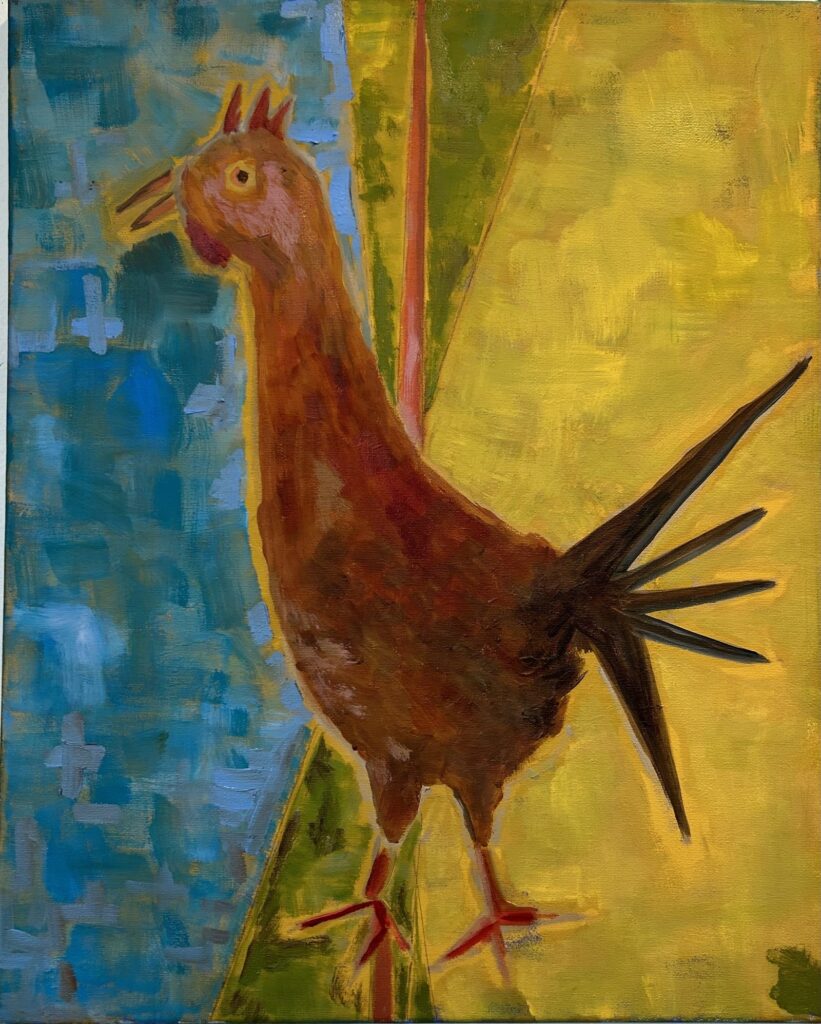
In her own work, Razo has focused on a range of people, from icons like Patti Smith to relatives or total strangers, including bookstore customers “with amazing outfits and clever stories.”
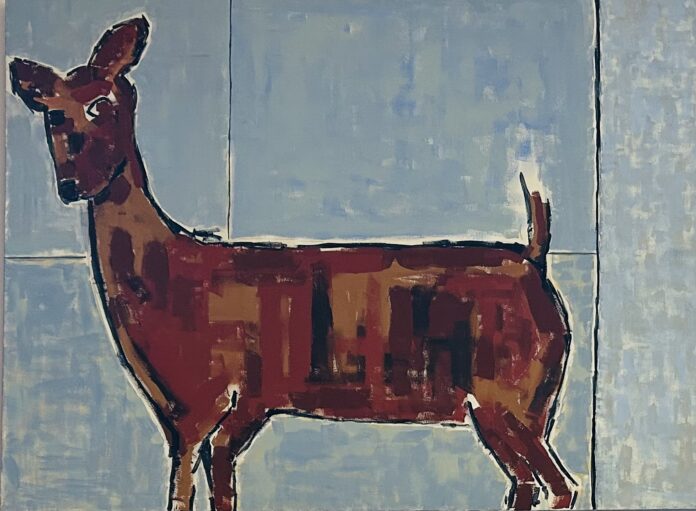
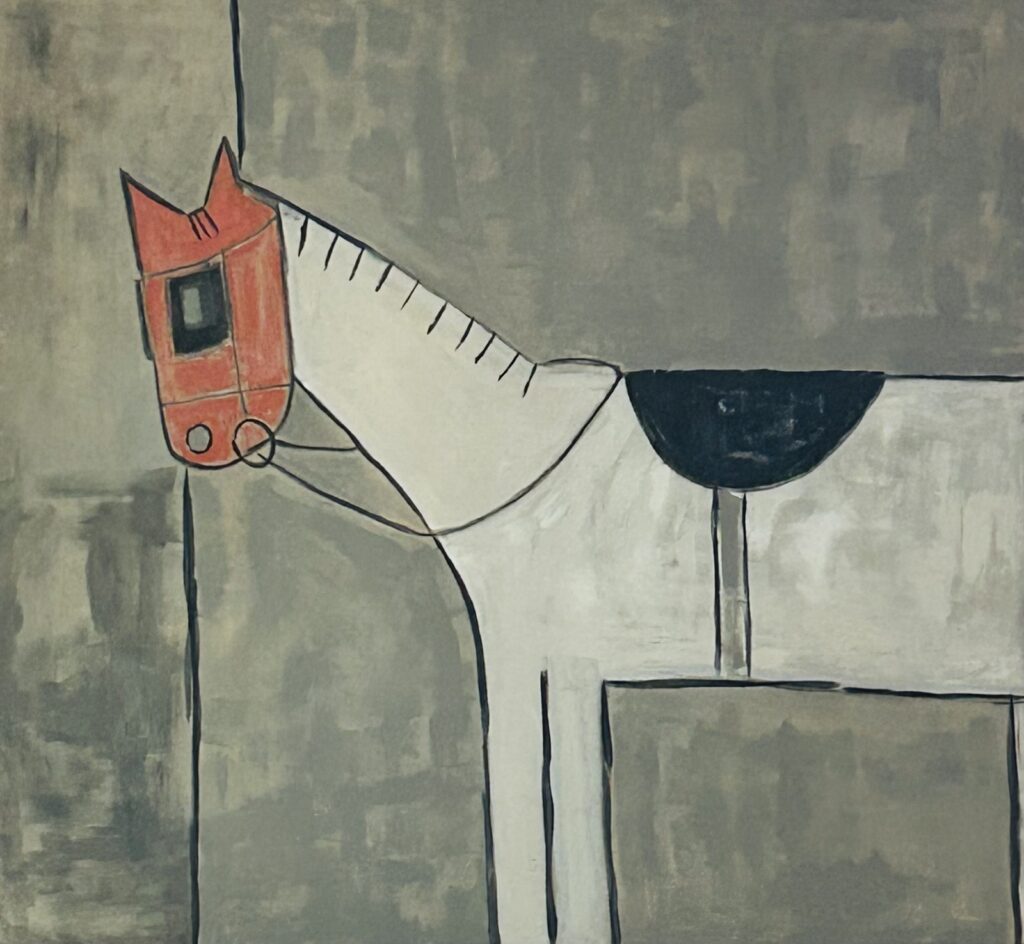
She also paints animals—Razo is involved with animal rescue groups and animals as therapeutic support for people in hospice—and, not surprisingly, she has a personal affinity with horses as subject. Her large painting, Ulysses, is on the back wall of Dog Eared Books where it has resided for years.
“I find it is a personal icon or totem for me,” Razo said.
Razo’s workspace is in the 1890 Bryant Street Studios in the former Best Foods mayonnaise factory, which houses studios for over 125 artists. Her studio, which she will be giving up in late fall, is on the third floor and shared with several other creatives.
“My space is in the entrance way—the birthing canal, as I like to call it. I generally arrive between 8:30 and 9am and stay until 1 or 2pm, three to five days a week, depending on what else needs my attention. I am a creature of habit and it is best if I keep to a schedule,” Razo said.
Razo keeps several pieces going at a time as she prefers being able to move between them as they progress. Naturally, she has another curious acquaintance to which she credits this inclination.
“I once met a man who used to drink with Philip K Dick, the writer. Dick told him that he had four typewriters set up and would move from story to story during the day. This is how I endeavor to paint. I move from canvas to canvas, working in multiple topical series, exploring color, form, impact, and resonance,” Razo said.
Razo begins by applying a base coat of acrylic paint then finishes with oil and/or varnish. In building layers, she says that the intention under the final work is a powerful base from which the piece emerges. She also incorporates pencil work and other tools that circle back to her background of living on a farm.
“I use a lot of pastel sticks—livestock markers for breeding sheep and cattle, actually. Breeders put it on the belly of the male and put lots of boys and girls out to pasture. Each male has a different color on his belly. At the end of the breeding season, they will know who had it together with whom, based on the colors on the females’ rumps. Clever, really,” she said.
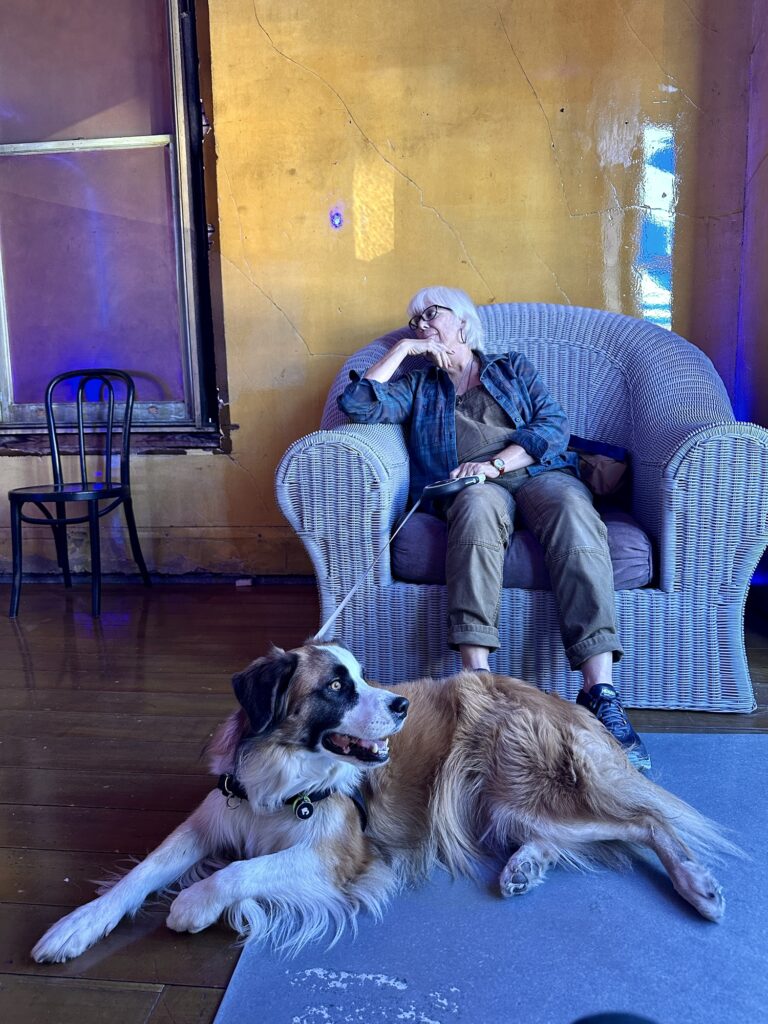
Far from those days, Razo was a member of the band, The Yeastie Girlz, formed at the Gilman Street Project in Berkeley in the 1990s. She says the band was the origin of the vaginacore acapella rap movement, which addresses themes of female sexuality and empowerment through “in-your-face lyrics with a sense of humor.” It remains a huge part of her life to this day.
“We still get together and chat about the world, and how oddly relevant our work is 30-some years later. We also write the occasional new set of lyrics,” she said.
Razo has been working on a series of paintings based on the concept of consent; consensual acts and non-consensual acts.
“Where do I start on the idea of consent. Jeffrey Epstein, our national President, ‘The Man who would be King’? So many to choose from. I’m also exploring the situations that we find ourselves in, at all ages. What exactly did we choose? How did we end up here? What was the outcome? Did we agree to this course of action?” she said.
She adds that she has come to realize that her work has always been about consent. Twenty years ago, she created a series called, We reserve the right to refuse service to anyone. Prior to that, her painting, Yes, No Thank You, was included in the de Young Open 2020.
“Sometimes we waffle with indecision, unable to grapple with our immediate desires. We can be easily manipulated by circumstance and desire and how to navigate conflicting feeling and purpose,” Razo said about the piece. “Often times the boundaries are blurred between the powers of yes, and no, and maybe. Perhaps we know who we are in the moment. Perhaps we are in a process of self-awareness and change.”
Razo is simultaneously investigating the topic of consumption within the context of consent. She asks the question of what we really need and what is our perception of what necessitates it.
“There is, I think, our unwilling behavior surrounding consumption. Consumptive consumption. This has been a big part of the reason that we are in the mess we are in, politically and environmentally. We just don’t need to buy so much stuff. And we certainly don’t need it delivered the same day. We’ve killed most of the local shops with our addicted on-line shopping habits,” Razo said.
Razo has also started a series of site-specific sculptural pieces in wood and cement at the farm where she grew up outside of Milwaukee. She says she has always wanted to work on installations, which she jovially refers to as “Outside(r) Art.”
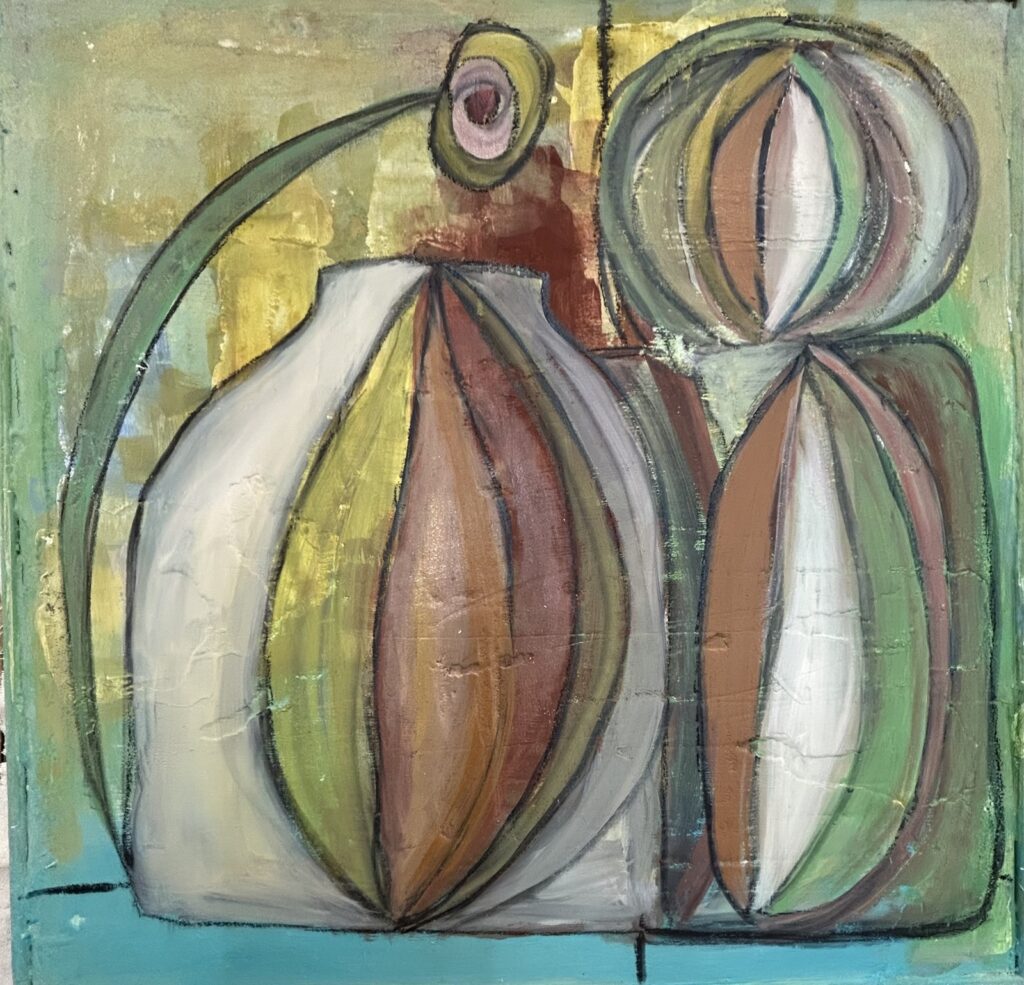
This fall, Razo will be included in a group show at SOMArts in San Francisco from September 18–27 and she will participate in Fall Open Studios at 1890 Bryant, sponsored by Art Span, from October 2–4. Razo shows work in San Francisco at City Art Cooperative Gallery, SFWA Gallery, Studio Gallery, and The Drawing Room. Additionally, she exhibits in Mexico City and through Oaxaca Arts in Mazunte, Mexico.
Beyond creating art, Razo obviously loves books, having owned several bookstores in San Francisco. She also likes to walk around the city and look at things, riding her bike and taking public transport, which she praises and thinks everyone should do. You might catch her in the project of planting avocado pits in empty tree basins around her neighborhood and documenting their progress. And Razo is an advocate for taking time to be contemplative.
“Take a break. Lie down under a tree. Look at the clouds. Think big thoughts. And most of all, be kind,” she said.
Razo’s years as an artist, both accidental and intentional, have provided an outlet for expression of these sentiments. In turn, she hopes viewers of her work will discover a certain reasonableness.
“By that I mean finding a hope and vitality that can only be realized by a certain honesty with yourself and your impact on the world,” Razo said. “Often the answers to the questions are revealed through the process of working it out. And looking at the journey. And being present.”
For more information, visit her website at www.katerazo.com and on Instagram.