Imagine my surprise to find in my mail the other day a campaign flyer opposing Proposition I, the Affordable Housing Guarantee Act, making the outrageous and false claim that if passed it would send money to a “slush fund” for “nonprofits.”
Proposition I raises no new taxes and merely confirms the voters’ intentions when they passed the original Prop I in 2020 that the transfer tax on properties over $10 million should be dedicated to building and preserving low-cost or “affordable” housing. I put “affordable” in quotes since the Mayor’s Office of Housing and Community Development has done much to define affordability upwards to the point that it almost doesn’t pass the smell test.
I am the beneficiary of the original Small Sites Program, under which MOHCD spent some $7 million in the mid-2010s to buy buildings that were about to be snatched up by predatory speculators. Using more than $2 million of that money, our building, the Pigeon Palace on Folsom Street, was purchased by the San Francisco Community Land Trust in 2015, saving our tenancies and keeping us in San Francisco. It is doubtful that any of us living here would have been able to stay in San Francisco if we hadn’t organized and helped the Land Trust buy our building. For the past decade, a great deal of important work in San Francisco’s cultural and political life might have been lost if not for this acquisition, and those of another 15 buildings during these years.
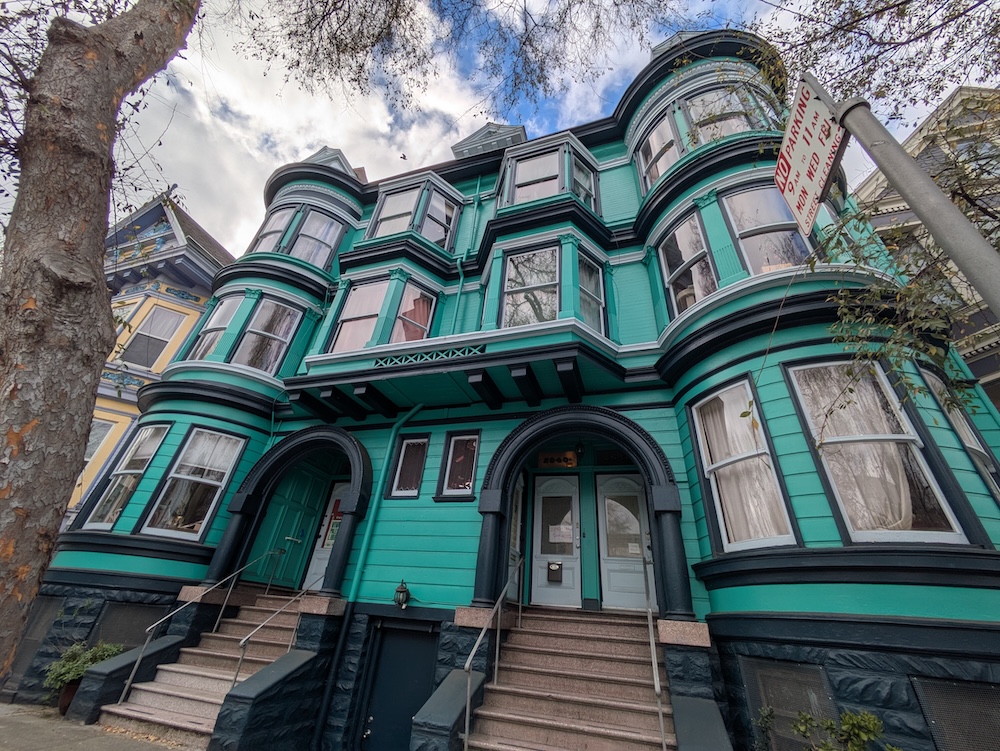
The general pattern going back decades is that low-cost rent-controlled housing is the primary target of the worst real estate vultures, who buy the rental properties from often elderly, long-time landlords who lived in their own buildings (as was the case in my place). Then they use the statewide Ellis Act to fraudulently declare they are “going out of the rental business” to throw out all the residents paying way below market rents. Then they flip the property and it becomes either a Tenancy-in-Common, condominiums (if they can win the annual lottery that limits such conversions) or it soon returns to being rented but now at three or four times more rent per unit. It’s been a very profitable racket, and it has ruined countless lives and seriously drained the city of its creative talent, its labor force, and its vitality—some even say it has irreversibly damaged the soul of San Francisco.
Proposition I seeks to solidify the voters’ commitment to creating resources to continue to remove rental properties from the speculative market. Mayors London Breed and Daniel Lurie have refused to dedicate the money as the original advocates of Prop I intended, putting it instead into the general fund. (This is a clever way to pit unionized city workers against housing advocates who are forced to contend for the same funds during a period of imposed austerity. The billionaires such as Lurie and Chris Larsen and Michael Moritz could easily tap their enormous personal slush funds to finance all the programs themselves if they weren’t committed to using their ill-gotten lucre to drive San Francisco’s politics to the right, to benefit the already obscenely wealthy and powerful.)
Hilariously, the campaign literature makes a big deal about the fact that the money is not focused on new building, which is true. It is dedicated to buying existing properties so speculators can’t drive out long-term tenants and flip their former homes into expensive apartments serving the nouveau riche.
They decry that taxpayer dollars would be spent to “permanently take homes off the market” by claiming that this deprives “everyday San Franciscans” of the opportunity to engage in the frenzy of real estate buying and selling plaguing our city. Any real “everyday San Franciscan” is probably a renter (two-thirds of us are) and even if they are well-paid workers in a hospital, a tech firm, or a bank, in this market only the tiniest of ultrarich speculators can afford to buy property. Who do these clueless propagandists think they’re speaking to?
And then, as a throwback to the red-baiting days of the 1950s and anti-hippie freakout of the 1960s, they make the silly claim that the “majority of money goes to experimental housing communes”!! If only! Nearly all the buildings acquired through the Small Sites program or by the Land Trust or by the Mission Economic Development Agency or the Chinatown Community Development Center continue to be owned by these well-respected and long-functioning and often-audited nonprofit housing developers.
In a few cases, there are group homes with multiple tenants sharing kitchens and bathrooms (who didn’t do that when they first started living on their own?) and who share collective decision making about managing their homes. They are a long way from being “experimental communes.”
Why do conservative business union piecards and Chamber of Commerce lawyers spin this into some kind of Stalinist bureaucracy where individuals are forced to “get approval”? These people are clueless!
They end their adventure in absurdity by once again pitting those of us working to address the housing crisis in a meaningful way AGAINST “firefighters, nurses, and emergency services” even though there is no conflict at all. It is only a conflict manufactured by the ultrarich who refuse to pay for the society that created the wealth they’ve cornered, and then allows them to maintain that wealth as if they “earned” it. Talk about absurdities!
We need austerity for the rich and common wealth for the rest of us.
Chris Carlsson is a resident board member of the San Francisco Community Land Trust, co-director of Shaping San Francisco and chief curator of the digital archive at Foundsf.org. He is also the author of four books, most recently the second edition of Hidden San Francisco: The Guide Lost Landscapes, Unsung Heroes, and Radical Histories(Pluto Press: 2025).