We’re celebrating Best of the Bay 2026 with a multitude of Editors’ Picks of things we love. Please join us at our 13th Annual Gala on October 27 to celebrate even more!
Luis Felipe Chávez grew up in a small town in Jalisco. When he was 14, he won a drawing competition, which encouraged him to explore on paper even more. His family moved to the United States, but he had a scholarship to the University of Guadalajara, so he stayed and got his BFA. It wasn’t until after graduating in 2020 that he moved to California, first staying with family in San Jose, and then moving to San Francisco.
Chávez has shown work in Mexico, as well as in Bakersfield, Palm Springs, and San Francisco. A solo show of oil paintings last year, INTERmedio, featured works with juxtaposed images from Mexico and the States, such as a cathedral in Guadalajara alongside one in San Jose, California, and the Torre Latinoamericana in Mexico City coexisting with the Transamerica Pyramid in San Francisco.

Earlier this year, Chávez went on a trip though Spain and Italy, and then on to Southeast Asia. The direction of his work has shifted significantly after taking in the religious art of Europe—and then hurting his knee in a motorbike accident, and having to spent five hours on a bumpy road to get to a hospital, in terrible pain.
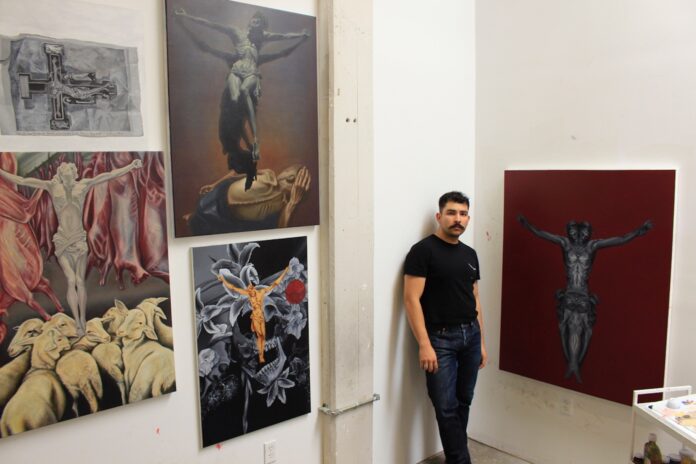
Where before his paintings explored migration, identity and belonging, now Chávez’s studio at the Pacific Felt Factory is full of paintings of Jesus’ crucifixion, largely inspired by his time in Europe.
With this new body of work, Chávez wants to delve into the idea of an oppressed body becoming the very image of power, and the contradiction between the symbolism of suffering and colonial systems.