OK, Now. We are Under The Stars, people. You know the drill, lovers of music and culture. This quasi-weekly column stays on message with strong-ass opinions, presenting new music releases and upcoming shows, hustling with the changes, and thunk-a-dunking with our WNBA Finals-playing Golden State Valkyries. Protect Ballhalla at all cost! Hop in—thanks for spending some time with us. It’s a week before Halloween, and bands are dropping projects left and right, like Gabby Williams dropping threes and Brock Purdy of the Niners dropping dimes…. So let’s get into it.
RIP Freddie Jackson…
NOISE POP FESTIVAL ANNOUNCES PHASE ONE OF ITS 2027 LINEUP
The first phase of Noise Pop’s lineup has been announced for its 2027 edition, which will run from February 18 to 28. Tickets go on sale October 23.
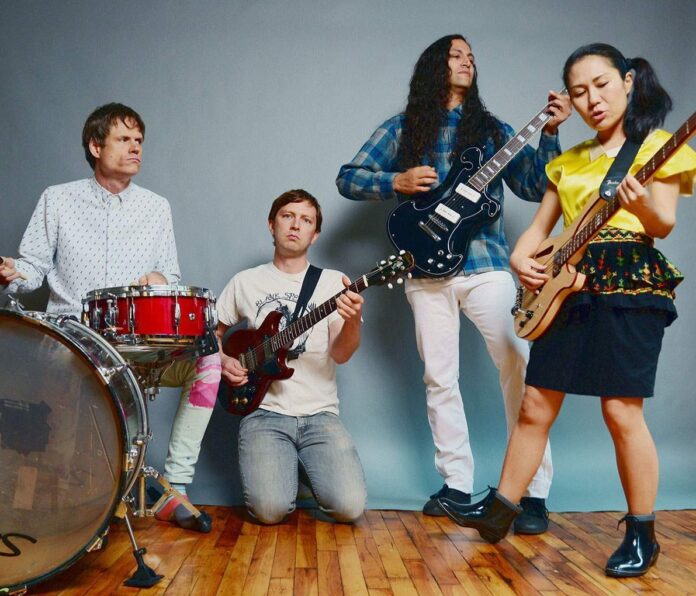
Look for SF’s own Deerhoof at Great American Music Hall as one of the headliners and Oakland-based art rockers Gumby’s Junk bouncing around, as they do. The 24-artist announcement also includes local group The Stone Foxes, Lambchop performing alongside Oakland’s Free Key Choir at Grace Cathedral, plus Gibby Haynes’ Butthole Surfers Mania at Great America Music Hall, and a live set from Modeselektor at the acclaimed experimental performance venue Gray Area.
On February 27, Caroline Rose will make festival history with Noise Pop’s first-ever performance at the Castro Theatre. She’ll take the stage at the landmark after a two-year, $41 million renovation that resulted in a modernized facility and a blitzkrieg of not-so-good press for new owners, Another Planet Entertainment.
Another highlight: electro-jazz innovators Sungazer and genre-bending electronic musician Button Masher will bring their boundary pushing blend of jazz, electronic music, and improvisation to Robert N. Miner Auditorium at SF JAZZ for the first time. More info here.
LATE ASTER, RECALL, RECALL (DELOS)

Last year, San Francisco experimental electronic duo Anni Hochhalter and Aaron Messing made DIY recording sound come alive. Their album City Livin’ nodded at lo-fi ambient, but with hip-hop timbres that reflect—well, city livin’.
Fast-forward a year, and this inventive duo—Messing is a composer, arranger, producer, and trumpet player based in San Francisco, and Hochhalter, a founding member and French horn player of the classical chamber ensemble WindSync—is back at it, making moves no one expected. They described their second album, Recall, Recall, as a “maximalist exploration of integrated electronics and brass instruments, neatly packaged into individually wrapped art-pop songs.”
They are not wrong. “Red Wednesday,” the first song on the track list, combines low-end bass with rippling atmospherics. Hochhalter’s voice floats out like morning vistas, with Messing supplying gentle brass accompaniment.
“I tend to think of each track as the vacuum-sealing of a few constellations of influences,” says Messing in the presser. “One song will have a chord progression inspired by Tigran Hamasyan’s solo piano piece, mixed with the song structure of a Son Lux ballad, featuring arrangement ideas from a Shostakovich string quartet. And the next one won’t have any of the same ingredients.”
Late Aster’s newest project includes performances and production by Tiny Panther Recording engineer Charles Mueller (guitar, engineering, and mixing) and Cameron LeCrone (drums, sensory percussion), and was produced and mastered by Mark Yoshizumi.
This sophomore release seems influenced by IDM shapes, while still maintaining that relationship with brass arrangements and gentle voices—that’d be Hochhalter’s contribution. It’s just a bit somber, with 11 songs that ebb and flow from atmospheric to busy and soft to scattered, while maintaining classical music harmonies that cohere succinctly with braindance textures. Purchase Recall, Recall here.
FUNKADELIC, MAGGOT BRAIN (ORG MUSIC/WESTBOUND RECORDS)
According to Discogs, Funkadelic’s Maggot Brain, the most optimum amalgam of Blackness ever put to record, has been reissued over 110 to nearly 120 times globally across various physical formats—including vinyl, CD, cassette, and 8-track—since its original release. Which begs the question: Why? How is it that this collection of psychedelic rock, soul, jazz, and funk is the one we, as a society, keep going back to for further examination and possible keys to our future? What ayahuasca voodoo (it was LSD, actually) did George Clinton cast upon Eddie Hazel and crew?
The release came post-Hendrix, who passed a year before Maggot Brain was released. But the allbum contains the seeds of Living Colour, Ween, Outkast, D’Angelo, and Brittany Howard. Red Hot Chili Peppers got Clinton to produce one of their early albums because of this record. Listen, in the final moments of the Donald Glover-directed, written, and executive-produced show “Atlanta”‘s Season 1, episode 6 titled “Value,” we are left with the image of a cherubic yet devilishly smiling Black male kid in whiteface.
Reminiscent of the editing on most of the “peak TV” shows of its era, the shot of the child lingers a beat too long. It ensures a creepy vibe, an inner-voiced “WTF” that can’t be dismissed. And in that moment, “Hit It and Quit It” by Funkadelic, off Maggot Brain, begins to play, escorting the viewer through the show’s credits. There was a precedent in how Glover’s hip hop persona Childish Gambino’s critically acclaimed Awaken, My Love! from 2016 possesses the prog-rock churchy-soul genius of early 1970s black music.
Many years ago, when I interviewed George Clinton—he told me to call him “George,” and for almost two hours, I did—he described Funkadelic’s early years as creatively fertile, but at times too far-out for the pedestrian listener to comprehend. At times, they performed in sheets, or just plain naked. “We were too Black for white and too white for Black,” he said with the go-to collection of words and ideas he’s used for over 40 years.
Say it however you like—the music slaps, and it’s the truth. Maggot Brain is an impenetrable arc of gospel, moving into various other genres. Funk (“the blues sped up” according to Clinton) has fed the quintessentially American songbook quite nicely. Songs like “Can You Get To That,” “Hit It and Quit It,” and “Super Stupid” remain foundational arrangements that keep floatin’ in the nebula, each generation picking them out of the sky for new examination. Pick up the reissue here.
BRIAN AUGER & THE TRINITY, BEFOUR (STRUT RECORDS)
It’s crazy, mind-bending, to hear a musician who so clearly understands how to fill in the gaps between genres and does it over and over, real simple, like a line cook hooking up some ham and eggs, loudly ringing the bell when he’s done.
Brian Auger, who plays in between, outside, and right on the head of jazz, funk, rock, or whatever was on his mind at the moment with blunt force “makes sense to me” honesty, once joined an outfit named Steampacket in 1965 with Long John Baldry and a then-unknown singer called Rod Stewart. Auger, the ultimate Swiss Army knife organ player known for Wile E. Coyote, Looney Tunes-energy in his playing style, has a multitude of access points for the uninitiated.
Befour was the last album of his celebrated Trinity era, which preceded the formation of his next band Oblivion Express. This final moment has Auger and company ramping and vamping hard on Sly Stone’s “I Wanna Take You Higher,” with rock-jazz chops, blues-based organ solos, and jammy fried frequencies. “Pavane,” adapted from Gabriel Fauré’s lauded classical composition, gets breezy Southern California colors and melodic, tinkling swinging organ stretches, with strings backing up those golden hour vistas.
It’s a standout for me; Auger lets doubters know, real clear, “Yeah, we got that classical bag too, homie.” A methodical reading of Herbie Hancock’s “Maiden Voyage” might be best received in a smoky-but-swanky North Beach jazz club after hours.
The reissue is fundamental listening, especially when you consider Auger’s next incarnation was the psychedelic soul shock of Julie Driscoll and the on-the-edge leaning Oblivian Express. It’s rooted in the final moments of its era, swirling around the early inklings of Miles’ move in the rock direction. Auger, too, was piecing together a whole other mosaic of progressive music. Order here.
37 HOUSES “JEALOUS LOVE (LIVE)”, LIVE IN CHICAGO EP
Listen, San Francisco band 37 Houses just keeps plugging on. Track “Jealous Love (Live),” is pulled from their forthcoming Live in Chicago EP, an eight-song release recorded during a particularly wild and lively set back in July 2026 during their summer tour supporting sophomore album When and How It Happened. You can be sure when the band plays The Pour House in Oceanside on November 14, it will be a show that reflects how endless touring has enhanced this moody and muscular band. Pre-order Live in Chicago EP here.
TREASURES, “WHERE I BELONG”
It’s always a special treat when we get a visual from a local band, they sound pretty good, and are expressing homegrown affection. And if they’re geographically specific? That is how you know they both love the city and actually hang out in it. Hometown outfit Treasures describe their work as “songs that hit hard without sacrificing melody and blending towering twin guitars, infectious hooks, and a distinctly pop instinct, walking the line between anthemic ’70s arena rock and the grit of the ’90s and early 2000s.”
You get the idea. Co-signs from Kelly Stoltz and Eric McFadden can’t be wrong, right?
What I see and hear in this video love letter to one of my fave parts of the city, the Outer Sunset, is a band whose songs come on the local bars’ jukebox with certain frequency. Between the clip’s iconic vignettes at The Riptide, Ocean Beach, Taraval Street, the Great Highway, and the super-dope Tunnel Records shop, you have a ready-made sonic narrative that portrays a full-day, non-Hollywood version of hanging in SF.
Vibes, baby, vibes.Grab all your Treasures here.
.