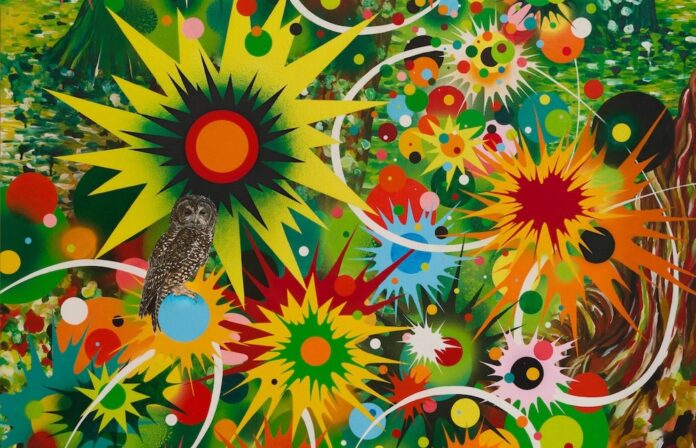
To say the works of Kara Maria are colorful is an understatement. In fact, her artwork explodes in a collision of vibrant hues and cosmic energy. Thematically, her pieces embrace the biodiversity crisis with swirling abstraction that gives way to thoughtful environmental connections.
“I draw inspiration from comic books, cosmology, the history of painting, and the natural world,” Maria told 48hills.
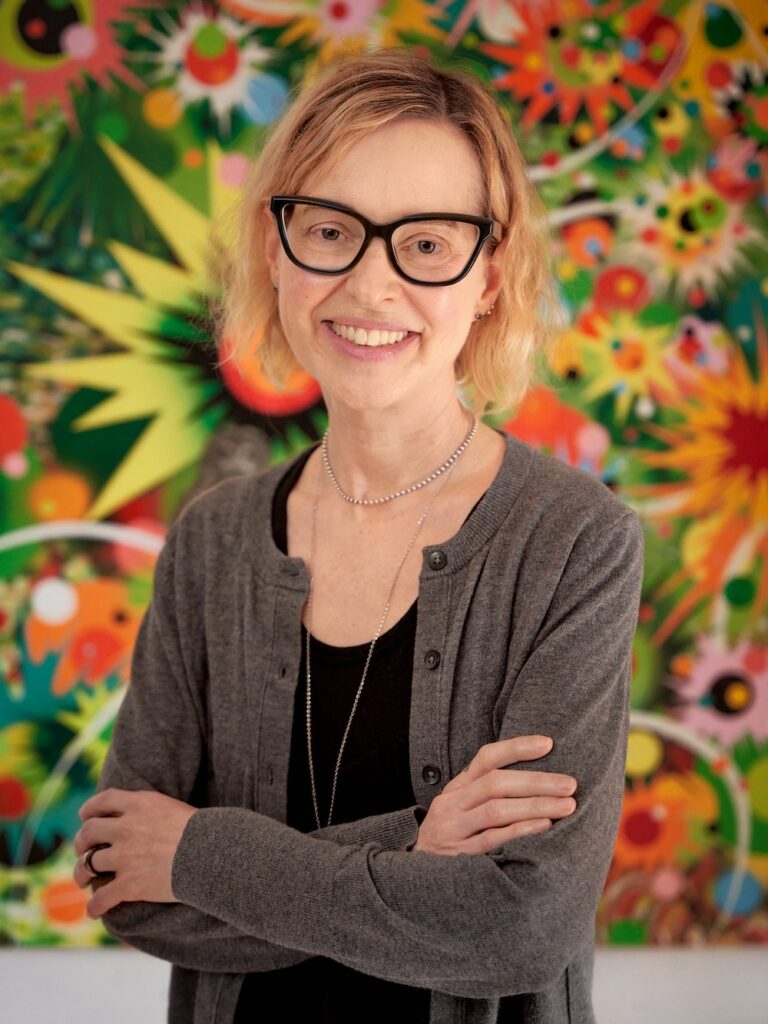
Interested in the formal elements of painting, such as color interactions, contrast of lines, shapes, and textures, Maria’s paintings are abstract at first glance, yet realistically rendered elements are hidden within. In her painting Stardust (Ohlone Tiger Beetle) for example, one must penetrate the colorfully celestial dynamism to find that little critter, a melding that emphasizes not only the beetle’s integrative nature, but its fragile existence.
Maria grew up in Binghamton, New York, a small upstate city about an hour south of Syracuse, near the Pennsylvania border. Originally a music major, studying clarinet and composition, Maria later began to explore different schools and fields of study, including three colleges on the East Coast and a study abroad program in Paris. She eventually moved to the Bay Area, earning both a BFA with honors (1993) and an MFA (1998) from UC Berkeley.
“While living in New York City and abroad, I began frequenting museums. In Paris, I took an art history class on 17th and 18th-century French painting, which was held inside the Louvre. I lived in Amsterdam for six months and spent many hours in the Stedelijk Museum, where I became fascinated by Wassily Kandinsky and his ideas about the interaction of music and painting,” Maria said.
When she arrived at UC Berkeley, unsure of a major, she took a variety of classes including color and composition with Bay Area minimalist painter David Simpson. That class changed the direction of her life.
“David gave us exercises, first using charcoal then acrylic paint, which made me feel that I could become a painter. I had been searching for an artistic medium to dedicate myself to, and I found it in painting. I have been focused on that ever since,” Maria said.
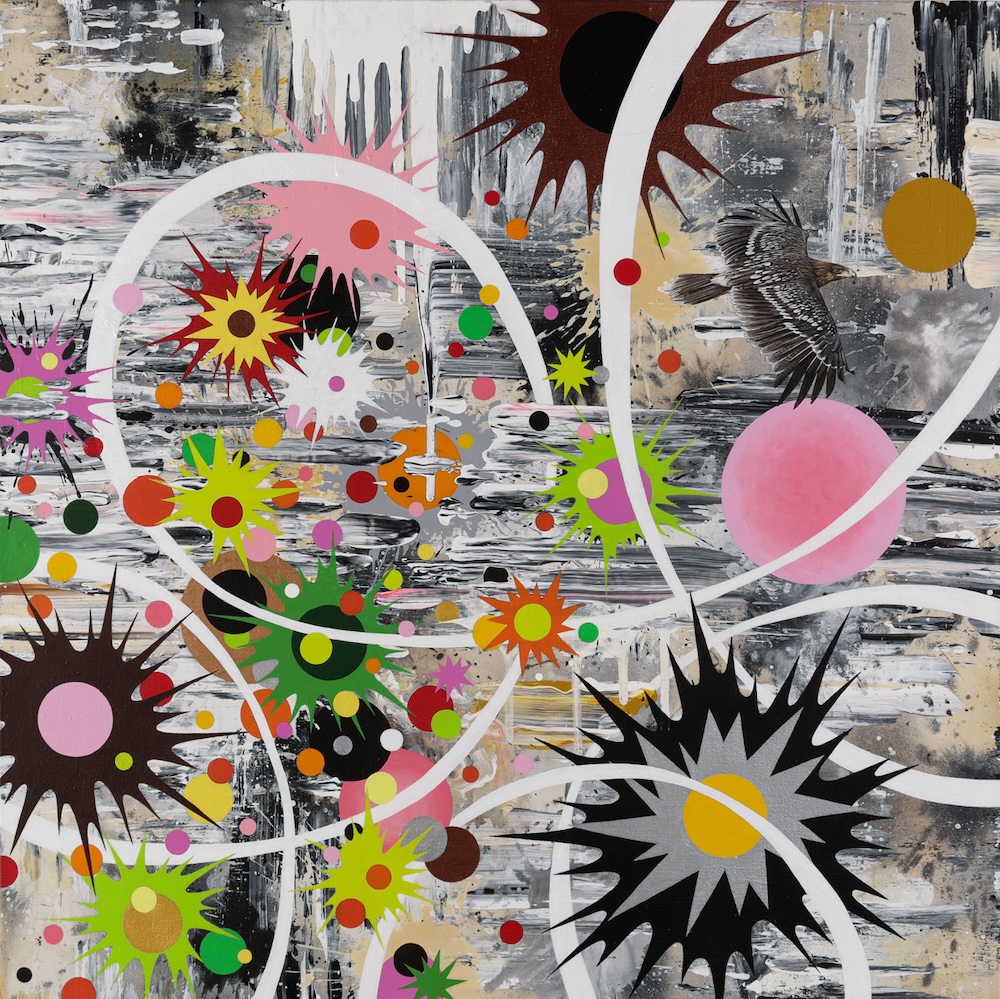
Since 2014, Maria has included threatened, endangered, and extinct animal species in every piece or work. Selecting specific animals through research of endangered species lists and relevant news stories, Maria brings issues to light. In the painting, Tropic of Cancer (Greater Spotted Eagle), the endangered bird whose migration over Ukraine has been disrupted by the ongoing war is featured.
“I began this theme after reading Elizabeth Kolbert’s book The Sixth Extinction, which documents the effects of human actions on Earth’s climate and explains how species are declining and disappearing at an unparalleled rate. Typically, a single, small animal is depicted within the larger space of the painting, creating a sense that it is overwhelmed by its environment. This illustrates the complexity of our world today, reflecting both the extreme pace of development and the ecological devastation left in its wake,” Maria said.
Maria’s studio is on the ground level of her home in the Miraloma Park neighborhood of San Francisco, where she works as a painter and multimedia artist. With its sliding doors that open onto a deck and garden, the space is beloved to her for its privacy and quiet.
“The previous owners had converted a portion of the garage into a roughly 300-square-foot recreation room, complete with knotty pine panels and a wet bar. It became my studio in 2001,” she said.
When painting, Maria begins by pouring thinned acrylic paint onto wet, raw stretched canvas to create staining effects.
“I build these effects in layers and once satisfied, I seal the canvas surface using a clear acrylic varnish. I then paint on top of this sealed surface, primarily using acrylics and acrylic spray paint,” Maria said.
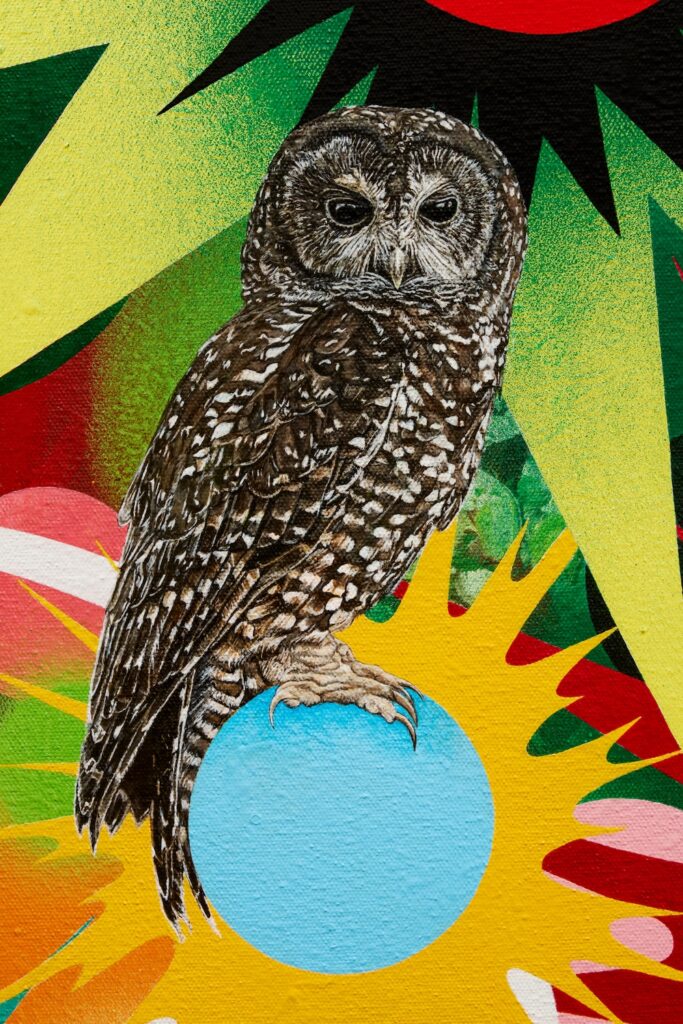
Donning jeweler’s magnification glasses for fine details, Maria says her paintings take a long time to create—and that completing them is the most challenging step. While working on a recent piece, The Magic Garden (California Spotted Owl), Maria shared that her engagement in research is inspiring but also time consuming. She looks to explore the reasons for animals’ endangerment and understand the complexities of the laws intended to protect them.
Serendipity and chance have led to some of her best opportunities as an artist. Maria says she was inspired by the works of Brazilian artist Ana Elisa Egreja, whose work she first viewed over the summer at Jessica Silverman Gallery in San Francisco.
“Her work combines the conventions of interior and still-life painting with elements of magical realism, including animals, vibrant colors, unique foods, and other distinctly Brazilian elements. One particularly gorgeous painting depicts a jaguar napping on an antique sofa in a room where the walls transition into a sunset sky filled with birds,” Maria said.
Another encounter came unexpectedly while boarding a flight in Mexico City, when she received an email from Adobe offering a commission to create a large-scale artwork for the Chase Center in San Francisco.
“It sounded too good to be true, so I initially thought it might be spam. I read it to my husband, who suggested I delete it. However, I decided to take a risk and reply, and I’m fortunate that I did,” she said.
The resulting artwork, Cosmic Expansion, was produced at Magnolia Editions in Oakland and is on display at the Chase Center as part of the Adobe Homegrown Series, through December 2026. Her other recent shows include the two-person exhibition, For the Record…, at Coastline College Art Gallery in Newport Beach and group show, Nature’s Pull with SCAPE (Southern California Art Projects + Exhibitions) in Corona del Mar.
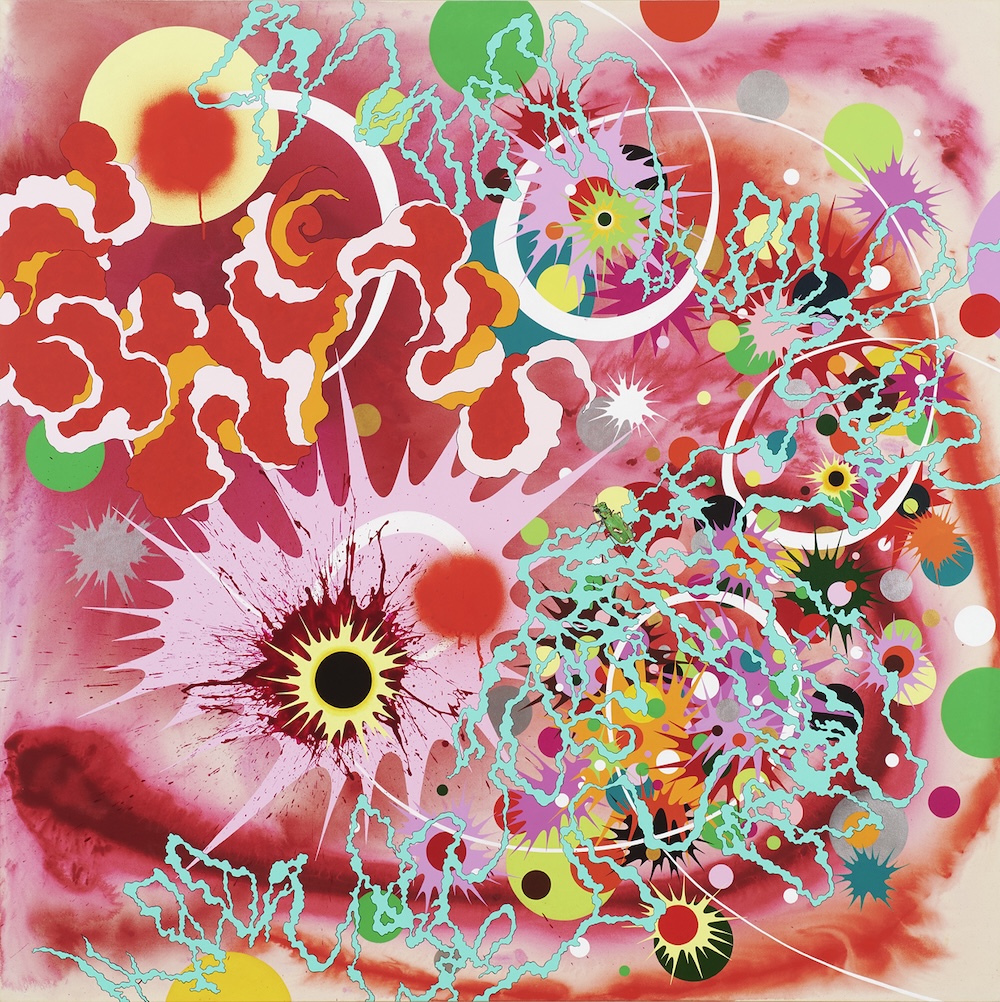
“The original show was part of the Under One Roof Art Fair, which brought together a selection of Southern California galleries, nonprofit art spaces, and artist-run cooperatives,” she said. “Paintings from my endangered animals series were paired with works by artist Suvan Geer to reflect on the vulnerability and remarkable resilience of the natural world.”
Maria was also included in the group show Het Beste Women at b. sakata garo in Sacramento and is featured in It’s Not Trash: Reclaiming and Transforming at Petaluma Arts Center through November 24; Energy and Motion II: Abstraction 2026, at Mark Moore Fine Art, Artsy Online Viewing Room, in Los Angeles through November 29; and Reclaimed: The Art of Recology, at Syracuse University Art Museum through December 11. In 2027, she will have work in Cosmologics at Equity Gallery in New York City from July 15 to August 14, 2027.
Maria has been an adjunct teacher of painting and drawing at Bay Area colleges and universities since graduate school. She continues to play the piano for her own pleasure and edification.
“I have also been very slowly learning Spanish since I met my husband, artist Enrique Chagoya, in 1995. I enjoy reading, especially novels. And I live with and care for a bossy and charismatic cat named Lili,” Maria shared.
Through her graphic and colorful artworks, artist Kara Maria hopes to stir our awareness and provoke positive dialogue about endangered species and how we might better care for our planet. She also intends for the work to communicate a sense of exuberance and an abundance of energy.
“I love this quote by author E.B.White: ‘I arise in the morning torn between a desire to save the world and a desire to savor the world. This makes it hard to plan the day.’ My artwork grapples with this same duality,” Maria said. “We live on the only planet thus far confirmed to harbor complex life forms. This is, of course, a very special and important fact. Safeguarding the natural systems and resources that maintain a hospitable climate for life should be of utmost urgency to us all. I believe that even in the most challenging circumstances, the best in people can shine through.”
Kara Maria is represented by Mark Moore Fine Art in Orange, California and Gail Severn Gallery in Ketchum, Idaho. For more information, visit her website karamaria.com and on Instagram.