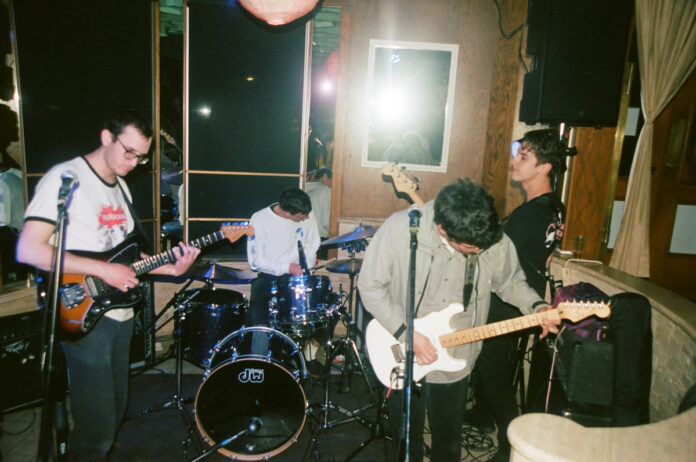
Talking to Pardoner’s Max Freeland is like getting sucked into a wormhole of San Francisco DIY history.
For those who’ve been to a lot of small indie-rock shows in the West Coast over the last 10 years, maybe the name Pardoner alone conjures the same feeling; there was a while in the city where the yellow Pardoner shirt from their first album Uncontrollable Salvation might as well have been the Unknown Pleasures shirt.
At one point, Freeland mentions that he used to be in a hardcore band called Moms, who I’m pretty sure I saw at a house show in the Sunset in 2014. I definitely saw Pardoner at the Honey Hive Gallery, before the ubiquity of those yellow T-shirts told me they were onto something. These are images of tight-knit, countercultural community, and Pardoner’s scuzzed-up and strangely beautiful indie rock belongs distinctly to that world.
The last time everyone in Pardoner was in the same geographic area was about three years ago. They’ve all split, Freeland to Philly (where his wife was in grad school), bassist Colin Burris and guitarist Trey Flanigan to New York, and drummer River van den Berghe to LA. “I think we are a San Francisco band, maybe,” Freeland says. “But maybe we don’t get to say that.”
As a result of a mostly virtual mode of communication, conducted largely through voice memos and intermittent practices, the band’s music has become far more pared-down and efficient since their previous album Peace Loving People in 2023. Their new album Target Practice is practically Beatles-like, spanning 11 songs in just 23 minutes. “We don’t get to jam, really,” Freeland says. “So like all the songs are pretty carefully written and not loose. It’s pretty rigid.”
If Pardoner sounds like the name of a metal band to you, you’re onto something. Born in Boston and raised in Fresno before moving to San Francisco as a teen, Freeland first started playing shows as a teenager in a black metal band—“that first Deafheaven EP had come out and we were like, let’s do that”—and transitioned into hardcore later on.
Much of the power of that first Pardoner album comes from the way its rock songs are absorbed into a dense and prickly atmosphere reminiscent of the most windblown black metal; it’s no surprise to hear Deafheaven producer Jack Shirley was behind the boards on three of the four earlier Pardoner records.
“For this one, I think we tried to take [metal] out completely,” Freeland says. “It kind of feels like hot dog-flavored soda, where in reality you just want a hot dog and a soda, not the two of them put together. It seemed natural at the time, but now it seems a little less natural to have half of it be a Pavement song and then have blast beats for 30 seconds. Maybe it wasn’t for the best.”
There are no whiplash tempo shifts on Target Practice, and the biggest musical gambit is the Auto-Tune on the title track. By contrast, the first few songs are set at almost the exact same tempo, as if to drive home how much discipline Pardoner exert on themselves on the record.
Freeland is 31, making this his first record of his thirties, and if the album feels just a little more classic-rock than the others in a skewed, R.E.M./Replacements-ish short of way, that’s on purpose. “We all still listen to hardcore and punk and stuff,” Freeland says, “but at least personally I thought it would be fun to make a record that maybe my parents might like.”
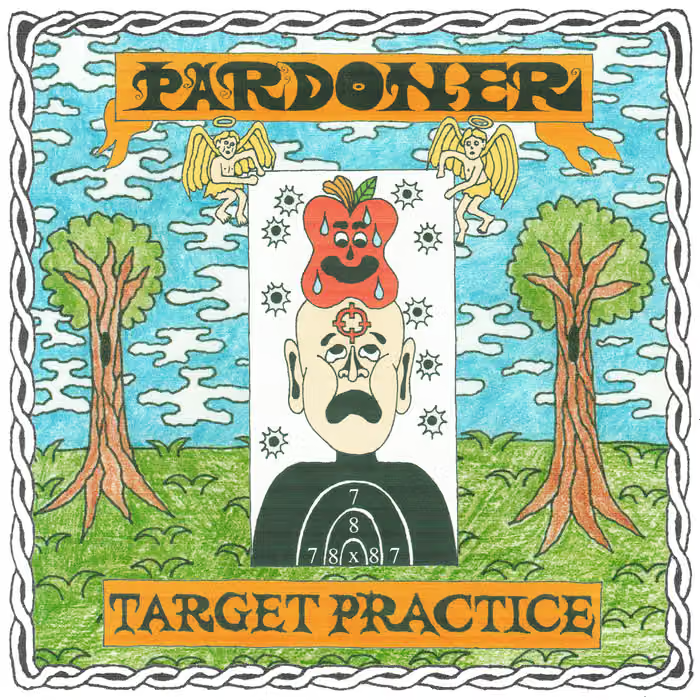
One thing hasn’t changed about Pardoner since their first album, though: the quality of their cover art, handled with aplomb by guitarist Trey Flanigan.(“I feel like half of the reason that we’ve done OK as a band is because the album art and the shirts are always done by Trey,” Freeland says. “I hope we’re not just a T-shirt band, but it’s definitely a little bit of that.”
Target Practice’s awesome sleeve features a crying William Tell figure being mocked by the apple placed over his head, surrounded by bullet holes as angels wait eagerly in the wings like hungry vultures to take him to heaven once the unseen shooter hits his mark. “We’re Living in Violent Times,” the penultimate song on Target Practice tells us. That’s a hell of a way to illustrate it.