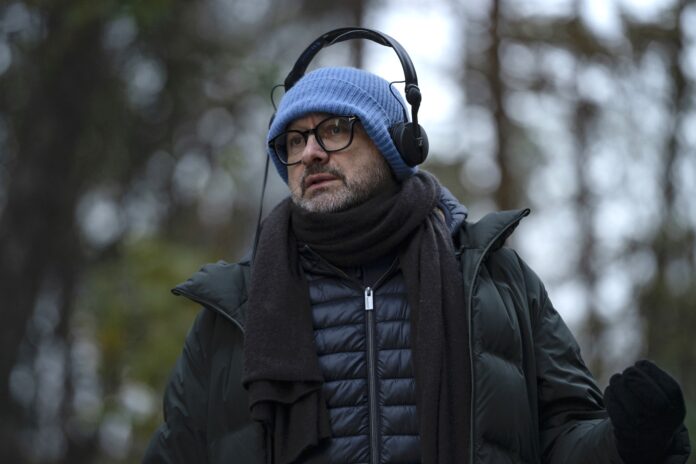
The billboards are real. That is one thing Andrey Zvyagintsev wants audiences to know about Minotaur, the Leviathan writer-director’s latest drama that takes place as Russia prepares for its 2022 invasion of Ukraine. The signs appear only momentarily in a couple of occasions, but the camera lingers long enough to emphasize the jingoism of that tense time.
“That was not something we made up,” Zvyagintsev says through an interpreter during a stop in the Bay Area to screen the film. (Read Dennis Harvey’s review here.)
“It was not a creative decision. It was something that was all over Russia. In most Russian cities, you could see those billboards with soldiers appealing to men to join the army with a contract and promising them really big sums of money, so that was the reality. That was a way of the power to communicate with the people. We just transferred that reality onto the screen.”
That the Ukraine invasion is embroidered into the fabric of Minotaur is an accident of timing. Zvyagintsev wanted to follow up his 2017 film Loveless with an adaptation. He looked at a handful of French films and decided he wanted to remake Claude Chabrol’s 1969 thriller La Femme infidèle (The Unfaithful Wife), a Hitchcockian tale of what transpires after a man discovers his wife’s affair.
The director’s ambition turned out to be impossible when the rights holders of Chabrol’s film rejected his proposal. Zvyagintsev was mulling what to do next when COVID first shut down the world, then, in 2021, nearly ended Zvyagintsev’s life. He became so ill that he had to be put into a medically induced coma. His recovery was glacial as his sickness robbed him of his ability to walk and speak requiring intensive rehabilitation to regain those skills.
The nine-year gap between films was not something Zvyagintsev could anticipate, but Minotaur could not exist without it. When he was able to start working again, he did not have to search for a project: The rights to La Femme infidèle were now available. And Putin’s aggression toward Ukraine added a whole new layer to the movie Zvyagintsev envisioned.
Russian businessman Gleb (Dmitriy Mazurov) is up against it. His business is bleeding employees as many head out of the country in anticipation of the coming invasion. Adding to the pressure, the government has asked him to put together a list of his workers who will be called up for military service. (Zvyagintsev says he did not make that up: Russia did impose military recruitment on private businesses.)
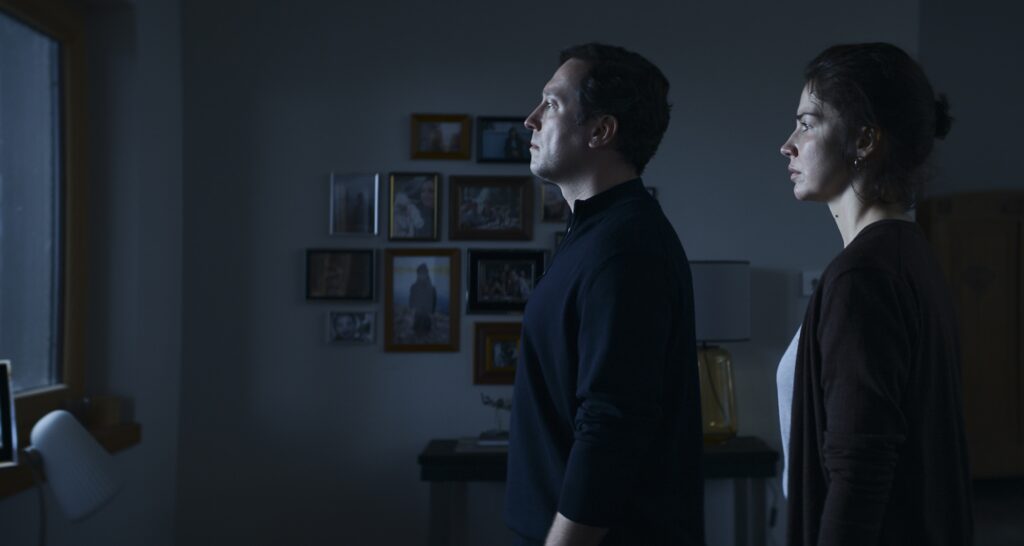
If Gleb’s work troubles are not enough, he catches his wife Galina (Iris Lebedeva) in a lie one morning. That leads him to obsess over what she is hiding, jealousy that sends him spiraling out of control.
“This was a huge blow to Gleb,” Zvyagintsev says. “It sends him into a jealous rage, but the two storylines exist separately. Gleb never discusses his work issues or whatever is going on in the country with the wife. Galina is dealing with her own issues of being a woman left without attention and having to seek that attention with another man, so in a way, everyone is affected by what is going on.”
The situation in Russia has had a major impact on Zvyagintsev’s own life. The filmmaker who has made his country’s bureaucracy and corruption a part of so many of his films has immigrated to France. He shot Minotaur in Latvia. He is not alone in his disgust with his homeland. His regular crew is also part of the Russian diaspora, making them all available for this latest shoot.
“It was incredibly important to have them, because you want to feel the rhythm, the same impressions, the same rapport that you have with people you know,” Zvyagintsev says. “The crew has been living all over the world in Vancouver, LA, London, Paris, Cyprus, and it was great to be able to assemble them all together.
“In the beginning, we were all speaking over Zoom, but then later on they all made it to Latvia, and it was great to see everyone’s faces. And I could feel that the film is finally really breathing because all those people were there at the same time, especially in the new circumstances of European filmmaking and European financing. It was very important to have them all there.”
Minotaur marks a transition point for its maker. Zvyagintsev’s last two films, Leviathan and Loveless won prizes at the Cannes Film Festival and were nominated for Best International Feature Film Oscars. Minotaur won the Grand Prix at Cannes, and the film is France’s Best International Feature Film Oscar entry. But now that Zvyagintsev no longer makes his home in Russia, a country that was not just a location but a character in so many of his films, what does he anticipate for his future?
“My next steps can really be anything,” he says. “I am open to making a film in English or French in future, and I currently have three projects that I’m considering developing. One of them is in Russia, but it’s kind of more of a transition into the outside world, and then two others are in English.
“Of course, this movie had to be in Russian,” he adds. “Although it is much more difficult to make a project in Russian when you’re outside of Russia, it’s hard in Europe. It’s probably harder in America. But I was lucky this time. It was absolutely obvious that we had to make it in Russian language because the film is about what’s happening in Russia today, so there was no other choice there, really.”
MINOTAUR is now playing in the Bay Area.