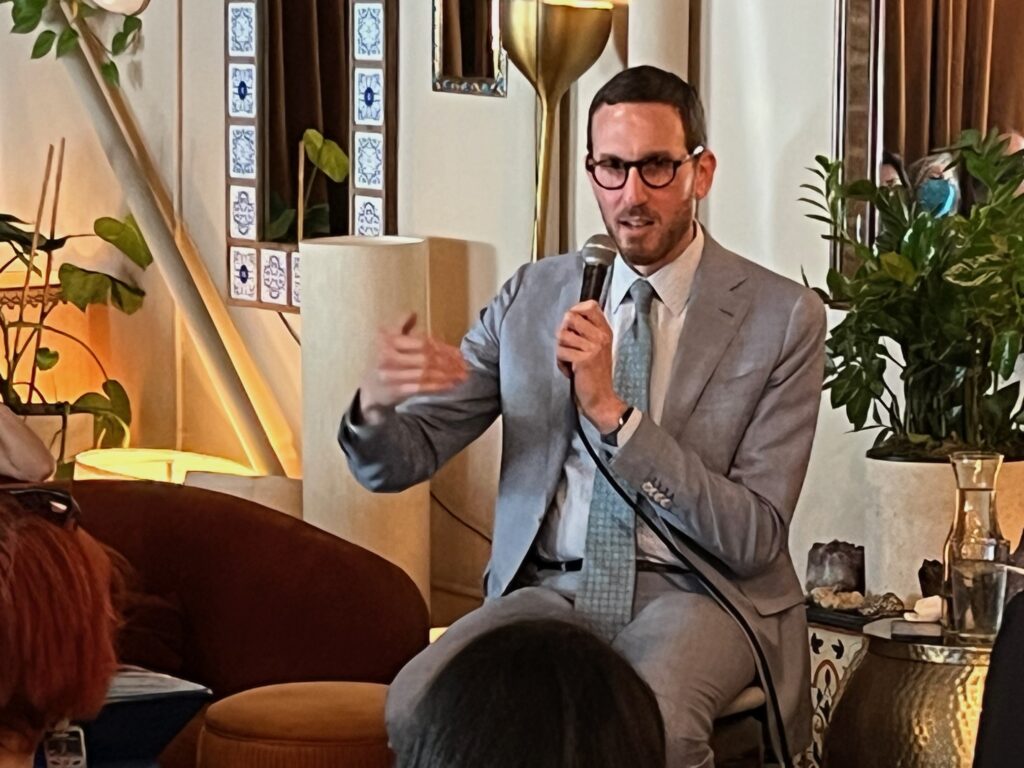
The Chron had a forum Wednesday with the directors of BART and Muni and state Sen. Scott Wiener to talk about the future of transit in the Bay Area—and I really wanted to ask Wiener a question.
The senator typically doesn’t respond to my calls and texts, so I bought a ticket to the event at Manny’s. (It was the second time I’ve ever been there. The first was to see Jane Fonda, who got sick and had to leave.)
The prognosis from the two transit leaders was beyond grim. Julie Kirschbaum, the director of transportation for the SFMTA, said that without a major new source of funding, “the 14R will come half as often and be three times as crowded. Seniors will wait for two or three buses before there’s room for them. Workers will have to spend money on Uber or Lyft to get to work on time. People who can afford it will start driving—and there isn’t the space for [all those new cars on the roads].”
(Note that Uber will be thrilled with this development, since the company’s business model depends on destroying public transportation.)
Bob Powers, the general manager of BART, said that system might have to close 25 percent of the stations, and trains would run only once every 60 minutes. BART, which was built as a system to bring commuters from the suburbs into downtown San Francisco, gets 75 percent of its revenue from the farebox—and since the downtown office economy has collapsed, that model no longer works.
These are, by any standard, unacceptable scenarios. San Francisco would be a nightmare without functional transit.
The problem isn’t new. As Wiener pointed out, “As long as I can remember, we’ve been discussing the unsustainability of mass transit.” He noted that “it’s an American problem. I was in Taipei recently and the subway cost 75 cents.”
Wiener said that the only answer is a new funding source. I agree. “In the long term, we need to think out of the box,” he said. I agree.
His immediate solution: For this year, a state loan to keep Muni and BART afloat. “We had to yell and scream” in Sacramento, he said, to make that happen.
Next: A ballot measure in 2026 that would likely impose a new sales tax in at least three counties (San Francisco, Alameda, and Contra Costa) and maybe five if San Mateo and Santa Clara join. “The voters will have to save us,” he said.
Wiener is sponsoring state legislation that would allow a regional tax, which is not authorized under current law. Even that money would not be enough to fund Muni, he said, so Mayor Daniel Lurie is looking at a 2026 parcel tax—a version of property taxes that’s largely regressive, since small homeowners would pay the same amount every year as, say, the owners of the Bank of America Building. (One of those owners is Donald Trump.)
Sales taxes are, of course, the most regressive form of taxation.
Rachel Swan, the Chron reporter moderating the forum, asked whether voters, facing high grocery prices, high housing costs, and a high overall cost of living would approve new taxes. Wiener: “Polling shows Bay Area residents get it about transit.”
Time for questions, and I made sure I was in the queue. When I got the mic, I asked:
We all agree transit needs more funding, but why does it have to be only a sales tax? Why can’t the Legislature authorize a regional and local income tax or a wealth tax, so we can make the billionaires who are getting all the Trump tax cuts help pay for transit?
Wiener didn’t answer that question. Instead, he said he’d support raising the state tax rate on corporations that got a federal tax cut, which is a fine idea, but he also said “we need a two-thirds vote in the Legislature to raise taxes.”
As Wiener walked out, I followed him, and to his credit (he is not a fan of 48hills) he stopped to answer my follow-up: Five supervisors are calling on you to support state legislation that would allow local income taxes; that just takes a 50 percent vote.
Wiener: “I wouldn’t even get it out of committee.”
I get it: The state Legislature is captive to the same billionaires that are trying to run San Francisco. And maybe it won’t happen in time for 2026, and we may have no choice but to live with a sales tax and a parcel tax, but in the long term, we need to completely rethink how we fund local government. (Taiwan, where Wiener loved the subway, has cheap, effective public transit, and also taxes the rich at higher rates than the US.)
I texted Wiener later that night:
Is it not worth a long-term effort to reduce economic inequality and save local government?
Maybe if you “yell and scream,” and put some political capital into it, and make economic inequality a priority …
He never responded.