Catherine Wagner is never not doing something interesting, it seems, whether it’s photographing hidden corners of Oakland’s Mills College Art Museum for 2018’s Archeology in Reverse series or using film canisters from the Berkeley Art Museum and Pacific Film Archive’s to recontextualize the history of movies in 2024’s Moving Pictures.
Mostly she works behind the camera, which I guess you’d expect from a photographer. But that’s hardly a limit; in the catalogue for Wagner’s latest show, Blue Reverie (through January 10 at 500 Capp Street, SF), curatorial and organizational director Lian Ladia writes “For Wagner, a photograph is never a document. It is scaffolding, a construction, an act of arrangement.”
Wagner is also fascinated with architecture, calling it the container for everything, and she says her work is also about “the built space,” which she sees as a metaphor for constructing identities.
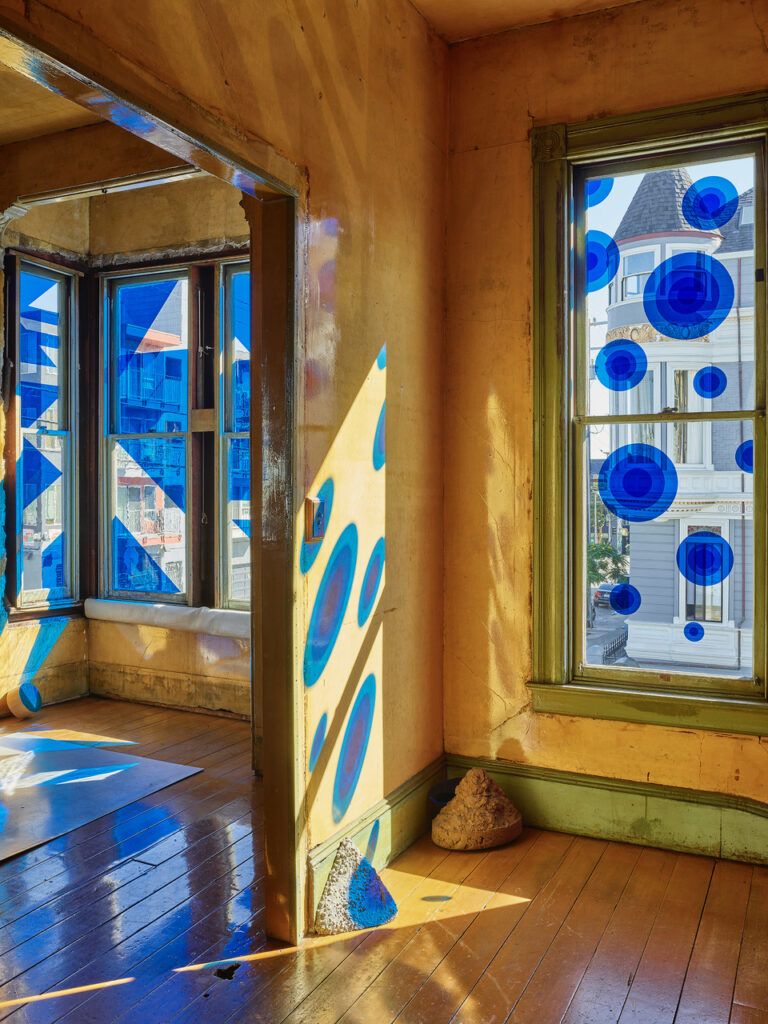
Conceptual artist David Ireland’s house in San Francisc’s Mission District at 500 Capp is one of those built spaces. Wagner has kept some of Ireland’s work and added her own in conversation with it. Along with photography, the exhibition includes installation, projection, sound, performance (at the opening four couples waltzed to “Blue Moon” by the Mavericks) and sculpture.
With Blue Reverie, Wagner is doing what you expect from the name by working mostly in cerulean hues. But she will surprise you in the way she does it. It’s not just blue paintings and sculptures—there are small hidden projectors that ensconce blue moons in the corners. The lightbulbs in the lamps have been replaced by blue ones. The dining room table has a blue light under it, making the dark wood glow.
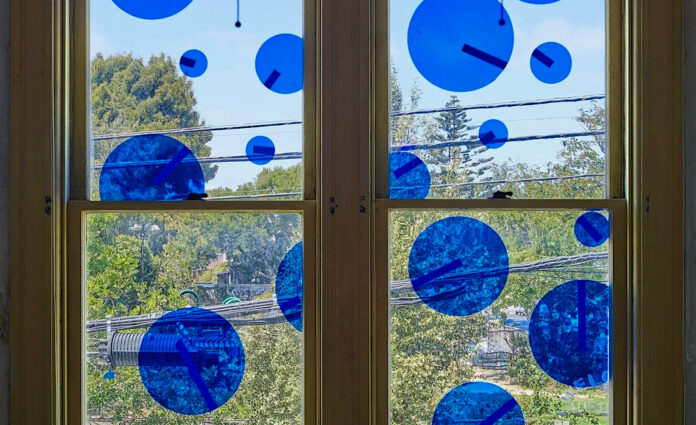
She made drawings on the walls with blue masking tape. And the windows are partially covered with a blue filter, in three gradients. When her gallerist Jessica Silverman came by with her young daughter, Wagner says the girl looked out the window, and exclaimed, “Look, Mommy—blue people.”
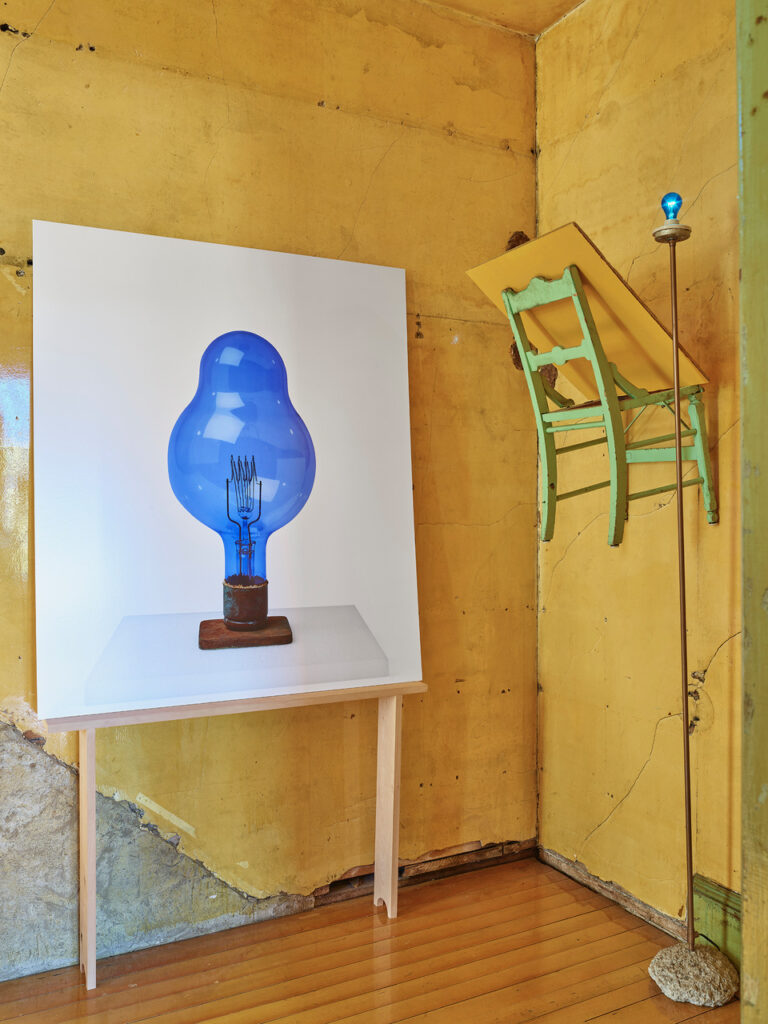
Light is a theme in Blue Reverie, and when conceiving of the show, the first thing Wagner settled on was five photos of antique lightbulbs. They’re from around the time the house was built in 1886. Created with an antique 8×10 view camera, the photos are life size, and she calls them sculptural works. (Wagner expressed gratitude to Sterling Art Services, who donated their services to frame the photos with waxed ash wood.)
Wagner and Ireland first met in 1999 when they shared a gallery in the exhibition Museum Pieces: Bay Area Artists Consider the de Young, at the San Francisco museum. For that show, Wagner’s project involved photographing old registers’ ledgers. Ireland hit on his piece after discovering a piece of metal in the museum’s wall. When they finished what they were building, Wagner says, iron workers would often sign their work with their initials. While looking at the metal he had found, Ireland got a surprise.

“That metal I-beam, which was kind of patinaed black, was inscribed with the initials ‘D.I.’ So he goes, ‘Oh, my God, my piece is done,’” Wagner said. “He was kind of pissed off about it because he’s like, ‘I can’t do anything better than that.’”
Since then, Wagner and Ireland had many conversations about conceptual work and making art until his death in 2009. She thinks of Blue Reverie as a continuation of their conversations, even though he passed away in 2009.
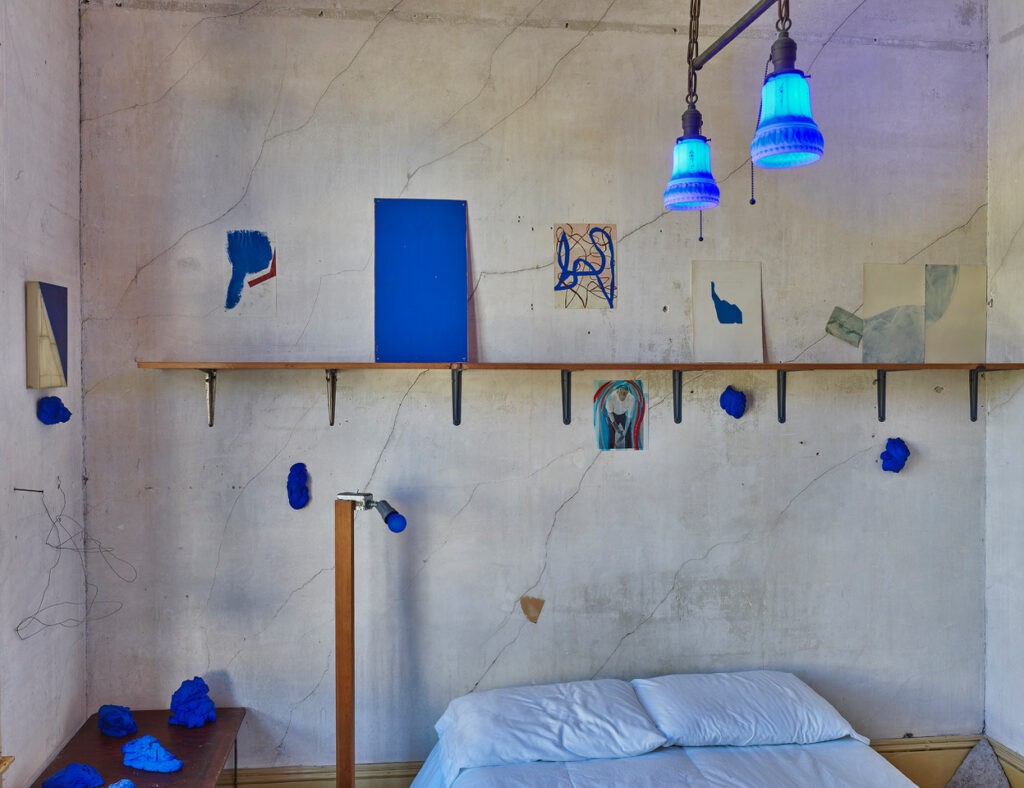
Wagner says she’s long been fascinated by the color blue—as she points out, she’s not alone among artists, with Yves Klein having a signature color he trademarked, Picasso with his Blue Period, and Ireland himself often employing the color.
In the catalogue, critic and curator Glen Helfand (who organized the 1999 de Young show) wrote: “500 Capp is studded with the color blue. In highlighting this pigmented thread in [Ireland’s] work, Wagner creates a literal lens, a commonality of interest and perspective.”
Wagner says she has enjoyed getting to continue the conversation with her friend.
“I wanted to pay homage to David, so I never wanted to do a takeover, but I wanted to allow a new facet of David to come through,” she said. “So many people talked about, ‘I’ve never seen the house like this.’ I came in with kind of a fresh breath of air.”
BLUE REVERIE is on view through January 10 at 500 Capp Street, more info here. There is a launch party for the catalogue on Tue/16, 5pm-7pm. It’s free, but you can rsvp here.