’Tis the season that’s supposed to be “festive,” but it makes sense that this week’s new movies are closer to furtive—their protagonists are all on the lam, in hiding, or otherwise harassed by oppressing forces. Given the political state of the nation at present, it’s a relatable mindset.
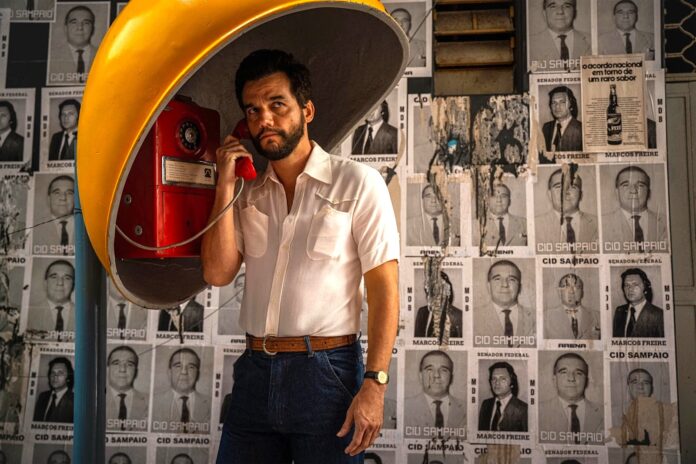
The most accessible and enjoyable of them is The Secret Agent, an internationally financed fourth narrative feature for Kleber Mendonca Filho, whose prior ones (Neighboring Sounds, Aquarius, Bacurau) have all been impressive. It’s 1977 in Brazil, “a period of great mischief” according to an opening on-screen text, and Armando (Wagner Moura) is driving alone cross-country to coastal Recife—the writer-director’s own home town. At a gas station en route, he tells inquisitive cops he’s just traveling to attend the local Carnaval celebrations. But we suspect his mission is more urgent, a threat of discovery underlined not just by the officers’ casual insistence on a bribe, but by the presence of a rotting corpse on the premises. The attendant says it’s just a would-be robber who failed to get away. Still, the fact that no one (police included) seems to care about a bullet-riddled corpse laying in the midday sun suggests violence and chaos are part of everyday life under the military dictatorship.
Armando lands in the apartment complex run by Dona Sebastiana (Tania Maria), a gossipy old lady who’s nonetheless a keeper of secrets—pretty much everyone living here is a political refugee of some sort or another. It’s an amiable community where our widowed hero quickly finds a lover (Hermila Guedes’ Claudia), plus a job in a records-keeping office. He also finds the real reason for his coming here: Son Fernando (Enzio Nunes), who’s been raised by grandparents while his parents stayed underground, from which one has just now tentatively emerged. That Armando—or Marcelo, one of his several aliases—is still at great risk gets reinforced when we realize he is actively sought by a pair of argumentative hitmen (Roney Villela, Gabriel Leone), who are eventually joined by a third (Kaiony Venancio).
As those men finally close in, The Secret Agent—which despite its title has no notable connection to the Joseph Conrad novel—explodes into a lethal action movie. But it remains unclassifiable, folding in elements of black comedy, cinematic homage, societal critique, vintage pop culture (everything from Chicago and Donna Summer to Jaws and The Omen gets a nod), frank sexuality, and the occasional episode of full-on surrealism. As expansive and confident as this director’s prior films were, this is a bravura leap, sprawling over nearly three hours that are never less than compelling, yet retain a bemused tone. The one place where that doesn’t factor is in a sporadic framing device that in the end takes over, as a latterday university researcher (Laura Lufesi) tries to piece together the events of decades prior. Her excavations are sorrowful ones whose indictment few connected to the original victims even want to hear.
That persecuted former professor Armando’s history has been well-buried is a fiction amply supported by 21st-century reality. Highly acclaimed at Cannes and elsewhere, Mendonca’s films have been politically incendiary enough at home to have been boycotted from Oscar submission by recent right-wing regimes. The Secret Agent’s twisting, fateful canvas, its methodical pace and widescreen elegance reminded me oddly of Michael Mann’s Heat, another epic of the hunters and hunted. But it doesn’t have that film’s self-mythologizing solemnity, maintaining a certain breeziness despite the crushing weight of authoritarian corruption. The performances (including Bacurau star Udo Kier in his final role) are note-perfect, the script’s giant, serpentine puzzle as surprising and relevant as that of One Battle After Another. It opens Fri/12 at the AMC Kabuki and Alamo Drafthouse New Mission in SF, expanding Fri/19 throughout the Bay Area.
The authoritarian threat is all too immediate in My Undesirable Friends Part I: Last Air in Moscow, Julia Loktev’s five-hour-plus documentary. The Russia-born, US-raised filmmaker began the project in collaboration with her friend Anna Nemzer. The latter is an employee at Moscow’s TV Rain, which at the start here is already the last independent broadcast channel allowed by Putin’s government. Even so, Nemzer and colleagues have been labeled “foreign agents,” and every transmission is forced to sport a disclaimer claiming you are about to watch foreign-sponsored propaganda. The truth, of course, is that TV Rain and a precious few other outlets are the only Russian news sources not parroting state disinformation.
Sustained by a commitment to journalistic truth, and the faint hope of a more democratic rule some day, Nemzer and co. are hemmed in at every turn. The authorities shut down any media it disagrees with, whether it’s advocacy for the homeless, disabled, or LGBTQ communities, or simple acknowledgement that the nation’s infrastructure is collapsing. Police routinely violate the Constitution, fines are levied for arbitrary reasons, personal financial accounts blocked likewise. At long-running newspaper Novaya Gazeta (which was co-founded by Gorbachev), several reporters have been killed for their investigations over the years. Despite all official denials, there is no question who ordered those deaths.
Still, everything rapidly gets even worse when Russia invades Ukraine in early 2022. In the later of this very personal saga’s five chapters, public protests are violently shut down, and there’s a drastic spike in opposition arrests. Loktev switches focus from nervous conversations in apartments, restaurants, cars etc. to newsrooms that might get raided any minute. Early on, Nemzer had mused “Now I find I’m in a situation where I’m seriously thinking, how will I choose between criminal prosecution and emigration?” Then there is no choice left: Colleagues are frantically fleeing the country. (Both TV Rain and Novaya Gazeta subsequently continued operating in exile.)

My Undesirable Friends—whose Part II is expected next year—provides a harrowingly up-close look at press freedoms under siege. Needless to say, it’s a cautionary tale we can’t afford to dismiss here in the U.S. At present it is scheduled to play SF’s Roxie Theater (more info here) in two halves, just Sat/13 and Mon/16. It’s also booked at Berkeley’s BAMPFA Feb. 14 and 26-27, with other Bay Area venues likely to eventually add some dates.
A quieter sort of oppression hangs over Cactus Pears (more info here), another Roxie opening that played the SFFilm and 3rd i festivals earlier this year. Rohan Parashuram Kanawade’s first feature, which won the World Cinema jury prize at Sundance, finds Anand (Bhushaan Manoj) reluctantly dragged from Mumbai to a rural home town for his father’s funeral. During the designated 10-day mourning period, he has to put up with endless pressure to marry—at age 30, his not having already done so is regarded as inexplicable. Few even suspect he’s gay, so far outside their reality is that concept, and apart from Anand’s mother (Jayshri Jagtap), no one is likely to be “accepting.” But while city life has offered him freedom, he sadly admits “the special friend(s there) never last.”
This low-key observational drama, which might recall the works of Satyajit Ray, provides him with a surprise salvation: Childhood friend Balya (Suraaj Suman), a shepherd who likewise resists being pushed into an arranged marriage by relatives. (Gay marriage is illegal in India.) Their finding one another might seem a little too good to be true, but the writer-director makes sure we have plenty of time to work our way there in emotional terms—it takes nearly an hour and a quarter before these two hazard a first kiss. It’s a touching, poetically restrained romance that avoids the pull of both over-idealizing and melodramatic tragedy. Cactus Pears opens at the Roxie Fri/12.