Between December 21 and January 3, I traveled to Cuba to participate in events organized to celebrate the 65th anniversary of the Cuban Institute for Friendship with the Peoples. I stayed at ICAP’s “Julio Antonio Mella International Camp” in the province of Artemisa along with approximately 120 Cuba solidarity activists from 24 countries (including Australia, Austria, Brazil, Catalan Countries, Chilie, Colombia, Costa Rica, Denmark, Ecuador, Germany, Greece, Honduras, Luxembourg, Mexico, Panama, Peru, Russia, Sweden, the United States, and Venezuela.)
The timing was dramatic: Our visit happened just as Donald Trump was attacking Venezuela and seizing its president—and as he was threatening Cuba and even insisting that Marco Rubio could be the next president of the island nation.
Venezuela and Cuba are close allies, and cutting off Venezuelan oil supplies will be another economic blow to a country reeling from decades of US boycotts and sanctions.
ICAP was created by Fidel Castro on December 30, 1960, almost one year after he declared the triumph of the Revolution. It aims “to build global solidarity with Cuba, counter US isolation, and promote the Cuban Revolution’s ideals by connecting international citizens with Cuban people through cultural exchanges, work brigades, conferences, and advocacy against the US blockade.”
During our time in Cuba, we participated in events to commemorate the accomplishments of ICAP, to observe the 67th anniversary of the Cuban Revolution, and to begin celebrating the 100-year birthday of Fidel (in 2026). Besides lectures and seminars (on the Cuban economy, and US-Cuba relations), we engaged in work activities, notably weeding, clearing rocks, and planting seeds in fields surrounding the Camp,
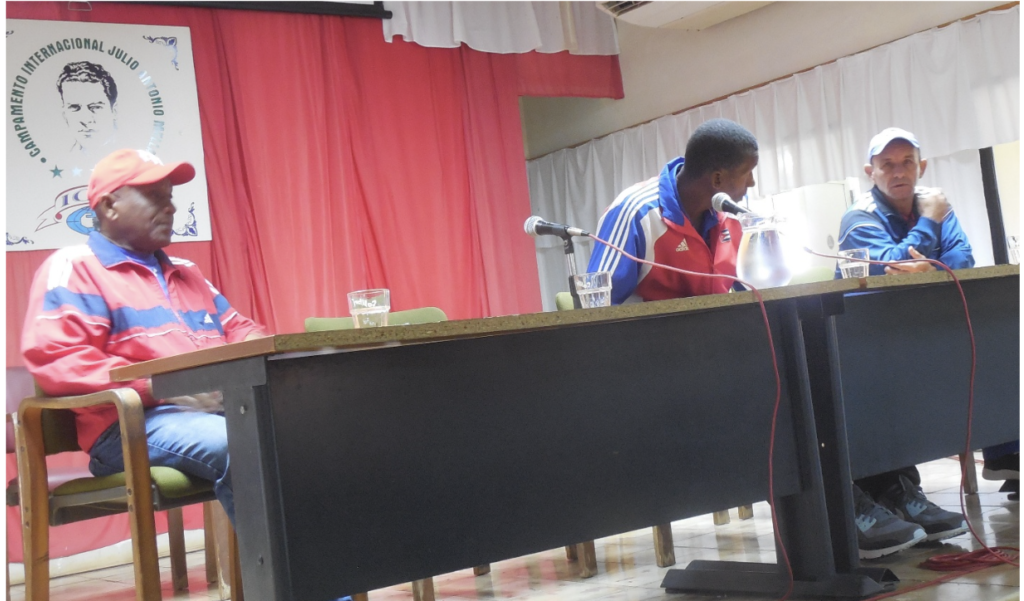
One of the highlights of my trip was a meeting with three representatives of the Ministry of Sports at the municipal level, including Hernando Roriguez Silva, a former Olympian who continues to coach the younger generation in his event, rowing. He and others on the panel remarked on how they were affected by the US blockade, making it harder to purchase needed equipment. They also criticized the current US actions denying visas to Cuban athletes who wanted to travel to the US or Puerto Rico to participate in preliminary events to qualify for the 2028 Olympics, to be held in Los Angeles.
While our group was arriving to visit the museum dedicated to the US mercenary invasion at Playa Girón (Bay of Pigs) in 1961, some members saw online a CNN report that the main harbor of Venezuela had been bombed. Although the story was picked up by a German media outlet, this turned out to be fake news.
However, as I was going to the airport to catch my return flight, I encountered what I had hoped was also fake news but turned out to be a true as well as reprehensible, a report that Trump had ordered bombings in areas of Caracas followed by a kidnapping (termed an “arrest”) of President Nicolas Maduro and his spouse, the first lady of Venezuela. They were whisked away and brought to New York City, where they were made to stand trial for allegedly being involved in “conspiracy to commit narco-terrorism.”

I am in agreement with the words included in the Final Declaration of the International Solidarity Brigade – 65 Years of Love for Cuba: “This is the moment to consolidate anti-imperialist unity to resist and overcome adversity, the only path that should lead us to the great avenues where free men and women can walk to build a better society.”