
There’s a particular way artists talk about San Francisco when the city has truly mattered to them—not as scenery, but as a place where something shifted.
For Cate Le Bon, the Bay Area lives in that register, folded into memory, music, and a formative period that still resonates beneath the surface of the Welsh singer-songwriter’s work.
“I’ve spent a lot of time in San Francisco,” she says, simply. “I knew someone very well there. San Francisco is one of the most beautiful cities in the world.”
What stays with her isn’t just the city itself, but the sense of communion she found there—the people, the atmosphere, the feeling of music moving fluidly between stage and audience. When she played the Great American Music Hall on her Pompeii tour in 2022, something crystallized.
“It’s hands down my favorite show that I have ever played,” says Le Bon. “The crowd was just so engaged, and the transference of energy was just palpable. Oh, God, it was incredible. I remember it as if it were a dream. We all felt like we’d won a competition.”
For Le Bon, San Francisco—where she returns this week (Fri/30; The Fillmore)—remains “a very special city,” one she associates with connection rather than performance, reciprocity rather than spectacle.
That sensitivity to emotional exchange runs through her latest release, Michelangelo Dying, an album shaped by the rupture of a relationship and ensuing reflection.
The title—arresting and slightly barbed—emerges from a lyric from the emotionally restrained album track “Love Unrehearsed.” Still, it operates on a broader level, holding grief, irony, and reckoning in uneasy balance.

“The album came into formation in this almost fevered state of being in the throes of heartache,” she says. “That’s a strange delirium—an echo chamber of a thousand thoughts at once.”
Rather than resisting that chaos, Le Bon allowed it to guide the record. She sang what surfaced, using the process to confront pain directly and move through it. The phrase “Michelangelo dying” arrived intuitively, capable of containing not only what she understood in the moment, but meanings that would emerge later.
“It speaks to experiencing love through art and the universal experience of heartache,” she says, while acknowledging how differently each person carries pain.
There’s also a quiet provocation embedded in the title. Le Bon points to its “tongue-in-cheek grandiosity” and to a frustration with how history often frames male artists and their muses, usually ignoring the emotional toll these inspirational figures bear.
The album repeatedly returns to ideas of pedestal-making and pedestal-breaking—of being elevated into fantasy and then crushed by it. “It speaks to the death of a pedestal and the death of a fantasy,” she says, “all of that kind of swimming around in and among the different song cycles.”
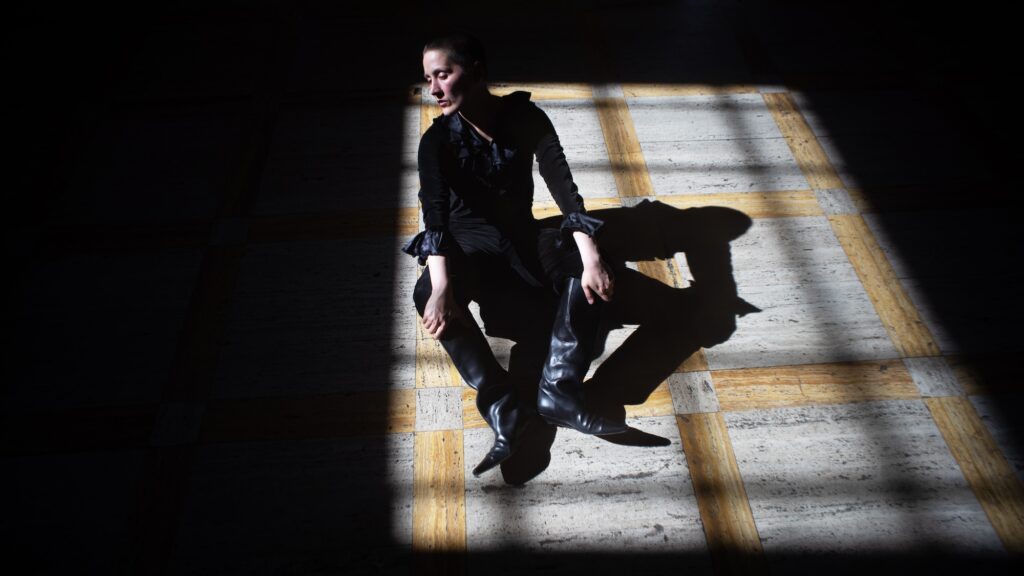
Michelangelo Dying resists a traditional narrative arc. Instead of linear storytelling, it unfolds through memory fragments and emotional swells, mirroring grief itself—recursive, overlapping, and unresolved.
Why Michelangelo? Le Bon allows that it could just as easily have been the poet Dante, though she keeps some reasons private. What matters is the shorthand: a classical figure whose name has eclipsed the human being behind it, much like idealized love can eclipse reality.
That tension becomes personal when Le Bon reflects on the self-erasure that shaped the relationship at the heart of the album. “There was a sense in the relationship that I was losing myself to keep someone else buoyant,” she says. “I had nothing left to give and had also abandoned myself.”
Recovery, she explains, required learning how to set things down without allowing them to harden into resentment. “You really have to make sure your tank is filled by the people you surround yourself with,” she says, “so you can fill other people’s cups as well as make sure your cup is being filled.”
Those ideas surface repeatedly on the record, including in the languidly paced “Is It Worth It? (Happy Birthday)”, where identity blurs and selves begin to mirror one another.
Le Bon describes the lyric about “crying through his eyes” as an expression of emotional interchangeability—how deeply entwined relationships can dissolve boundaries. That intimacy, she notes, can be sustaining or deeply destructive.
Projection, misrecognition, and imagined reciprocity haunt the album in different forms. Visually, the record reinforces those themes. The cover image places Le Bon inside a glass box—reflective, transparent, and restrictive all at once. Multiple versions of the self appear, fully visible yet contained.
The process of making the album mirrored that intensity. Le Bon doesn’t work from a fixed formula; instead, she seeks to create conditions in which self-consciousness falls away. “The hope is that you can annihilate your identity as much as possible,” she says, allowing something unguarded to surface.
Heartbreak accelerated everything. Lyrics and music arrived simultaneously, feeding into one another in a controlled freefall. Pain was constant. “Leaving somebody you love is a horrifying reality,” she says. Writing became an act of endurance—a way of sitting with heartache until it could finally be left behind.
Performing the songs introduces another transformation. What was once private becomes communal. Because the album isn’t anchored to a strict narrative, the songs continue to evolve onstage. “Some nights, some songs hit harder,” Le Bon says. “And I go, ‘Oh, God, that felt different tonight.’”
That sensitivity extends to the audience itself. Toward the end of the conversation, Le Bon returns to the live experience—not as a product, but as a shared presence.
She speaks candidly about her frustration with phones at shows and how screens disrupt the exchange she values most. She recalls a recent night in Hamburg when she asked the audience to put their devices away—and they did.
“It was absolutely magical,” she says, describing something rare and contingent, made possible only by collective agreement.
For Le Bon, that remains the hope: that music can transport not through documentation, but through surrender. “It’s almost like trying to explain a dream to someone,” she says. “It’s not really about the events, it’s about the feeling.” When it works, it’s beyond words.
When Le Bon steps back onto a San Francisco stage this week, she isn’t returning to a memory so much as reopening a conversation—between performer and audience, between past selves and present ones.
The songs may carry traces of heartbreak and repair, but what matters most is what happens in the room: a shared attentiveness, briefly held, before it disappears again.
CATE LEBON Fri/30. The Fillmore, SF. Tickets and more info here.