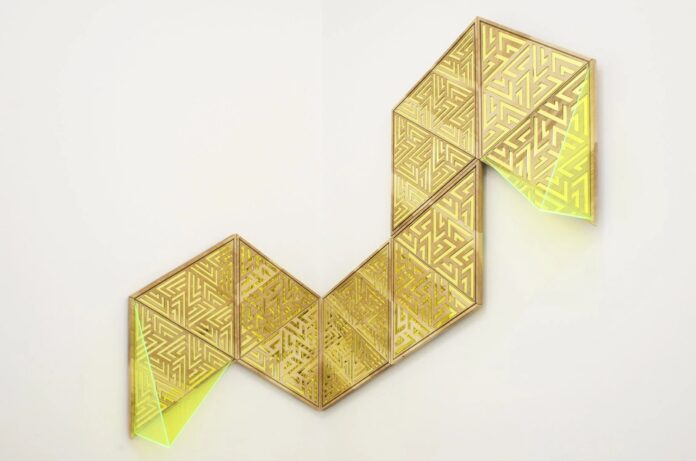
Ana Teresa Fernández’s ‘Coatl’ slithers around a corner of Romer Young Gallery in Dogpatch, bridging two walls with a hypnotic flash of angular gold metal glyphs laser-inscribed into oaky wood, its ends jutting out in two ouchy neon yellow plexiglass “fangs.” Viewers of a certain generation will immediately be put in mind of the once ubiquitous Rubik’s Snake, adding a level of nostalgic humor to the piece, while viewers of the generation before that might recall modular architecture and the retro-future blueprints of Buckminster Fuller.
More digital-oriented observers might instead see a stream of inscrutable program code unscrolling, echoing ancient Aztec codices. “Coatl,” or serpent, plays off the name of Aztec god Quetzalcoatl, the “Plumed Serpent,” who represented the union of earth and sky, as Mexican artist Fernández here unites two walls. Or is she instead erasing the corner’s border?
“Abstraction can free Latinx artists from the burden of performing their identities for the market or a specific audience,” curator Erik Barrios-Recendez told me on a recent gallery visit. “But it can also give them space to touch on big and pressing topics that concern Latinx identity—immigration, spiritualism, colonialism, and the constructed realities of identity itself. Abstraction can tap into our futurity: What does it look like when we pass through colonialism, when we don’t sacrifice our roots and our culture to move around in the world? Or, you know, artists can just be free to have fun and make beautiful things.” (Anyone lucky enough to have seen the ravishing retrospective of Cuban artist Wifredo Lam at the NYC MoMA can attest to that last part.)
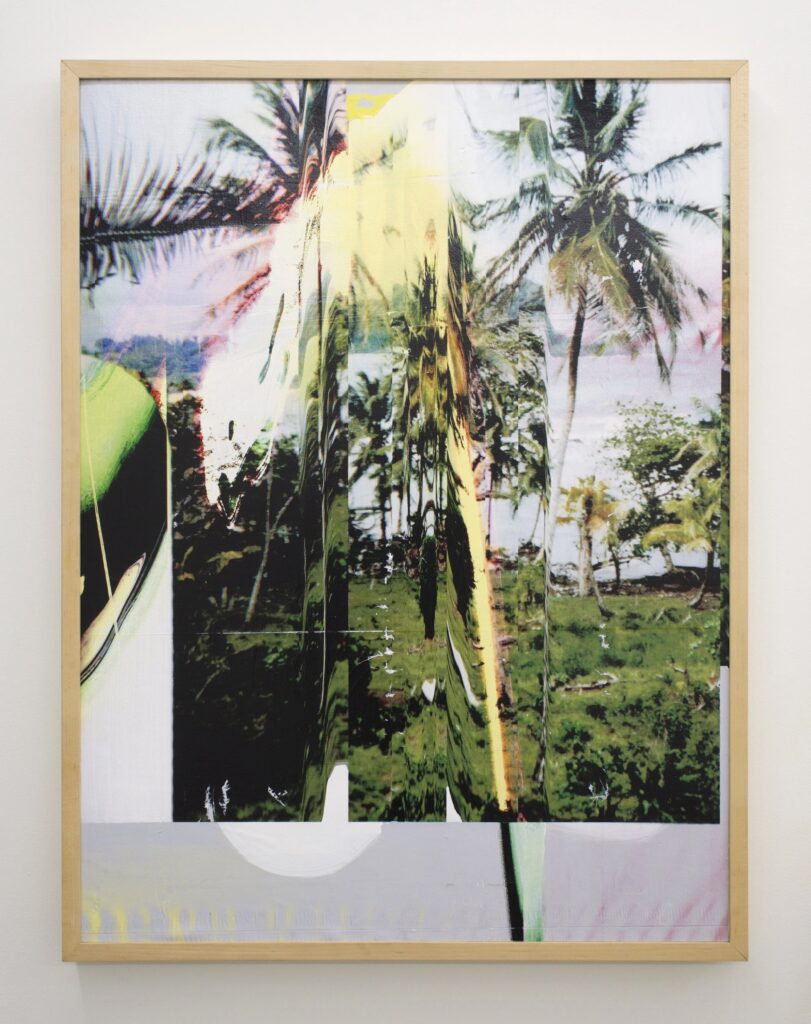
Barrios-Recendez’s small but powerful show “Rebel Forms“ (through March 7, artists’ talk Wed/25, 6:30pm) brings together some better-known names in contemporary Latine art with a focus on recent abstractions. “The show was sparked by thinking about things like South American ruralist architecture and abstract artists from Brazil that inspired early American abstraction—these things weren’t really given credit as inspirations until very recently. Latinx artists pioneered the genre very early on. And I feel like now we’re like re-playing the genre, but in a different way. The artists in the show are embodying the possibilities and new kinds of fluency of the form.”
Next to “Coatl” is Bolivian-American artist Miguel Arzabe‘s 2024 “Entropía,” which continues the reference connection between digital and ancestral. Arzabe’s typical style straddles painting and weaving, threading strips of canvas through each other to create a 3-D picture plane calling back to the visual language of Andean textiles. Pale blue and pink-washed Atari-like pyramidal shapes drape a cerulean, almost bonshō, form, which radiates zips and cursors against a volcanic orange. At first look, “Entropía” summons a strange eco-cultural future, another ulterior codex. But the title gives pause.
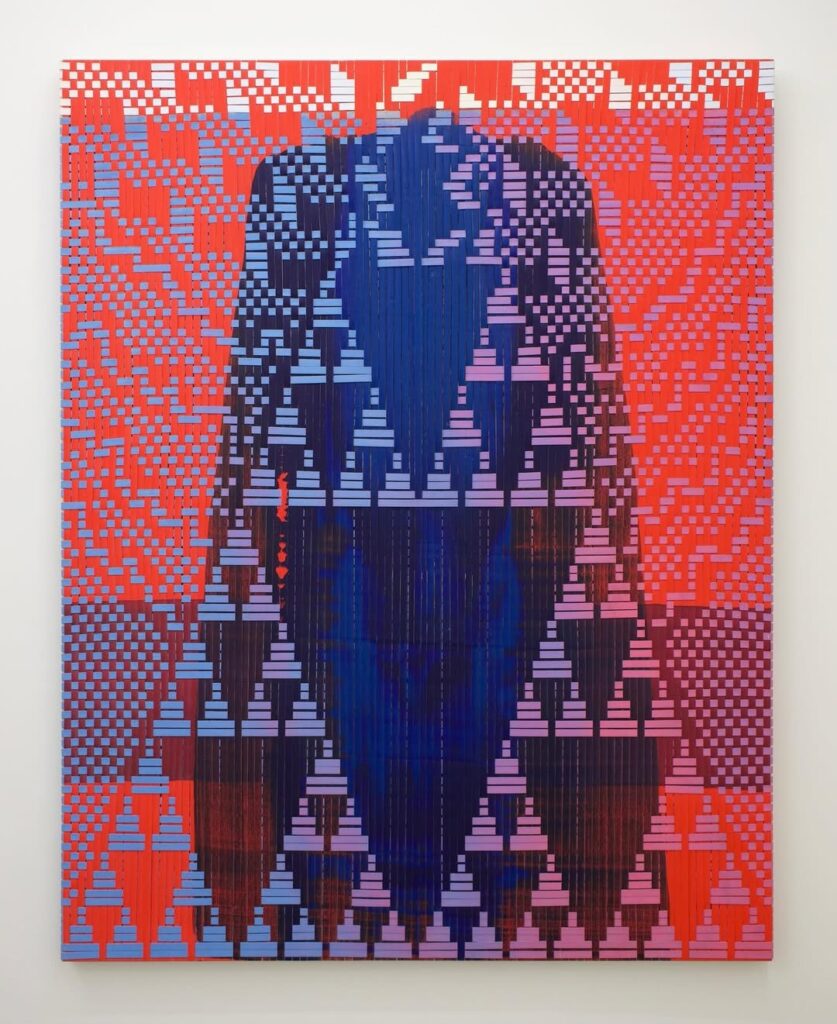
“Entropy can be a wearing down, but it’s also part of a cyclical process,” Barrios-Recendez said. “Order becomes chaos, chaos becomes order, regeneration. ‘Entropía is a very spiritual piece, but also very mathematical piece. It’s in the shape of a pyramid, which makes me think of the pre-Columbian preoccupation with building pyramids everywhere. There’s thousands of them, you know? But this piece is also derived from a mathematical equation for fractals, which trace disorder and complexity. In New Mexico during a residency, Miguel made a triangular sculpture out of mud. Out in the elements, the mud started to disintegrate and dissolve. He used that inspiration to create this piece. So there’s this idea of creating something for it to be destroyed by nature.”
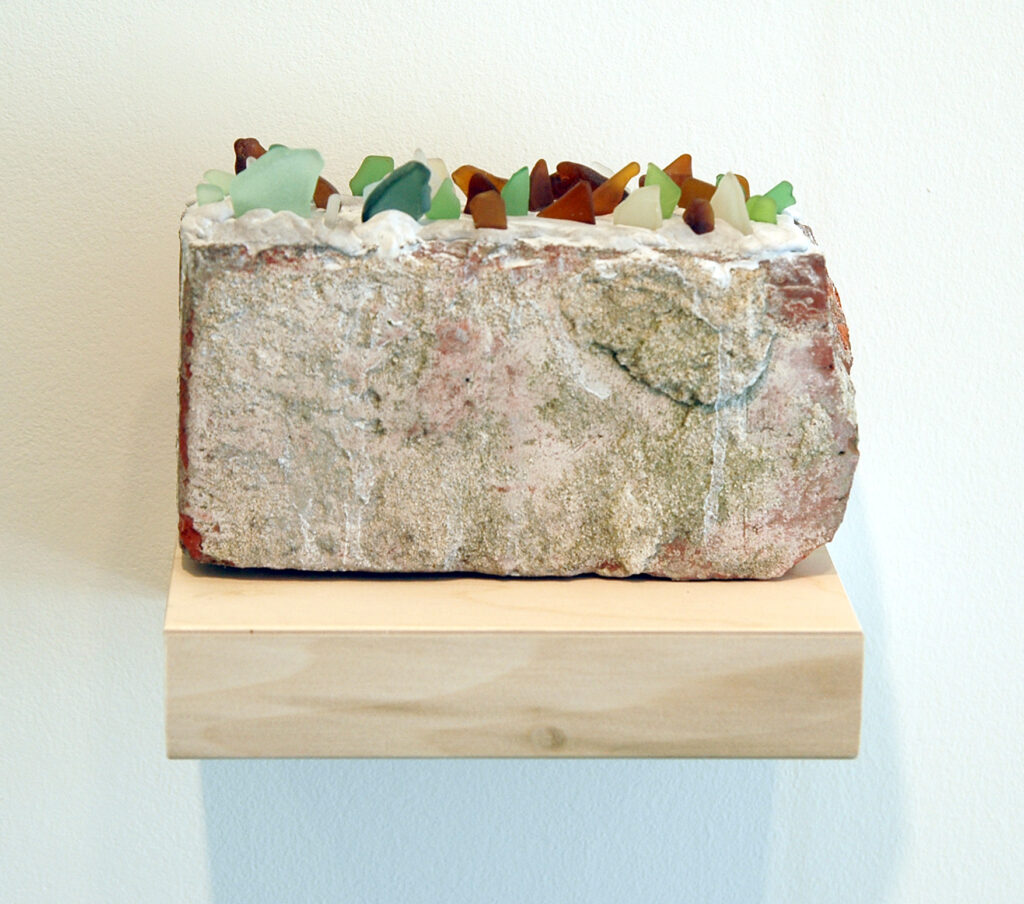
There are some swerves in the show from pure abstraction that bring heavy real-world references. Pablo Guardiola’s 2011 “Sea Glass Wall” aestheticizes the broken bottle-studded concrete walls surrounding housing compounds. Julio César Morales’ 2025 “Hopefully Invisible #1, #2, #3” incorporates his ghostly pencil drawings of people hidden in cramped, airless compartments being smuggled over the border. Pilar Agüero-Esparza’s 2024 “Lace/Her Womb” features a semi-deflated, flesh-colored woven sack of leather—the artist comes from a family of Mexican leather-workers—whose placental shape invokes both the exquisite trauma of birth and the often deadly borders placed around women’s bodily autonomy.
Barrios-Recendez recently moved to San Francisco from Southern California; this is his first curated gallery show after one he organized while working as Latinx community specialist at Creativity Explored. “Rebel Forms” is bursting with ideas, and one inspiration was the difference between Southern and Northern California Latine community. “I grew up in a kind of advanced Chicano culture, and the extensive population of other Latinx people from all over was vibrant in both its differences and similarities. Being Mexican American and coming up to the Bay, I felt like Latinx people are kind of lumped in together; I really felt abrasive with that, having to become more generalized. It’s actually made me dive deeper into learning about different Latinx cultures, and think about how we can uplift these individual cultures.”

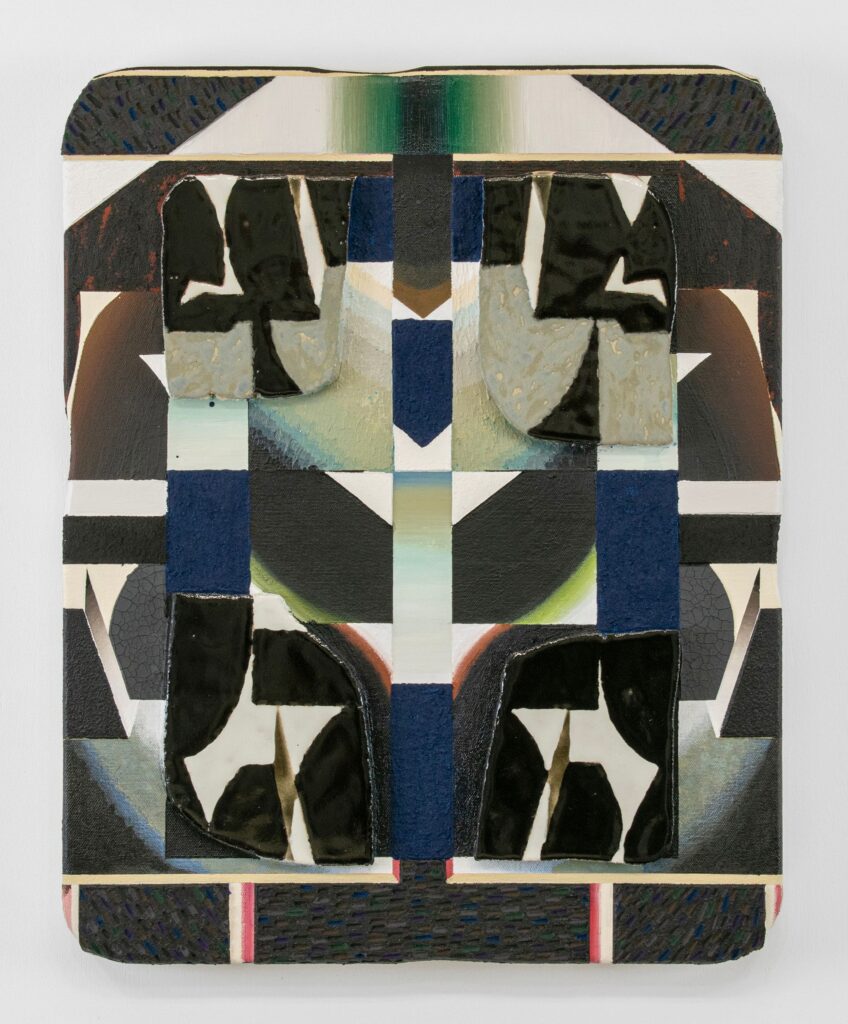
One of my favorite pieces in the show is called “Night Driving With Halo Around Lights and Increased Glare,” a 2025 painting by Salvadoran artist (and SFSU grad) Kevin Umaña. In many ways it’s a typical abstract painting, incorporating broken ceramic tiles into its bracing geometry, which contrasts thick black, white, blue, and brown lines with delicate green, orange, rose, and gray-blue luminosity. It invokes the glare of headlights while driving around on a drizzly evening, but Barrios-Recendez elaborates a deeper story.
“The painting has a very square-shouldered shape, a masculine shape that makes me think of mechanics, or yard workers, or other blue collar jobs. Professions that here in the US contain a lot of Latinx men. You have to do your 9-to-5 in order to survive, so your freedom comes at night. Cruising culture, night-driving culture, is one of the spaces Latinx men have made for themselves where they’re free to play and make community outside work. For me, this painting invokes an individual’s story of release from the physical demands of work into freedom.”
REBEL FORMS runs through March 7 at Romer Young Gallery, SF. Artists’ talk Wed/25, 6:30pm. More info here.