“Bari’s got expensive clothes, I can’t buy Trader Joe’s!” CBS News workers chanted in front of the Battery Street office in San Francisco on Tuesday morning.
Writers and producers on the small CBS 24/7 team organized a 24-hour walkout starting Tuesday morning to fight for fair wages and employee protections. San Francisco workers in the streaming division, represented by the Writers Guild of America East, organized a bi-coastal day-long work stoppage after delivering a strike pledge to Paramount management last week.
The strike happened just as CBS, under Bari Weiss, announced it was shutting down its national news service for radio networks and laying off dozens of employees.
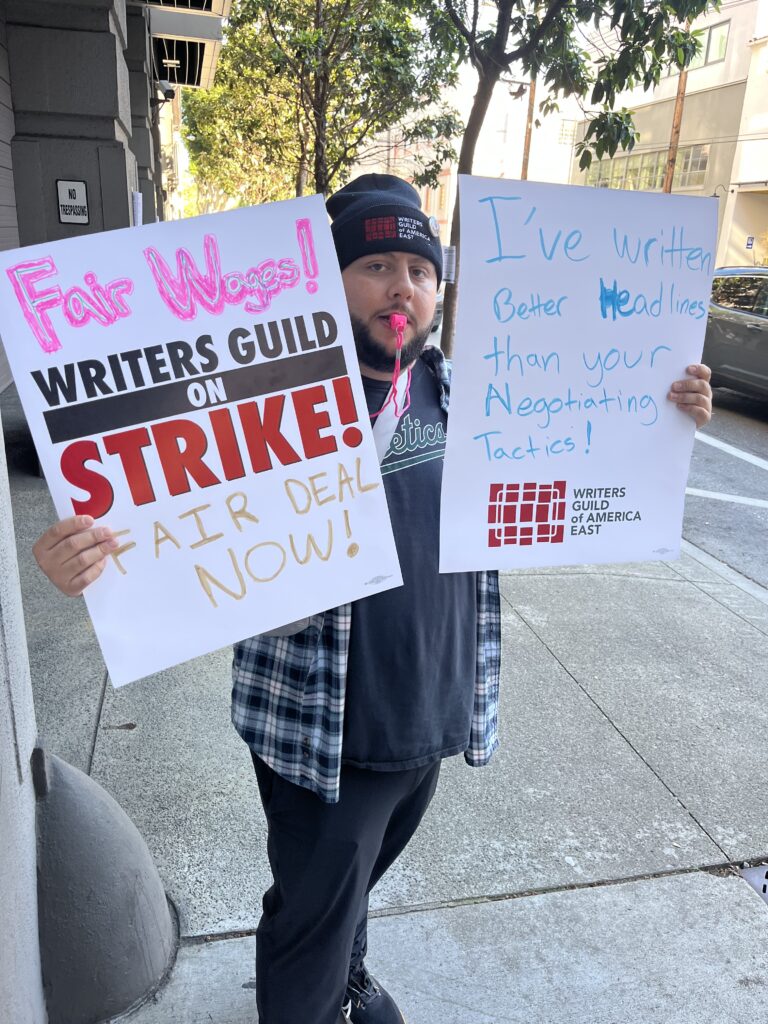
“This is just a 24-hour walkout,” said one striking worker. “We’ll see where it goes from there … we’re closing the gap. We’re not there yet with what we believe is fair and fair wages and meeting the rising cost of living and the demands of a 24/7 news operation too. There’s a lot that entails; you switch up your life a lot.”
Pedestrians, passing cars and some CBS staff showed their support for the workers on the picket line.
Negotiations broke down last week after Paramount refused to compromise on a guaranteed wage increase and some reimbursement around tolling, according to striking workers who spoke to 48hills and asked to remain anonymous.
Workers asked for a wage increase and were disappointed by the company’s response. Paramount offered around half of what workers were asking for in negotiations. Under the previous contract, workers had been guaranteed a 3 percent raise annually for three years. To start the negotiations, the company offered a 1.5 percent raise, though they eventually increased to 1.75 percent.
Shortly before the 24-hour walkout management offered a 3 percent raise, the original starting point.

As detailed in the previous piece about this strike, that raise is wholly inadequate to keep up with the increased cost of living in the Bay Area.
“I’m going to go in tomorrow and my bosses tomorrow, I’m not going to have anything personal against them, it’s not them,” one worker told us. “It’s something from above and we’re hoping it gets there soon. Nobody wants this, nobody wants to lose money.”
Many on the 24/7 team are expected to work irregular hours, arriving to work at 3 or 4 am in many cases. Such hours can make transportation difficult and workers at the San Francisco offices pushed for the company to cover the toll costs for travel over bridges but were rebuffed.
While the New York team, about 50 people compared to the 10 person San Francisco team, was also looking for the company to support transit costs, in the Bay Area the tolls are a primary focus. Many team members can’t take BART, which doesn’t open until 6am, into work. For those in the East Bay or North Bay, the union pushed for their company to support toll costs, which increased to $8.50 January 1.
The rising toll cost coincided with a CBS News return-to-work policy, as one worker outlined. At the start of this year, the company told workers that they were expected to be in office five days a week, where previously writers and producers had more flexibility.
Weiss, the editor-in-chief, and CBS News have not responded to requests for comment. This is the first real labor test under her leadership and comes as the network undergoes some massive changes.
When Weiss started in October, 2025, she reportedly sent staffers a memo asking them to detail their work and explain what they felt was and wasn’t working. That strategy was reminiscent of the first year of the second Trump term, when Elon Musk and members of DOGE sent widespread memos to government workers asking them to report their productivity or leave. With Weiss at the helm, CBS News has undergone some dramatic shifts, as ratings dropped precipitously and talent left.
The 24-hour strike is a kind of last resort for frustrated workers who, motivated by their passion for their jobs, are just looking for a livable wage in an increasingly unlivable city.
“We love what we do. Every journalist loves what they do. It’s not a matter of we’re trying to be mean or anything like that. We’re looking for fairness and we love what we do,” a worker said.