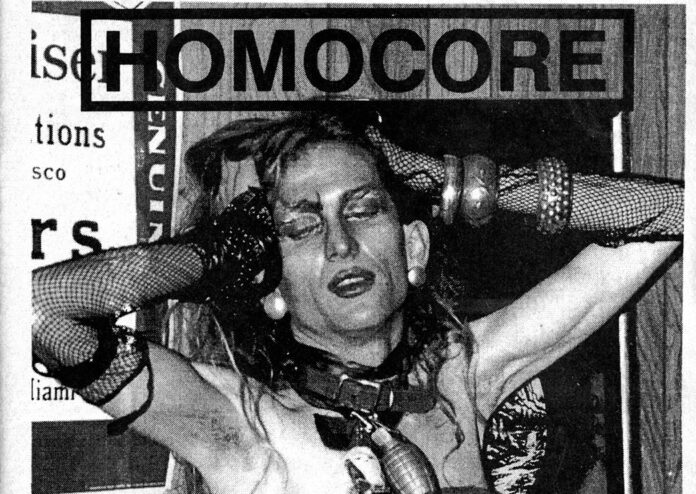
In a San Francisco increasingly defined by AI companies, disappearing subcultures, and the quiet flattening of once-radical spaces, the return of Homocore—as an anthology and a live event—lands less as nostalgia than as an interruption. It resurfaces a publication that once gave queer punks a language for themselves when neither mainstream gay culture nor straight punk had room for them.
The Homocore Zine Anthology Launch party (Mon/30; Adobe Books) brings co-creator Tom Jennings back to the city where the publication first took shape, alongside figures tied to its afterlife and to the Pretty Gritty gallery exhibition in late 2025, which helped reignite interest in it.
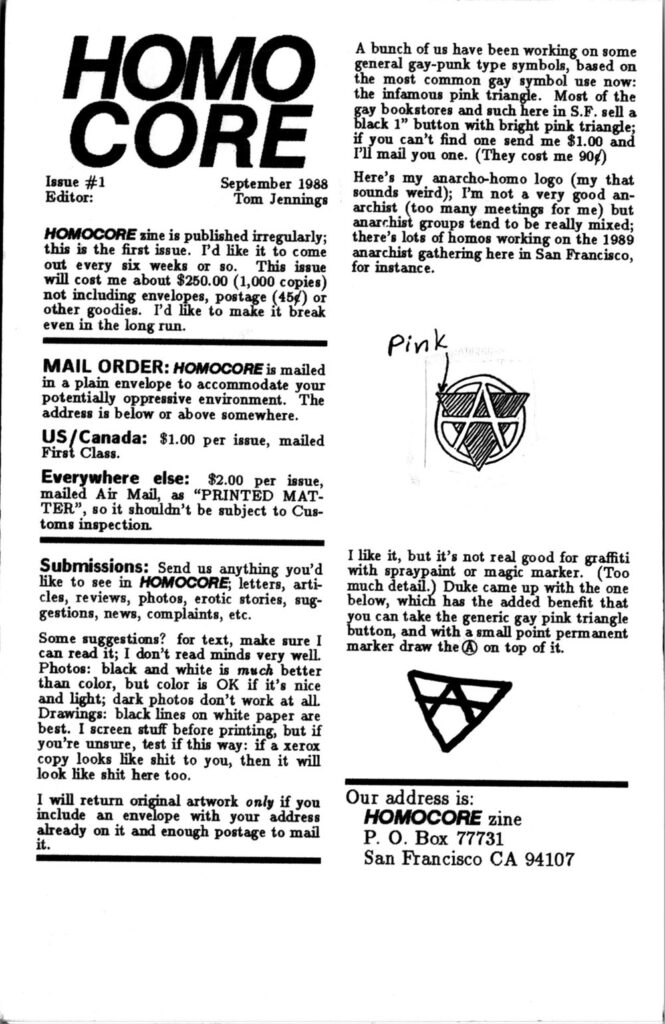
Jennings describes the event in loose, half-amused terms which suit the project itself, which was never polished or institutional. Its pages—assembled from cut-up strips of typed text, photos, and clip art, then glued or taped into place and run through a Xerox machine before being stapled—were never meant to last long enough to become objects of literary recovery.
“First of all, it’s 30-something years old and was physically rotting away,” Jennings says, looking back at the original issues. “They were printed on newsprint, and no real thought was given to their archival value or longevity.”
The irony is that Homocore now returns as a substantial new anthology, a 300-page volume released in February 2026 with improved page-image quality and a new introduction, replacing the rough scans that circulated online for years.
In Jennings’ online Sensitive Research archive, those earlier versions are now framed as superseded, even as the book preserves the rough, handmade immediacy of the originals. One omission remains: issue 5½, the notorious “Bad Poetry Issue,” excluded because its enormous two-by-three-foot format resists reproduction, only adding to its mythology.
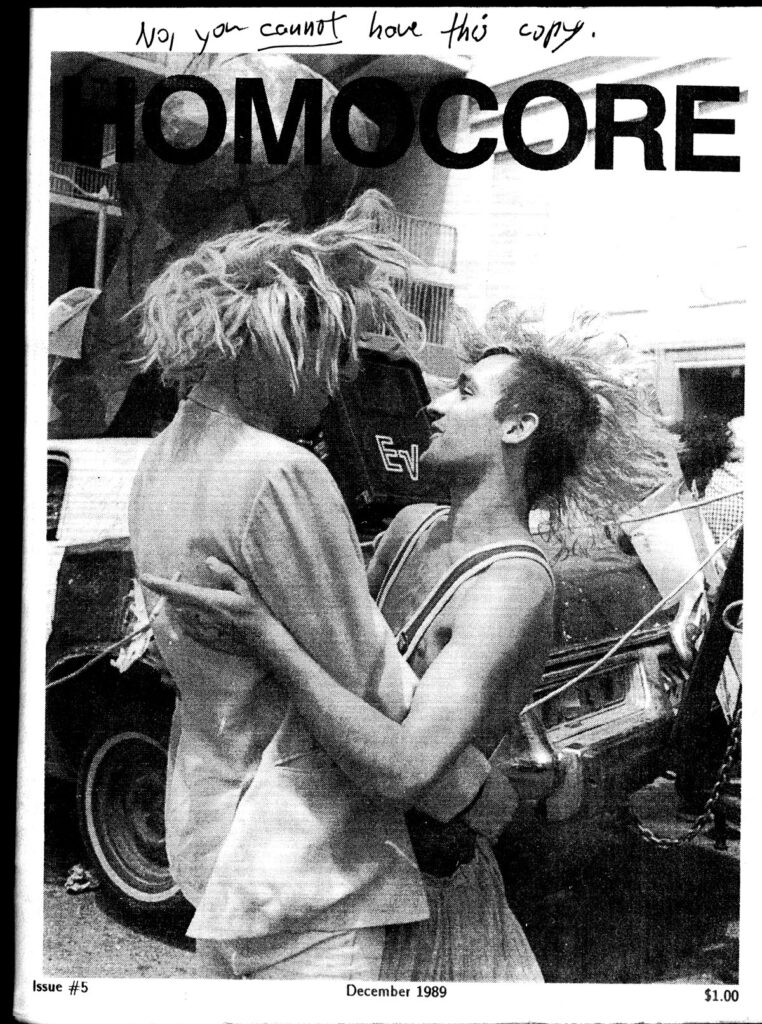
Homocore began less as a publication than as a response to a gap, one that existed before San Francisco entered the picture and before Jennings and his co-editor, Daniel “Deke” Motif Nihilson, assembled the first issue. The term itself emerged in Toronto, coined by G.B. Jones and Bruce LaBruce in their zine J.D.s as a fusion of “homosexual” and “hardcore,” naming a queer punk sensibility without a stable platform.
After meeting Jones and LaBruce at the 1988 Anarchist Survival Gathering, Jennings and Nihilson brought that vocabulary west, launching Homocore in September 1988. Over the two years, it ran through eight issues (including the oversized 5½) before ending in early 1991.

What gave the zine its immediate force was not just its content—personal essays and manifestos; flyers, show listings, and rants; found imagery and appropriated text; and letters from the community—but its timing. At the tail end of the ’80s, queer punk was a lived reality without a shared language or infrastructure.
“At that time, being a punk and being queer were not compatible,” says Jennings. “They were just disjoint sets. So we were looking for the holism of just being a fucking weirdo, yourself.”
That search for a way to exist without partition became the zine’s animating logic. It also made Homocore one of the earliest West Coast vehicles for what would later be recognized as queercore, quickly becoming essential reading for those alienated from both straight punk media and assimilationist gay culture.
The magazine, influenced by J.D.s and MRR, published work by artists and writers across the scene—LaBruce, Jones, Donna Dresch, Daniel Nicoletta, Larry Livermore, Steve Abbott—and moved fluidly between underground music, visual culture, and literary experimentation.
Subjects included the performance group The Popstitutes, artist Jerome Caja, and the 1989 San Francisco Lesbian/Gay Freedom Day Parade, where a radical queer contingent beat a makeshift police car into submission.
That reach extended in unexpected ways: Nihilson conducted an interview with Naked Lunch author William S. Burroughs, an encounter Jennings recalls with typical bluntness as one in which “Daniel got groped by Burroughs in Lincoln, Nebraska,” folding Beat-era provocation into the same messy, irreverent ecosystem.
Jennings, however, resists framing any of this as legacy, returning instead to the conditions of its making. “It was all in the moment, and it was done as cheaply as possible,” he says. “No masters or originals were kept. They were live documents. They were basically living culture on the ground.”
What the anthology preserves, then, is less a publication than a set of relations—letters, arguments, graphics, confessions, and the accumulated pressure of a scene making itself visible in real time. That network becomes clearer in the anthology’s structure, which collapses chronology and allows the issues to speak to one another.
“It takes Homocore 1 through 7 and juxtaposes them,” says Jennings. “So you can see it all at once—the commonalities and differences between issues.”
Though rooted in San Francisco, Homocore circulated far beyond it, operating as a hybrid of anarchist politics, sexual urgency, and a refusal of cultural separation. Jennings’ own trajectory helps explain that synthesis. Born in Boston in 1955, he arrived in San Francisco in 1983 after working in early computing (he famously authored the protocols for the first BBS system), moving between technical and subcultural worlds that rarely intersected.
He remembers his first impression of the city vividly. “I took the Muni, came above ground, and there’s a fucking punk show at Castro and Market,” he recalls. “And the Dead Kennedys are playing in the street. I’m just standing there, going, ‘OK, this is why I came to San Francisco. And, wow, there are a lot of drugs.’”
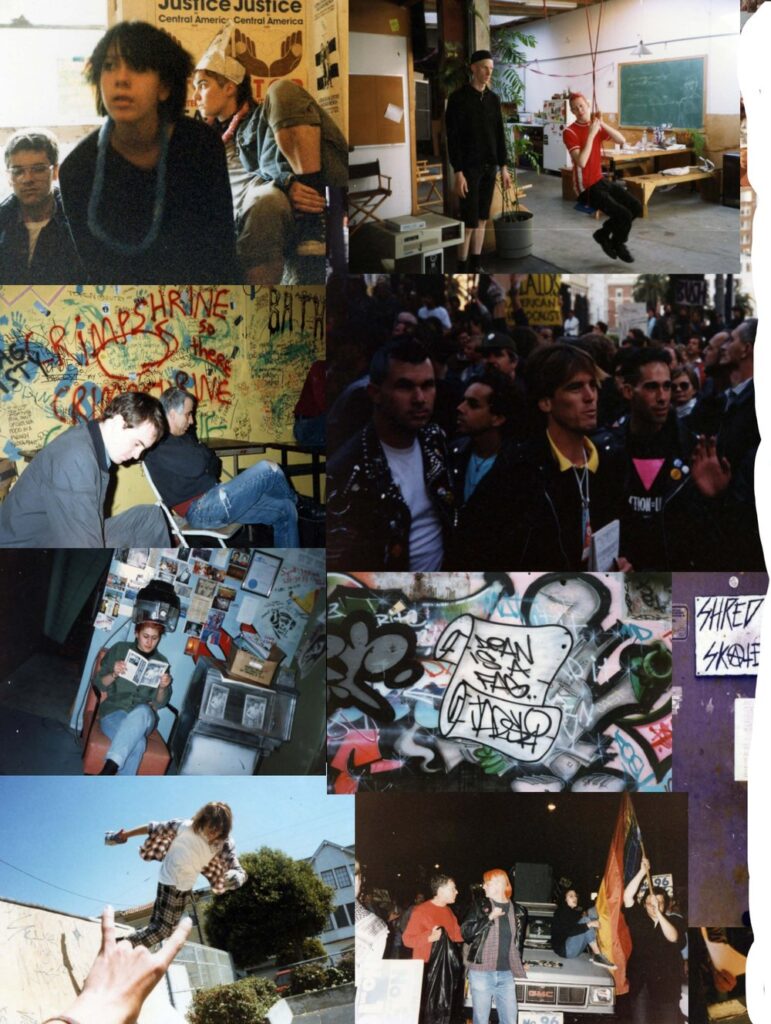
He gravitated toward the loose network of punks, skaters, and anarchists orbiting spaces like the Shipley Street warehouse and the Shred of Dignity Skaters’ Union, where living, making, and organizing collapsed into one environment. The improvised, communal chaos of it all mirrored the zine itself: fast, collaborative, and unconcerned with preservation.
That transgressive version of the city, where Jennings’ women roommates would boil their menstrual sponges in shared pots to unsettle the men, and where up to 100 punks could squat and rehearse nearby, inside the abandoned vats of the old Hamm’s Brewery, made Homocore possible. It was also, inevitably, temporary.
The zine operated on trust and exchange: Letters arrived from isolated readers; cash was mailed in envelopes; issues were sent back out. “This was serious shit,” Jennings says about both the production process and the many painful letters he received from distraught readers that made their way into the issues. “It was just too hard to think about.”
That weight coexisted with a system that now feels almost implausible. “All those people trusted us with a fucking dollar in an envelope,” he says. “And they trusted us to make good on it. And that obligation—we fucking fulfilled it.”
It’s a stark contrast to the metrics-driven logic of contemporary social media platforms. “Instagram and Twitter users are just obsessed with followers, as if a fucking follower count means anything at all,” says Jennings. “Where five people having a conversation in a room literally changes those people’s lives.”
Jennings left SF in 1996 and eventually settled in Los Angeles’s Echo Park neighborhood in 2000, marking not just a move but a shift in orientation. “In San Francisco, I did everything I wanted to do,” he says. “And when I left, I was fucking done. I didn’t hate it. I didn’t burn any bridges. I just had no interest in going back.”
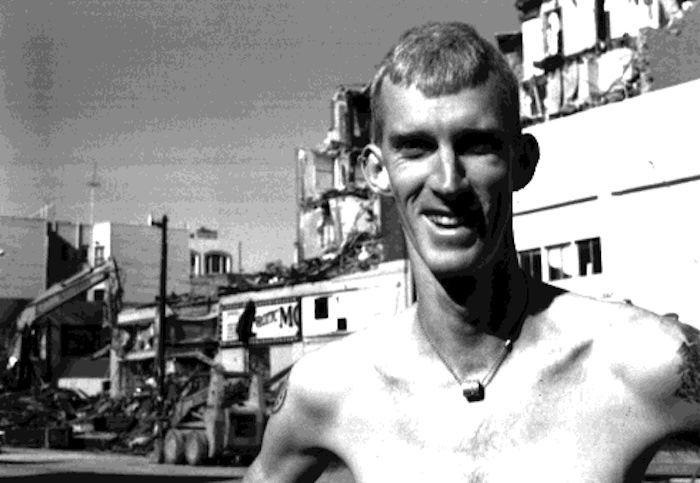
Reflecting on Pretty Gritty’s Homocore-related exhibition in SF, late last year, Jennings makes a similar point: “A lot of people who walked by saw only 100 people there and may have thought that’s not much of a show. But it was world-changing.”
What the anthology preserves is not just a document of queer punk history, but a record of how culture builds itself under constraint—through proximity, improvisation, and commitment. Jennings sees echoes of that pressure now, a similar sense that dominant systems will not accommodate what falls outside them.
In that context, it reads less as a monument than as a resonant reminder to subsequent generations. “Maybe someone will hand out five new zines today,” he says. “Three of the people will throw them away, and two of them will become interested and maybe even collaborate—and that’s the right number.”
And for one night in San Francisco, inside a small independent bookstore on the last Monday in March, that logic will briefly reassert itself—not as nostalgia, but as proof that meaningful culture still begins the same way: with something crude, immediate, and alive enough to be handed from one person to another.
HOMOCORE ZINE ANTHOLOGY BOOK LAUNCH Mon/30. Adobe Books, SF. More info here.