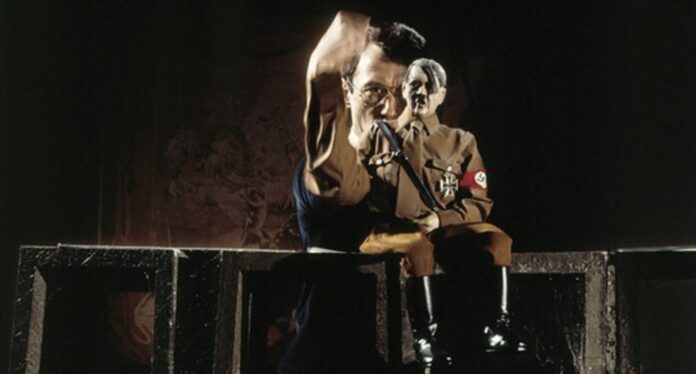
Few movies have been discussed so much and seen so little as Hitler, A Film From Germany, the 1977 magnum opus from German director Hans-Jurgen Syberberg. It played a succession of international festivals, including Cannes, then got very slowly got released in a handful of countries (in the US as Our Hitler)—but to what extent? It’s quite possible this seven-hour behemoth hasn’t been screened in the Bay Area since a reported Palace of Fine Arts showing 48 years ago. Those curious might not want to put off attending the one-off projection at Berkeley’s BAMPFA this Sat/16 (starting at 1:30pm, with a dinner break around 5:30pm), unless you figure you can wait another half-century or so for the next chance.
Still alive if reclusive all these decades later at age 90, the director himself has hardly cooperated in keeping even his most famous work accessible. When some subsequent writings and comments drew accusations of reactionary anti-Semitism, he seemed to gradually cease desiring any standard public exposure for his filmic work at all. There are a number of titles on his IMDB page (most literary-monologue-based collaborations with the actress Edith Clever) that it’s unclear anyone ever saw. Like mad Bavarian King Ludwig II, of fantastical-castle-building fame, Syberberg seems another unicorn-y case of a person creating eccentric, monumental objets d’art out of private obsession, and for essentially private amusement.
Ludwig and German exotic-adventure author Karl May were the principal subjects of two prior epic features whose “Wagnerian trilogy” was completed by Hitler. All three (plus his 1982 Parsifal, a phantasmagorical “staging” of the opera) are audiovisual meditations on Germany as culture, ideal, delusion and monster—examined from the angles of historical analysis, psychology, legacy, indictment. Syberberg’s educational background was in theater, art history and literature. Turning rather counter-intuitively towards documentary cinema as a career path instead, he increasingly expanded that form to accommodate his own version of the Gestamkunstwerk, or total work of art—intellectual inquiry as avant-garde spectacle, essayistic rather than narrative, equally indebted to (among many others) Wagner, Brecht, and trick-photography fantasist Melies.
A Film From Germany is like a vast forbidden museum filled with the dusty, often grotesque remains of what shaped Hitler, what he wrought, and what he meant to a public rapt, then retroactively eager to “remove the stain of shame.” It also asks, what to do we do with him now?
Divided into four parts, the multinational coproduction (West Germany, France, UK) sprawls over epochs and theses without ever leaving a soundstage. Syberberg’s actors monologue (sometimes as long as 40 minutes at a stretch) pastiched texts drawn from speeches, interviews, other artworks et al. while surrounded by mannequins and set elements supplied by Cinematheque Francaise’s Henri Langlois. There are occasional close-ups, but almost never any dialogues; while the editing isn’t static, the feel is less “cinematic” than akin to a procenium, or diorama, with moving figures who seldom stop talking—an exception being Syberberg’s own young daughter Amelie, who moves through the wreckage of her country’s recent past like a silent conscience.
Behind these tableaux vivants, which also encompass puppets, sex dolls, and miniatures, there are often rear-projected images of…well, anything and everything relevant. Old newsreel and propaganda footage, slide-show photos, vintage kitsch of the silver screen and Nazified society, concentration camp and battlefield horrors. It’s all there, for us to sort out: Hitler as both “a people’s leader without equal” and “devil incarnate.” He’s “Mephistopheles playing to a full house, which is burning,” that self-immolation somehow innate within the bizarre mission to combat an alleged “empire of the Jews.”
Syberberg transforms him into figures of myth, including the celluloid legends of Dr. Caligari, Peter Lorre’s child murderer in M, and Chaplin’s buffoonish Great Dictator. Less chameleonic are the testimonies of real-world confederates, not excluding Hitler’s valet and Himmler’s masseur. Even the Fuhrer’s German Shepherd Blondi (who also died in that bunker) is afforded some POV—perhaps more so than Eva Braun, or any other adult woman for that matter.
We’re meant to be exhausted by the simultaneously busy and glacial onslaught. “Why are you fidgeting in your seats? Are you bored perhaps?” asks one of many fourth-wall-breaking solo performers, the most prominent among them Andre Heller and Fassbinder regular Harry Baer. Unlike many projects of similar length and conceptual abstraction (or even Syberberg’s Parsifal), this Hitler doesn’t induce a trance-like effect. The constant barrage of verbal intel demands full attention, only partly cushioned by the inventive visual presentation and the various musical excerpts utilized. It’s rather less like sitting through “a movie” than a long day of lectures at an academic conference—albeit one staged as multimedia performance art.

Can A Film From Germany be loved? Susan Sontag certainly thought so, to the point where by the end of her published paean to “one of the great works of art of the 20th century,” you might begin to wonder if she’d lost enthusiasm for every other work in that span. Coming at the tail end of BAMPFA’s “New German Cinema” series, this rare exhibition does connect Syberberg stylistically to some contemporaries, notably Fassbinder and Ulrike Ottinger at their most extravagantly theatrical. But there is really nothing else quite like it, at least not on the same scale. “Art is an exalted mission that demands fanaticism,” someone says at one point. While exaltation in ambitious excess may not be every viewer’s experience, this elusive director certainly defines the role of artist as fanatic. More info on the Berkeley screening is here.
Two new movies opening this weekend are also ambitious in their own, very different ways. Silent Friend, which opens Fri/15 at SF’s Roxie Theater and Marin’s Smith Rafael Film Center, is a very literary conceit in which the titular entity is a 300-year old ginkgo tree sitting on the grounds of the 500-year-old university in Marlburg, Germany. It is a mute witness to three successive human dramas: In 1908, aspiring botanist Grete (Luna Wedler) becomes the school’s first-ever female student, though her presence is greeted with little save sexist humiliations and scorn by both peers and staff. In 1972, farm-raised Hannes (Enzo Brumm) finds himself out of step with hippie-ish classmates. His outsider status is not at all clarified by the on/off attentions of free-spirited Gundula (Marlene Burow), who’s conducting a whimsical-sounding study of whether plants “think” and “feel.” In our own time, Hong Kong-based neurologist Dr. Wong (Tony Leung Chiu-wai) comes here to complete a research project, only to become trapped by the COVID epidemic—which leaves him quarantined on campus with a surly native groundskeeper (Sylvester Groth).
Hungarian writer-director Ildiko Enyedi made a splash nearly forty years ago with the B&W period fantasy My 20th Century, though her rather sparse output since then hasn’t been as widely seen—not even the Oscar-nominated 2017 On Body and Soul. This handsome, contemplative piece is engaging in its individual narrative panels, which she cuts between with increasing rapidity as its 147 minutes proceed. But as a whole, it doesn’t really add up to anything in particular, including the philosophical/biological framework of the tree’s “perspective.” Silent Friend is an admirable, accessible experiment of sorts, with good casting (Leung is particularly fine). Still, the profundity it seems to be reaching for ultimately escaped me.
Not at peace with nature or anything else are the protagonists in The Wizard of the Kremlin. Based on Italian-Swiss writer Giuliano da Empoli’s reportedly excellent 2022 debut novel, it’s a fictionalized account of Vladimir Putin’s rise as seen through the eyes of right-hand man Vadim Baranov—a made-up figure inspired by real-life Vladislav Surkov, who indeed was considered the Russian leader’s closest confidante and power-architect before his abrupt ouster in 2020.
Somehow realized as a French production in English directed by the Gallic veteran Olivier Assayas, Wizard is a fascinating idea that seems to have fallen into otherwise-capable yet entirely wrong hands. Why do almost none of the actors attempt Russian accents, instead going for a gamut of affectedly very British ones? Primarily shot in Latvia, the film never seems convincingly “Russian,” less due to locations than tone and performance.
Putin, referred to throughout as “the Tsar,” is arguably the evil mastermind of our era, the one that makes all other extant despots (including our own) look like bumbling amateurs. Jude Law takes a decent stab at the part, but the script by Assayas and Emmanuel Carrere doesn’t give him material that would generate any sense of real threat. Worse, a wholly miscast Paul Dano as “Vadim” seems no driven schemer (let alone a “new Rasputin”) like his real-life model, but a passive observer whose presence in the halls of power seems incongruous. Alicia Vikander has a thankless role as a sort of post-Soviet Darling, climbing the new ladder of capitalist corruption but finding life empty in that penthouse suite.
With its stilted dialogue, earnest but unconvincing feel (apparently the novel has more satirical punch), and strange detachment from everything that ought to provide underlying suspense—war in Ukraine, politically convenient “suicides,” etc. simply get mentioned in passing—this is a slick, expensive enterprise that rings hollow. It’s not quite dull. Yet it manages to rob urgency and weight from some of the most consequential chapters in recent global history, which is surely not what Assayas intended. Wizard seems to be one of those multinational productions that at some point lost hold of its original vision, arriving as a polished but inert package without any pressing reason to be. It opens Fri/15 at Bay Area theaters that were TBA at presstime.
In contrast to these physically expansive canvases, there is the almost microscopic view of Aleksandr Sokurov’s 1997 Mother and Son—which constituted a modest breakthrough to foreign audiences for a Russian filmmaker who’s experienced problems with the authorities both before and after the collapse of the Soviet Union. His subsequent one-take pageant Russian Ark was more widely seen, and 2011’s fascinatingly perverse Faust won the Golden Lion at Venice. (Now 74, he’s had health issues… but one suspects open political opposition to Putin is the real main reason his output has almost completely stalled out ever since.) I am also very fond of some of his other movies, including cryptic sci-fi Days of Eclipse (1988), 1990’s The Second Circle, and his own queasy-dream Hitler study, Moloch (1999).
But Mother and Son, which is getting its first local revival in some time at the Balboa on Tues/19 (more info here), is probably his masterpiece. It’s simultaneously the simplest and most all-encompassing Sokurov film—an exercise in transcendentalist cinema arguably even more purer (and certainly more rhapsodic) than anything made by his late mentor Tarkovsky.
Almost bereft of dialogue or plot, it has a young man (Alexei Ananishnov) returning home to care for his mother (Gudrun Geyer) in her dying days. Nothing much “happens.” Nevertheless, the primal parent-child bond, and its place in all of nature, suffuse imagery at once gorgeous, dislocating and familiar, their stirring potency like information not understood, yet fully absorbed by an infant. Mother and Son is the sort of joint that will strike some impatient souls as watching paint dry. But for those who can get on its achingly poetical wavelength, it is one of the all-time great screen expressions of non-sectarian mysticism.