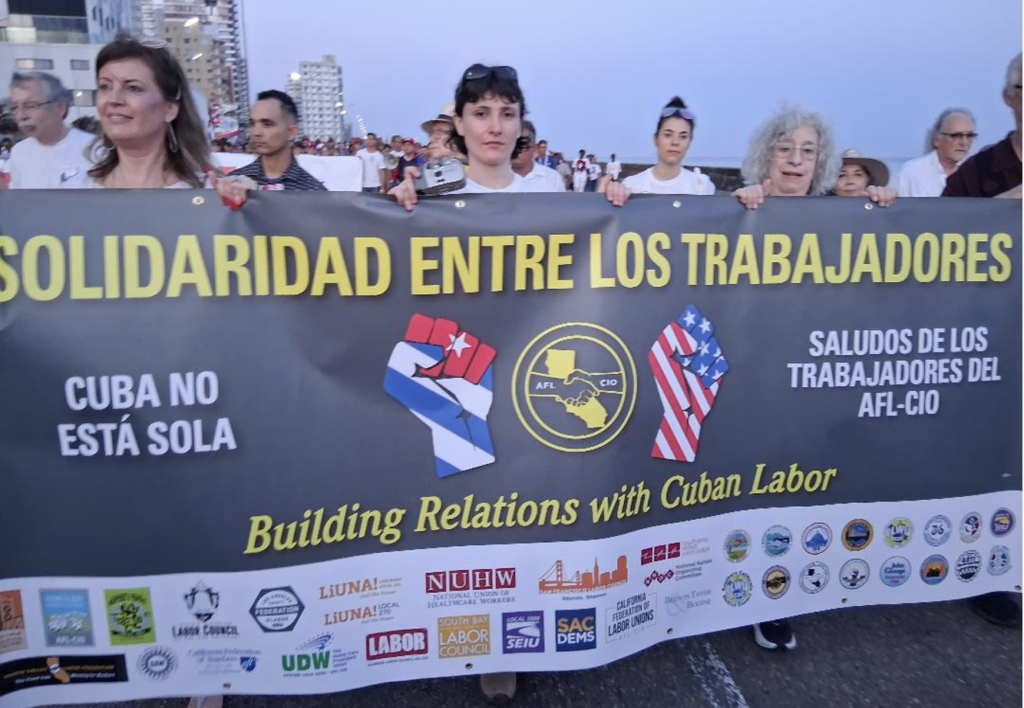
I joined the Building Relations with Cuban Labor delegation traveling to Cuba between April 25 and May 3. This organization, based in northern California and endorsed by 35 unions, including the California Federation of Labor, has been organizing delegations to Cuba for more than 10 years. During our visit we met with Cuban workers at various entities, including a cigar factory and Hotel Nationale, as well as participated in a seminar with leaders of the Confederation of Cuban Labor.
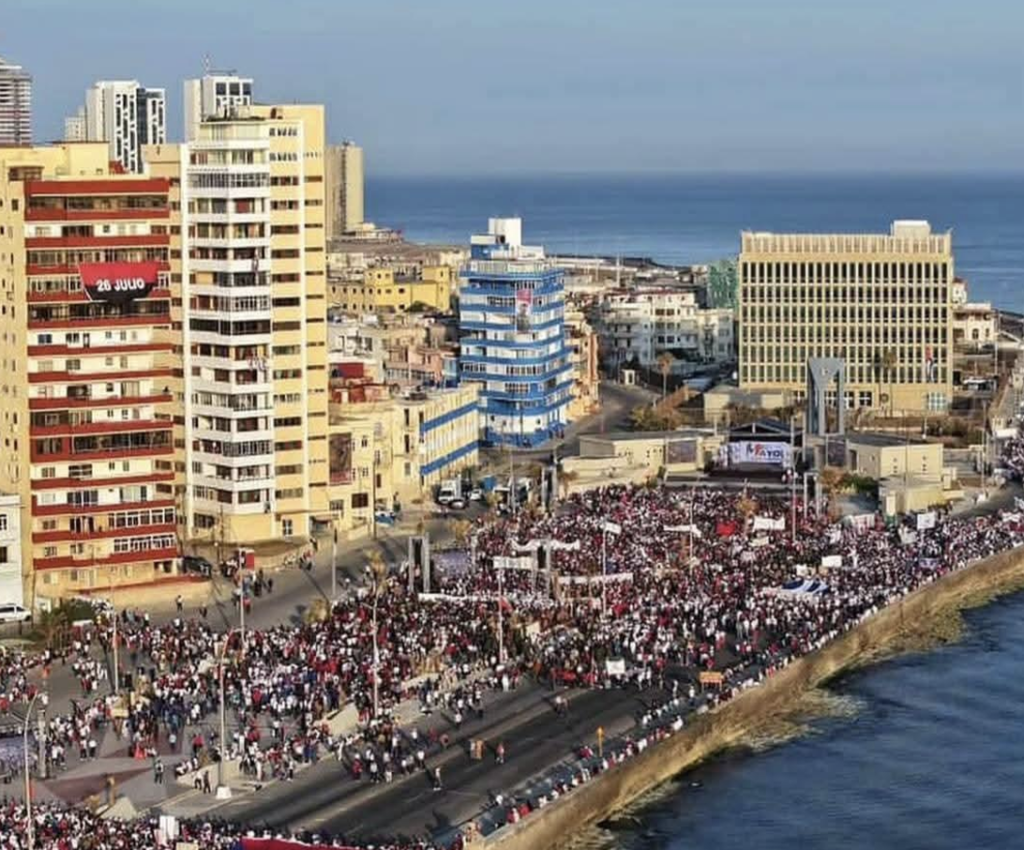
One of the highlights was our participation in the May Day march and rally. In Havana, we joined approximately 500,000 Cubans from different sectors, marching from the Revolution Plaza down to the Malecon (road that runs along much of Havana’s coast). Then the marchers proceeded past the US Embassy building and gathered in Imperialist Plaza, facing the embassy building. The rally program included singers and dancers in addition to talks by various union leaders. We learned later that approximately 5 million Cubans had participated in May Day events across the island nation.
In our visits to various institutions (the Museum of the Literacy Campaign, the Latin American School of Medicine, and the Center for Genetic Engineering and Biotechnology) we learned about the history of US aggression against Cuba, starting in 1899, when US troops invaded and occupied the island just as Cubans were about to win their independence from Spain.
Speakers also informed us about the 1960 State Department memo by Lestor Mallory, which proposed “denying money and supplies to Cuba … [in order] to bring about hunger, desperation and overthrow of government.” In line with this goal, the US has implemented an embargo—or what the Cubans correctly term a blockade—for more than 60 years. These evolving sanctions—or unilateral coercive measure— were initially authorized by presidential executive orders, but in 1992 and 1996 Congress legislative these hostile economic measures through the Torricelli and Helms-Burton acts.
During Donald Trump’s first term, his executive orders added 243 sanctions, including restricting travel, limiting family remittances by Cuban Americans, and placing Cuba on the ridiculous list of State Sponsors of Terrorism. President Joe Biden, despite campaign promises, basically retained the Trump measures, and kept Cuba on the SSOT list until the last days of his administration.
When Trump took office again in January 2025, he immediately re-placed Cuba on the SSOT list and ramped up the economic war again, including instituting an oil blockade. On January 3, 2026, after the US bombed Venezuela and kidnapped its president, Nicolás Maduro, and First Combatant Cilia Flores, the administration halted shipments of Venezuelan oil to Cuba. On January 29, Trump threatened to impose financial penalties on any country that sold oil to Cuba.
On May 1, Trump signed an executive order targeting energy, finance, and mining sectors in Cuba and promising punitive measures against foreign banks that engage with Cuba. Although it’s uncertain how this will be applied, the Office of Foreign Assets Control of the US Treasury Department explained that the executive order “authorize(s) sanctions on non-Cuban foreign persons for providing support to Cuba.”
More recently, on 7 June, Trump placed the Institute for the Friendship with the People and its travel organization, Amistur, on a bogus list of agencies that are “threats to the security of the United States” and prohibited Americans from connecting with them. This action targets the Cuban organizations that most US solidarity groups work with in organizing their trips to Cuba.

The overwhelming majority of countries in the United Nations General Assembly have condemned the “embargo” 33 times. In 2025, Cuba’s Minister of Foreign Affairs, reported to the U.N that “the 60+ year US embargo against Cuba has caused an estimated cumulative economic damage exceeding $170 billion.” Even before the start of the oil blockade that has caused electricity blackouts and transport limitations, hampering Cubans access to healthcare and food and causing untimely deaths, the Center for Economic & Policy Research reported that between 2018 and 2025 Cuba’s annual infant mortality rate has increased from 4.0 per to 9.9 per 1,000 live births, due mainly to the US embargo.
During my time in Cuba blackouts were a routine part of the day, and I witnessed some of the other impacts of U.S. policy—almost empty pharmacy shelves (because of the difficulty of importing some medications and the challenge of Cuba purchasing the ingredients needed to produce medicines) and trash overflowing (because of fuel shortages limited the frequency of trash collection.)
Despite all these serious challenges, Cuban colleagues and friends remain resilient. Cuba Solidarity activists are increasing their activities to support the Cuban people (bringing medical and other material aid, organizing protests and educational events, and engaging in lobbying).
Cuba solidarity activists in the US and internationally have especially stepped up because of the explicit threats of military action by Trump, Secretary of State Rubio, and Secretary of War Hegseth and the administration, levying criminal charges against the island’s former leader, Raúl Castro.
One example of this is the “No War on Cuba” campaign, involving hundreds of organizations in the U.S. and around the globe, conducting marches and rallies on June 3 and planning a week of actions June 28 to July 4.
In what Cubans term a “state of siege” by the US, Cuba’s leadership has adopted 176 measures aimed at “overcoming immediate hardships, stimulating production, attracting [foreign] investment, and strengthening social production.” In mid-June, President Miguel Diaz-Canel presented this package of measures, including expanding the role of the private sector, to an “extraordinary plenum” of the Cuban Communist Party and, subsequently, to the members of the National Assembly of People’s Power, with both bodies voting unanimously to approve the measures.
While liberal and conservative media in the US have labeled it “a package of free-market reforms” and “a sign of an impending transition to capitalism,” I tend to agree with Isaac Saney, a professor at Dalhousie University in Halifax, Canada. He argues that “far from representing a retreat, these measures constitute a strategic effort to preserve and deepen the social gains of the Revolution … [T]he socialist state enterprise will remain the principal pillar of the economy … The state’s responsibility for healthcare, education, social security and social welfare remains unchanged.”