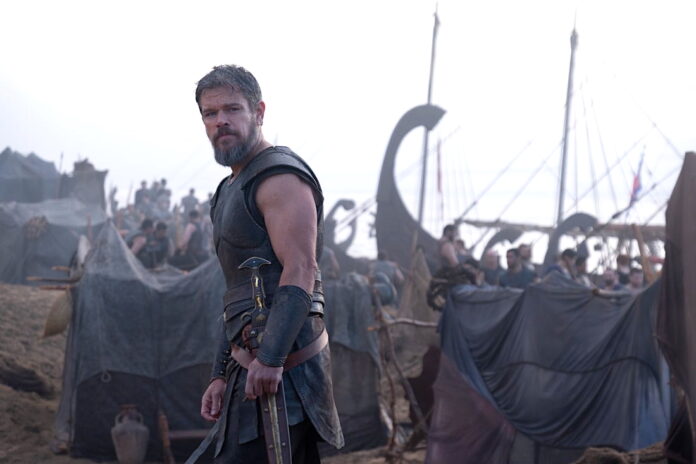
Our current culture wars are largely fueled by manufactured “controversies” only expected to last a news cycle or three—long enough to distract from important issues (like the skyrocketing cost of living) for a bit, then make room for a fresh trivial outrage. Now that The Odyssey is actually here, you have to wonder how fast the last few weeks’ related hot topics will vanish into the cultural mist. I’d say that happens by the end of this opening weekend. Because it’s a solid movie by a fanboy favorite, Christopher Nolan, mostly starring white male actors engaged in macho heroics, albeit of an elevated, based-on-ancient-literature stripe.
Yes, a Black woman (Lupita Nyong’o) plays Helen of Troy, and a trans man (Elliot Page) plays a Greek soldier. Though the latter is a lesser-known figure (Sinon, lifted from Virgil’s Aeneid rather than Homer’s Odyssey), not the famous Achilles, as much pre-release carping mistakenly claimed. But in any case these are not central roles, worked into an overall narrative tapestry without special emphasis. Only an exceptionally reactionary fusspot would be able to stay focused on those casting decisions while resisting everything else that holds attention over nearly three hours’ course. Once they’ve actually seen it—and you know they will—the whiners previously whipped into a frenzy by the usual pundits and YouTubers will find their vehement objections greatly diminished.
I’ll admit Nolan is a filmmaker whose work I’ve generally appreciated without great enthusiasm. The comic-book movies, sci-fi Rubik’s Cubes, and historical dramas (Dunkirk, Oppenheimer) were all highly accomplished… but his sensibility doesn’t connect with me, emotionally or otherwise. The Odyssey is another movie I probably won’t feel any great need to see again. However, it is impressive, particularly by the standards of current popcorn spectaculars, and in the context of a pretty uninspiring Hollywood year to date: An intelligent epic, fulfilling modern audiences’ expectations for action/FX-driven content without succumbing to cartoonishness, carrying some of the somber tonal weight of classic Greek tragedies while remaining reasonably light on its feet. Those 173 minutes never feel rushed, yet they’re over before you know it.
Matt Damon is Odysseus, King of Ithaca who at the start has been gone many years since leaving to fight in the Trojan War—which is long over. His queen Penelope (Anne Hathaway) still hopes he’ll return. But others assume he’s dead, which places her and son Telemachus (Tom Holland) in an awkward position, having to fend off unruly suitors who’d gain the throne by winning her hand and hastening his demise. Meanwhile, Odysseus is indeed alive, but amnesiac—his life saved by island nymph Calypso (Charlize Theron), who’s reluctant to let him go.
Nonetheless, she does eventually let him recover memory, so we see scenes from his ill-fated odyssey: Successfully invading and conquering Troy via the “Trojan Horse” (whose unpleasant interior is graphically depicted), then finding the voyage home thwarted via a series of traps laid by angry gods. His troops’ numbers are steadily dwindled by encounters with a giant cyclops (Bill Irwin), a sorceress (Samantha Morton), the Sirens’ deadly song, and more.
These wonders have often been depicted in a kitschy fashion onscreen, with heroic musclemen, glamour babes, claymation monsters, and such. Nolan goes for something grittier, underlining the chaotic, ambiguous, and ugly in perils glimpsed amidst panicked fleeing. Battle isn’t dwelt on until late, when a flashback to the sacking of Troy, then Odysseus’ revenge on the would-be usurpers of his crown, are portrayed at violent, expansive length.
There are things to quibble with here, and they’re not Page, Nyong’o, or a lack of Greek actors that never seemed to bother moviegoers in this tales’ many prior incarnations. (Seriously, just how “accurate” does casting—or costume detail—need to be for a 3000-year-old myth?) Damon and Hathaway take their parts very seriously to generally effective ends. Still, we never forget they’re modern American actors—something that sticks out worse in Jon Bernthal’s Menelaus (he seems like a guy who’d heckle chicks from the corner pizza parlor), and isn’t helped by the director’s sometimes flatly modernized dialogue. (I really didn’t want to keep hearing Telemachus call his missing father “my Dad.”)
Zendaya doesn’t register in a largely mute, thankless role as goddess Athena. Robert Pattinson gives good Basil Rathbone as the most conniving of Penelope’s suitors, though it’s a one-note character. Others variably well-used include John Leguizamo, Benny Safdie, Mia Goth, Himeh Patel, Corey Hawkins, Logan Marshall-Green, Andrew Howard, and James Remar. But the only time I really got excited over an actor’s contribution was during Morton’s sequence—she has the chops to create something larger-than-life from equal measures of magic, malevolence, and pathos.
I could also wish for something more inventive than Lugwig Goransson’s original score, which never seems to do much more than ramp up or dial down the percussive pounding. But otherwise Nolan’s Odyssey is stylistically cohesive in good ways, grounding the fantastical in a human era that looks pretty rough even on the royal plane. The episodic narrative flows nimbly, despite a certain grandeur of overall arc is missing. It’s a strong enough movie to make all the inflated pre-game debates look yea sillier than they did last week. Once you’ve seen it, a logical response to the haters becomes even more obvious: Get a life. The Odyssey opens in theaters nationwide this Fri/17.
Also ruffling some feathers due to its divergence from a long-running story’s norms is Evil Dead Burn, the sixth feature in a horror franchise that’s also included a TV series, a stage musical, and video games. The first three were all directed by Sam Raimi, starring a deliciously berserk Bruce Campbell; 1992’s Army of Darkness was a letdown, though perhaps only in contrast to its fairly genius two predecessors, The Evil Dead and Evil Dead II. When the series got rebooted with plain Evil Dead in 2013, it had shed those talents (save as producers), plus most of the original frenetic, sometimes downright-slapstick dark humor—compensating by ramping up the sadistic grimness and gore. As did Evil Dead Rise a decade later, and that goes double for Burn.
All these recent films have used talented new directors, this time the lucky pick being Frenchman Sebastien Vanicek. His 2023 first feature Infested was a spider chiller that had scares, wit, style, and heart. There’s some bravura stylishness in Burn, even if it often feels gratuitous—a late tracking shot through umpteen stunts, perils, and FX is as show-offy as it is undeniably impressive. But everything else is missing. The bulk-quantity violence and ickiness displayed here become monotonous, because both plot and narrative seem negligible. As with many movies championed by fans of “extreme” content (which has become a genre in itself amongst some younger French filmmakers), this avalanche of grisliness is eventually just an uninvolving slog, misanthropic and even kinda dull.
After an opening setpiece in which two fishermen on a lake meet ghastly ends for no obvious reason, we meet quarrelsome couple Will (George Pullar) and Alice (Souheila Yacoub), who work together at a restaurant-club he owns. They’re celebrating the birthday of his younger brother Joseph (Hunter Doohan) with the latter’s girlfriend Thya (Luciane Buchanan). But that happy occasion gets lost in yet another marital fight when Will begins bullying his French wife once more. He drunkenly peels off in his car, promptly colliding with a lethal specter from the lake, then dying in his wrecked vehicle.
At the subsequent funeral, the siblings’ parents (Tandi Wright, Erroll Shand) blame their daughter-in-law for death, while grandma (Maude Davey) is just a senile hag, malicious towards everyone. Nonetheless, all reassemble at the latter’s dilapidated country house, the better to be entrapped by “Deadite” spirits who’ve already taken possession of Will’s corpse and his not-yet-dead dad. (A late grandfather, it seems, sparked vengeful ire by poking into their occult dimension.)
Written by Vanicek and Florent Bernard, Burn is duly relentless, but in an over-the-top way that’s more tiresome than exciting or atmospheric, let alone credible. How many times can people get thrown across a room into a wall, then get up again? An infinite number, it seems. The series’ murky mythology is paid scant mind. Rote blather about “love” and “family” (as well as spousal abuse) rings hollow because we never sense these filmmakers care a wit about their one-dimensional characters—a real disappointment after Infested, whose multicultural Paris tenement teemed with affectionate life.
Vanicek’s technique is energetic, yet bludgeoning rather than engaging; the effect is bombastic and soulless. I’ll look forward to seeing what he does next, if only in the hopes that this hamfisted bloodbath was a wrong turn made on the assumption he was giving audiences (and/or Hollywood) what they want. Evil Dead Burn is currently playing theaters nationwide.
Elsewhere in coming days, there are a host of local revivals, from the comedic to the romantic to the queer. In the first category, there are two tributes to beloved performers: On Sun/19 the Castro Theater will tip hat to late SF resident Robin Williams with both his locally-shot drag hit Mrs. Doubtfire and Spielberg’s Peter Pan spin Hook; on Thu/23 there’s a screening of La Cage aux Folles remake The Birdcage, with a live drag pre-show. Info on all three programs is here.
Tue/21 through Sun/26 the Vogue offers its own salute to Jacques Tati, the brilliant French comedian, showing three of his six features as writer/director/actor. His signature character, the bumbling and oblivious Mr. Hulot, reached an apex with 1958’s Mon Oncle, a hilarious nightmare of push-button suburban modernity. But Tati’s own artistic zenith was the subsequent Playtime, in which Hulot was but one figure in a vast ensemble. Its extraordinary, Rube Goldbergian sprawl of Buster Keaton-style visual comedy was a costly commercial flop in 1967, but is now considered one of the entire medium’s great, magical achievements. Tati’s last film (though he didn’t pass away until 1982) was 1973’s Parade, made for Swedish television—a charming if more modestly-scaled ode to the circus and his own music-hall roots. Schedule, showtimes, and ticket info are here.
Love is in the air at the Roxie with the re-release of All About Lily Chou Chou director-Shunji Iwai’s 1995 debut feature Love Letter, a wintry whimsy in which Hiroko (Miho Nakayama), a young woman who lost her fiancee in a mountain-climbing accident two years earlier, decides to write him a letter at his last-known address. To her great surprise, that sentimental gesture gets a real world answer, from a woman with the dead man’s name—and an eerie resemblance to Hiroko. As with many a latterday Japanese romcom and/or tearjerker, this magical-realism-tinged tale is a little twee and treacly for my taste, despite its visual elegance. But it is a great favorite for many, even becoming a major hit at the time in South Korea, where for obvious historical reasons all things Japanese are generally not beloved. It opens Fri/17.
Two wildly different milestones from the U.S. independent LGBTQ+ cinema sphere are getting area showings. This Sun/19 the Roxie Theater will host a 25th anniversary showing of newly restored By Hook Or By Crook, then-SF-based writer-director-stars Harry Dodge and Silas Howard’s road-trip buddy flick. Its shaggy, seriocomic take on both genre tropes and gender norms made it an immediate, unprecedented “trans-butch queer classic.” The afternoon screening (info here) will be followed by an in-person Q&A with Dodge and producer Steak House, moderated by Jenni Olson.
On Thurs/23, Certain Women’s “Women Directors” series at the Orinda Theatre will bring Lizzie Borden’s 1983 Born in Flames. That arresting, overtly polemical debut feature is a dystopian allegory in quasi-documentary form, portraying a future in which radical women’s groups attempt overthrow an oppressive patriarchal order. It premiered a full two years before Margaret Atwood first published The Handmaid’s Tale. Also being shown is Abigail Child’s Mutiny from the same year, an entry in her experimental-shorts series Is This What You Were Looking For?—this one a joyously frenetic montage of footage showing women in almost every conceivable role and activity. Info here.