This is Drama Masks, a Bay Area performing arts column from a born San Franciscan and longtime theatre artist in an N95 mask. I talk venue safety and dramatic substance, or the lack thereof.
Sometimes I’m really glad to be wrong. At the start of the year, I made a grim prediction that “At least one local theatre company [would] go all-in on AI.” Having officially passed the year’s midpoint, it relieves me to say that no Bay Area theatre company has jumped off that cliff as of yet. I’m guessing that’s due to the same technophobia behind theatres’ refusal to adopt streaming. Mind you, streaming is a wonderful technology that expands an audience from the black box to the entire globe. But what would “a true theatre artiste” be if they didn’t shirk from new tech like cavemen from fire?
Although no local theatre seems to have gone “all-in” as of this writing, the cancer that is AI has still managed to creep into the community. One BIPoC-focused Bay Area venue uses slop posters and flyers to promote their work. If you’ve read my writing over the past five-or-so years, then it’s no secret that I’m not a fan of that sort of environmentally-disastrous plagiarism. My lack of enthusiasm resulted in a staffer from the aforementioned venue defending the choice, sarcastically suggesting I pay them for a graphic designer or to come down and do it myself for free.
Having been on both sides of the promotional wall before, I pointed out that any number of MS Paint and/or Photoshop-style apps still have countless non-AI templates that have only gotten more refined over the decades—and some come pre-installed for free on any PC. Added to that, the Bay Area is home to any number of arts institutions full of students that will happily do the work for internship “experience.” (Mind you, my pro-worker heart breaks at the thought of unpaid internships, but if it’s a choice between that and an environment-killing plagiarism box, I’ll gladly take the flawed human.) I also suggested ways to adjust the event to account for budget, but the debate, such as it was, quickly grew to an impasse.
In fairness, we shared a disgust at unpaid labor. Where I would not move, however, was on the use of AI as a replacement. I found it particularly egregious in promotion of an event for Black art and history, a history littered with work being stolen by unapologetic white gate-keepers. AI has whittled that process down to a science: Why give an opportunity (paid or not) to the next Ernie Barnes when you can type in a single prompt that instantly produces a garish facsimile for free?
If you ever wonder why an increasingly larger swath of the public says “there is no ethical use for AI,” it’s because there isn’t. It’s tempting to think of oneself as “not political,” but that’s an excuse attempting to erase one’s culpability in what’s wrong with the world. Every dollar you spend at Starbucks supports a union-smashing anti-DEI conglomerate that crushes small businesses; every choice to ride a robo-taxi absolves both automakers and tech companies of responsibility for running over kids; every Google search or Amazon purchase supports ICE murders.
And again, this is worse in the art world because promoting the work and history of BIPoC artists can’t be done conscientiously with a device that’s proven to steal from the very artists you’re trying to promote. You don’t wanna be an activist in the streets, that’s one thing, but don’t actively feed into the system destroying us.
As both theatre artist and culture writer, it’s my job to stay attuned of good and bad changes. I’m well aware of how difficult performing arts production and promotion have always been, as well as how much more difficult they’ve gotten over the past year and a half. I also get that the reason unpaid “opportunities” exist is to avoid paying people what they’re worth. By taking the person out altogether, that labor will never get the equity it deserves. AI (often) costs nothing, complains about nothing, and works extra hours for nothing. By using it, that’s what we’re saying art and hard work are: nothing.
Thankfully, this was an isolated incident from one local theatre. So far.
Scabmuggers at The Freight
How appropriate that my long-winded anecdote about workers’ rights segues directly into a new play about organized labor. Specifically, a play about labor leaders and the bureaucratic idiosyncrasies that can often get in the way of any actual change being made. (Anyone who’s sat in SF City Hall knows this all too well.) So, when a group of labor leaders get together just to butt heads with one another, what becomes of the tired workers they represent? Will their equity once again be pushed back until it vanishes completely?
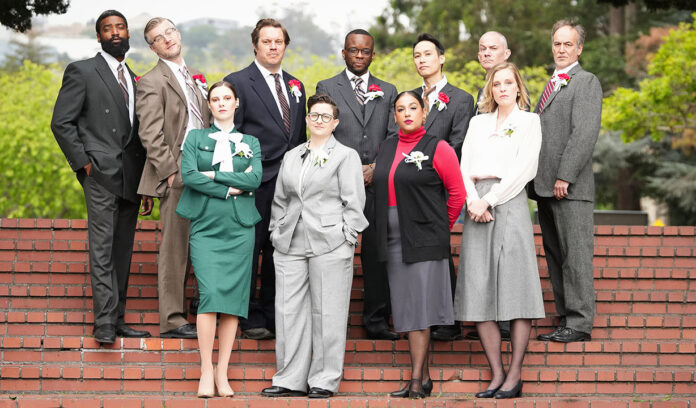
Set 30 years in the past, Yvonne Martinez’s Scabmuggers (final show July 21 at The Freight, Berkeley) takes us back to the time when collective bargaining still carried weight—before Clinton set out to finish what Reagan started. We find ourselves at the hallowed halls of Harvard University, where union leaders from as far as Japan and Australia have come to join their Yankee equivalents to learn how to, well, be better union leaders. It’s a diverse group, which leads to a great many biases rearing their ugly heads, and several misogynist lines being crossed. How are these people meant to argue in favor of their unions when they constantly argue with one another?
Scabmuggers seems like a product from the era it portrays. It’s apparent how much research Martinez put into the story (based on her novel, inspired by people in her own life), and how eager she is to share that knowledge with the audience. Several monologues are direct-to-audience addresses illuminating historical events like The Ludlow Massacre and the long history of PoC workers being shortchanged by white workers who, quite frankly, should have been their allies. Martinez herself has spoken about the importance the story has taken on in light of the new revelations made about Cesar Chavez.
Unfortunately, that doesn’t make for a gripping play. Martinez writes her characters in broad strokes, some of them outright cartoonish. The narrative has the structure of a made-for-TV movie, with clear villains railing against PC culture and clear heroes speaking in overly-expository missives. It isn’t that they’re saying something to be dismissed, it’s that it doesn’t sound like normal human speech.
Not having been to The Freight in years (back when it was Freight & Salvage), I was pleased to see that it boasted an impressive HVAC for a venue of its size. CO² levels on my Aranet4 hovered around 600ppm during both acts, peaking around 644ppm by the final bow.
Scabmuggers is akin to having the perfect idea for a song and humming the right melody, but not finding the right lyricist to really bring it to life. Like its characters, its heart is in the right place, however.
SCABMUGGERS final show July 21 at The Freight, Berkeley. Tickets and further info here.