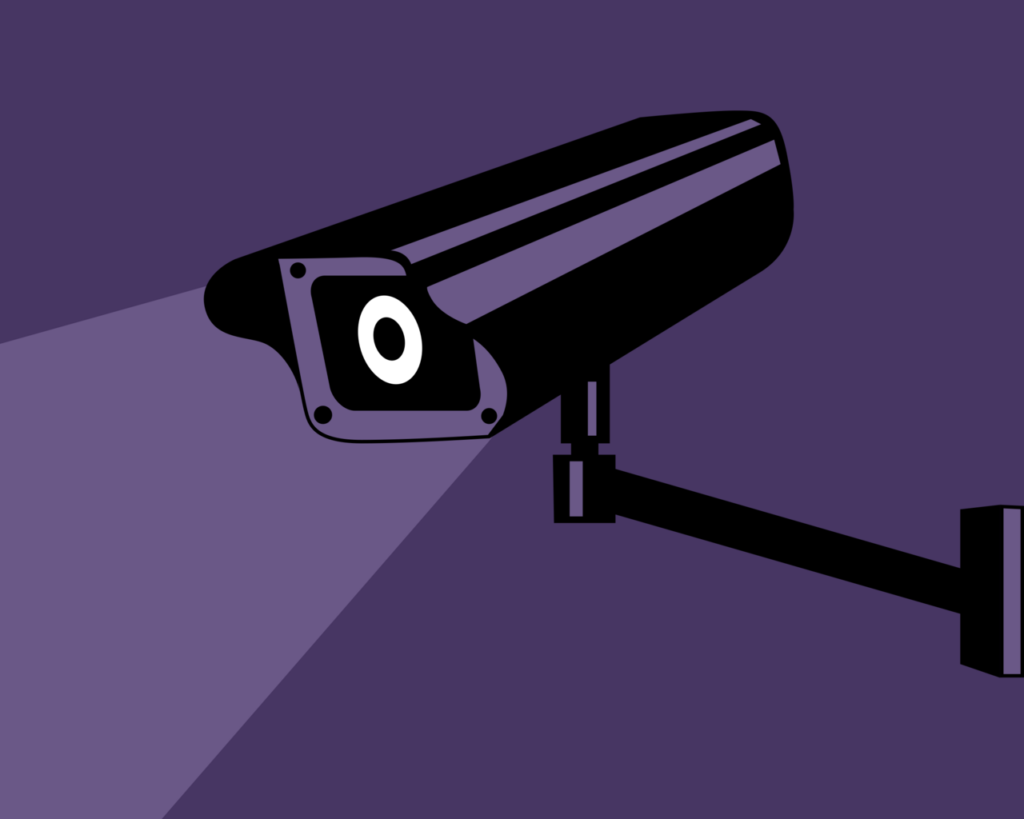
When San Francisco ostensibly became the country’s first city to ban the use of facial recognition in 2019, it was rightfully championed as a legislative win against predaceous surveillance technology. But, eight years later that ban has been undercut into ineffectuality.
Prop E, which passed in March, 2024, stripped away the limited guardrails regarding surveillance and expanded police powers. Now, it’s not just the police expanding its technological repertoire but private businesses as well. In mid-June, Cydney Hayes reported that three gay bars in the Castro were equipped with Patronscan Guard+, a biometric and personal data collection device.
While the 2019 ordinance doesn’t apply to private businesses, it’s clear that the once solidified support for regulated surveillance has dissipated. San Francisco has become a proving ground for new surveillance technologies like AI-equipped license-plate reader cameras and drones as first responders, all coordinated through a state-of-the-art $10 million Real Time Information Center. The RTIC was supported by a donation from crypto-billionaire Chris Larsen, who was also a financial supporter of Prop E.
“The power dynamic some of these companies can leverage now is significant,” Brian Hofer, executive director of Secure Justice, said in a statement to 48Hills. “San Francisco has a unique concern. Ripple’s Chris Larson is SFPD’s funder for surveillance technology, and his offices host their real time crime center.
Hofer said that Ripple “was under serious SEC investigation, which was dismissed after Ripple made a $5 million donation to Trump’s inauguration fund.”
That type of cozy relationship should have been a major red flag to City Hall. The fact that it wasn’t is further evidence of how far San Francisco has strayed from the facial recognition ban era.
Compiling lists of gay and trans patrons sets a disturbing precedent, one that would’ve been unthinkable in San Francisco just a few years ago.
“As we speak, the federal government and anti-LGBTQ actors across the country are putting together databases of trans people and attacking our community in every way imaginable,” Sarah Philips, campaigns director at Fight for the Future, said.
Fight for the Future, a nonprofit based out of Massachusetts focusing on privacy rights and technology, is pushing back on the use of facial recognition and issued a safety advisory to all bargoers ahead of pride weekend. In the statement, the organization noted the proliferation of facial recognition technology at private venues, highlighting a story from early June revealing that security at Madison Square Garden tracked a transwoman minute by minute in its panopticon of high-tech surveillance.
“We are calling for these bars to immediately stop use of this technology, apologize to our community, and commit publicly to never exposing us to harm with surveillance technology ever again,” Philips said.
(Patronscan says its devices do not use facial recognition data.)
Given the high-profile nature of San Francisco’s stance against intrusive technology, one would expect city officials to come out against the use of the technology on its citizens. Thus far, no supervisors have offered even a qualified rejection.
The politics of the pandemic in San Francisco, especially regarding policing and crime, quickly became reactionary, with regional and national media running with a “Doomloop” narrative that exacerbated existing fears of the city’s wealthier tech workers.
Six years after the pandemic, both property and violent crime are down significantly but, looking at the city’s politics, you wouldn’t be able to tell. Mayor Danel Lurie and the majority of the supervisors have rolled over any and all opposition to surveillance technology in service of so-called public safety.
“San Francisco has moved far away from its 2018 Privacy First policy and 2019 facial recognition ban,” Hofer said. “We’re presently litigating against the city for violating that ban. The voter-approved Prop E removed critical guardrails pertaining to both public and private camera networks, and drones.
“It’s alarming that City Hall isn’t more concerned that Trump is targeting specific demographics like the LGBTQ community and immigrants, and private facial recognition data could easily be obtained to harm those individuals.”
The result is an ever-expanding and unaccountable surveillance state that makes all San Franciscans less safe. A routine SFPD compliance audit this May revealed nearly 300 “improper inquiries” of the city’s license plate reader database over the past year. This comes after The Standard reported last September that out-of-state agencies had performed more than 1.6 million similar searches with at least 19 related to ICE, in violation of California state law.
Despite the 2016 law barring police from sharing ALPR data with outside or federal agencies, violations continue. Given that the existing surveillance technology has been abused and rules have already been broken, the advent of facial recognition being used in a private business is a huge threat to San Franciscans.
“It’s not automatically a bad thing to use private vendors to provide government services, we’ve done that for a hundred years,” Hofer said. “But when those vendors like Flock come with baggage, and have lopsided contract terms that shift liability towards the taxpayer and away from the vendor, when their data security protocols are lacking, then we have real problems.”
Philips said it’s a monumental risk to the public to allow these technologies to continually proliferate unabated.
“The use of facial recognition technology that can be used to criminalize and target the LGBTQIA+ community in our spaces is a complete betrayal,” Philips said. “We are calling for these bars to immediately stop use of this technology, apologize to our community, and commit publicly to never exposing us to harm with surveillance technology ever again.”