In the summer of 2023, Flock Safety used the phrase “Detect, Decode and Deliver” as the tagline for its Falcon (License Plate Reader camera), Raven (gunshot detection microphone) and Condor (Pan Tilt Zoom camera) products. This alliterative tagline belies the reality of a powerful system that collects information regardless of suspicion and, far from the company’s claims of supporting public safety, poses a monumental risk to the general population.
In early May, El Cerrito’s city council voted to allow its contract with Flock Safety to expire. As of June 7, the unassuming black cameras will be shut off. This is in keeping with a public reckoning, both in California and across the country, around Flock Safety’s surveillance practices. That same month, Berkeley’s city council extended its ALPR Flock contract for another year, but voted down an expansion.
The outrage from citizens is juxtaposed with an increased proliferation of Flock’s LPR, and newer features, in residential and commercial settings.
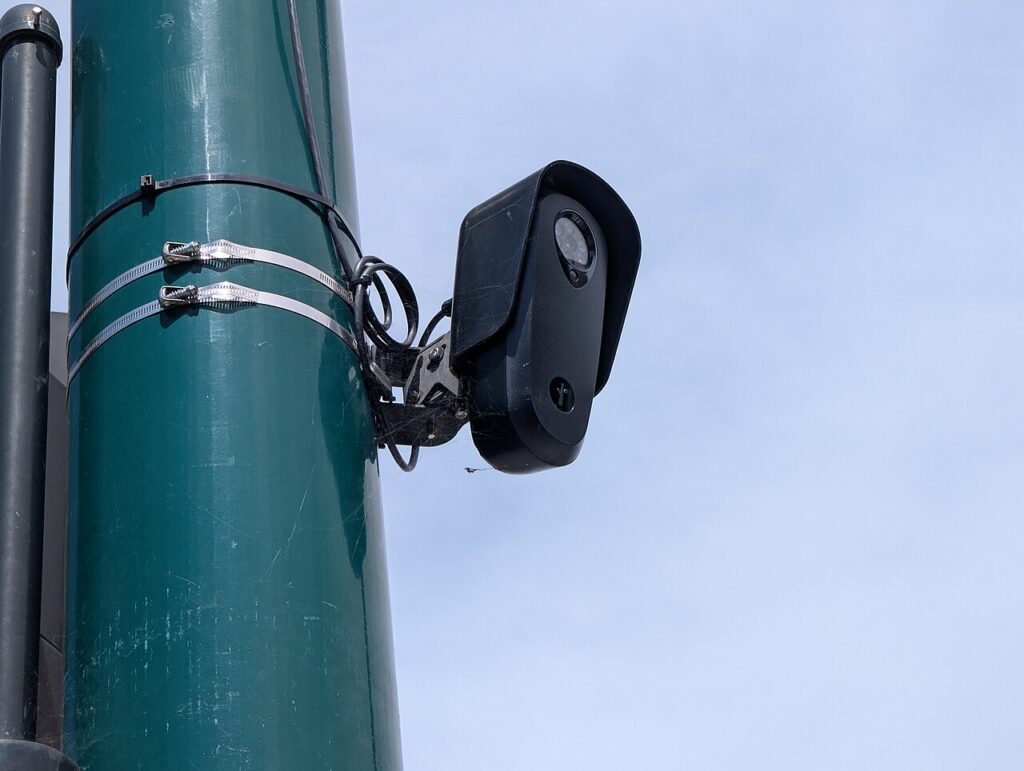
For example, Home Depot and Lowes shared license plate reader data acquired from their parking lots using Flock’s cameras with law enforcement. This poses some ethical and legal challenges in California, since state law prohibits the sharing of ALPR data with outside agencies, and it has been repeatedly shown that Flock’s LPR data is accessible to federal law enforcement agencies.
According to a public records request reported by 404Media, Home Depot parking lots were outfitted with the Flock Raven device, which is ostensibly a gun-shot microphone. However, by the company’s own material the devices do more than listen for gunshots and are fully integrated into Flock’s pre-existing expansive surveillance network.
Flock’s partnerships with retail brands like Home Depot, Lowe’s and Ulta Beauty is distinct from previous strategies, where Flock focused on embedding in neighborhoods through municipal purchasing and home owners associations. As detailed in my previous pieces, the rampant unchecked expansion has already had severe consequences, and is drawing severe pushback.
This contrast between the public sentiment and private growth illuminates the failure of regulators, both in the Golden State and elsewhere, to meaningfully regulate.
“I think the regulations are there, like many states have regulations about where surveillance can be placed, how it can be used and who can use it, how it’s stored, who can access it,” said Chris of DeFlock, a volunteer organization dedicated to mapping Flock’s LPR cameras across the country. “But the majority of it, the vast majority of it goes entirely unenforced.”

With some limited exceptions, legislators have refused to impede the company’s continued expansion.
“It’s terrifying and I also think it’s really important that we put everything in the context of the federal moment we find ourselves in,” Cat Brooks, an organizer and co-founder of the Anti-Police Terror Project, told me.
Flock, as opposed to the infamous Thiel security firm Palantir, markets itself as a softer, more ethical surveillance company. In reality, Flock is building a vertically integrated surveillance system that extends nationwide with the Falcon, Raven and Condor devices designed to share information with each other in real time.
These three devices, in conjunction with some of the recent search developments like Freeform demonstrate the fundamental risk this surveillance it poses to everyone.
Last October, shortly before a piece outlining San Francisco’s ever-expanding private surveillance network came out, Flock announced that its Raven devices would start picking up “human distress.” The Raven microphone, like Flock’s other devices, is integrated into the nationwide network collecting detailed personal information on all Americans, regardless of criminal suspicion.
“Shotspotter was just microphones … This is being rolled out with a suite of interoperable devices and sensors,” Matthew Guariglia, Senior Policy Analyst at the Electronic Frontier Foundation said. “It’s not just detecting gunshots or loud noises, you could hear a loud noise, immediately see what cars are in the vicinity.”
“You can integrate that on a platform that is Flock native that does AI analysis and integrates historic data. It is selling this as one piece of a larger suite of sensors and analytics.”
ShotSpotter, the company that pioneered the gunfire locator microphones like Raven, was founded in Menlo Park in the 1990s by Robert Showen while he was working for the Stanford Research Institute. Since then, the company’s technology has been installed in hundreds of cities and more than a dozen college campuses. Flock takes the pre-existing technology and advances it.
Using AI, the microphone is now picking up so-called “human distress.” Guariglia, who detailed the development in an EFF blog post, noted that even two years after the announcement, there’s little to no clarity on what qualifies as distress.
“…When we found the ad, the original image was an alert with text that said ‘screaming’ and after we put out our blog post, they changed it to just say generically distress,” he said. “Which we pointed out that in a number of states, this technology would be illegal because of eavesdropping laws.”
Raven is also folded into a massive pre-existing spying network that is controlled by one company. Flock has done what ShotSpotter could’ve only dreamed of.
The consequences of ShotSpotter’s technology were already violent, with one infamous case of a child in Chicago getting shot at by police for playing with fireworks. But, to supercharge that listening technology with AI and fold it into a platform like Flock’s that’s been proven to be both a security liability and a risk to the public, is incredibly dangerous.
The Raven devices are high-powered microphones equipped with AI to decipher which sounds are gunshots. Setting aside the risks with misidentification, once the microphone picks up the purported gunshot, it will notify the city’s police department (either by text, email or through Flock’s internal portal). The company claims Raven can identify gunshots within 90 feet. The accuracy is predicated on the triangulation from multiple devices, so naturally Flock encourages customers to purchase more devices for increased accuracy. The devices then assess how long it took to pick up the sound and compare that to the time it took for another device to pick it, then determine the location.
The picture below, pulled from the 2023 Raven demo, ostensibly outlines how Flock’s machine learning works.

In the video, Flock’s Tyler Harris, a former sheriff and police officer in Georgia, outlines how the Raven works in conjunction with the other parts of Flock’s system. He notes that it provides “situational awareness” by combining “advanced acoustic sensors and machine learning.”
A chief Flock selling point to cities is the expansive and affordable surveillance network. “A recent comparison showed that you could purchase one square mile of Raven and eight Falcons, which is our LPR, for the same price as the competitor’s gunshot detection alone,” Harris said in the video.
Flock sells cities not just a series of devices but a multi-faceted surveillance package.
“We can install a one-square mile deployment in as little as five business days and even sometimes less… The longer the devices are in the field, the better they get at detecting gunshots,” Harris says in the video.
Functionally, Flock’s Raven devices are high-powered microphones equipped with AI that listen not just for gunshots but to the surroundings at all times. The AI then parses what it hears and, if it determines that “human distress” was heard, it will notify the police. That said, the information is collected regardless of whether or not it’s shared with the police. Given the extensive evidence of abuses, illegal surveillance and criminal negligence that has occurred using Flock products, it’s imperative legislators enforce the existing regulations to protect the populace.
While the Raven collects audio, the Falcon ostensibly focuses on vehicles, Flock’s Condor cameras are recording people.
Last December, Oakland’s city council voted to continue using Flock’s extensive surveillance network as part of a $2.25 million contract. While the focal point of public contention with the contract was Flock’s LPR cameras, another facet of the surveillance network in the East Bay are the Condor, or PTZ, cameras.
“PTZ is the pan tilt zoom camera, those are the ones that kind of look like the orb,” Sarah Hamid, Director of Strategic Campaigns at Electronic Frontier Foundation, said. “They’re a different kind of camera, those too are shareable so you can give another jurisdiction four states away access to rotate your pan tilt zoom cameras.”
Flock’s Condor cameras are designed to capture video of people, not vehicles. They can be set up to automatically zoom in on people’s faces and track their movements or they can be used manually by remote access. As Hamid noted, they’re integrated into the Flock platform and are designed to be shareable in the same way Flock’s LPR data is shareable.
The same month as the Oakland city council vote, 404Media reported on Flock’s Condor devices. Reporter Jason Koebler and his colleagues were able to watch the camera feeds in real time without bypassing any encryption or using any password. They found that at least 60 of Flock’s Condor cameras were “exposed to the open internet.” Considering how widespread the Condor cameras now are, these live feeds being so easily accessible poses a huge danger to the public.
“We watched Condor cameras zoom in on a woman walking her dog on a bike path in suburban Atlanta; a camera followed a man walking through a Macy’s parking lot in Bakersfield; surveil children swinging on a swingset at a playground; and film high-res video of people sitting at a stoplight in traffic. In one case, we were able to watch a man rollerblade down Brookhaven, Georgia’s Peachtree Creek Greenway bike path,” Koebler writes.
Critically, one of Flock’s chief marketing points is that all of its hardware is integrated into a sprawling network that includes the LPR cameras, the gunshot detection microphones, the PTZ cameras and now, a natural language search feature.
While the Falcon, Raven and Condor are daunting developments in hardware, Flock’s Freeform feature is a frightening integration of AI into the nationwide network.
In mid-April, Flock announced the development of Freeform on its blog. It was framed as a content moderation technique. Functionally, it uses AI to scan video and returns results based on the search terms provided. Some of the limited examples provided by the company were
“LPR cameras can use Vehicle Freeform, allowing police to search for things like ‘blue car spray-painted with yellow graffiti’. Video cameras have additional Freeform capabilities that allow officers to search for characteristics on people, like ‘man wearing a cowboy hat’.”
The company’s attempt to frame it as a content moderation tool belies the reality of the search’s power and the risks that come with it. One of the subtle but deeply troubling components of the Flock network is its integration and organization.
“It’ll pull video footage as well, so for example it’ll show a man walking through an area with a backpack and it doesn’t appear to be ALPR but rather video footage,” Saira Hussain, Senior Staff Attorney at EFF said.
“If you search for a camo hat, you’re able to track this person. Again, in a protestor context, that is absolutely terrifying because that’s how you’re going to be able to track protestors,” Hussain said. “You’re going to be able to track them not just through the course of the protest or whatever it may be but also determine whether they traveled to the protest by foot or by car … So it really is the connection of tracking people.”
In practice, Flock’s hardware are just cameras recording; they’re not limited specifically to capturing one set or group of images and, with the advent of the Freeform search, this creates an outsized danger as people’s daily movements can be tracked from location to location, on a minute to minute basis.
“One of the reasons why this is possible is because all of the Flock hardware are just cameras; it’s not a specific camera that’s only capturing license plates. It’s just capturing footage,” Hamid said. “We know this because, as a city, you can purchase an ALPR program from Flock but you can also, at any time, add a feature upgrade and turn that ALPR program into a VMS screening program where all of those cameras can turn into VMS screening where you’re constantly screening footage.”
The VMS screening program, as Hamid details, opens the door to widespread abuses and, in California, potentially legal abuses.
“That’s not just you can access the streaming footage, you can give another jurisdiction access to access the streaming footage. Another jurisdiction can tap your streaming cameras and tap your footage. If you give them permission to,” Hamid said. “Across state lines, and that means that they’re not just capturing or looking through a list of license plates, they’re just looking at footage and are able to apply Freeform to it…”
DeFlock and other organizations have been attempting to shed light on the black box network that Flock operates. One blog, which has detailed reports of Flock’s data collection and search queries, shows tens of thousands of audit logs from SFPD’s uses of Flock. The researchers break the information down into relevant subcategories including statistics, costs and operators, among others. Until December 2025, audit logs reviewed by the blog would shorten an officer’s name and contain unique IDs. Since last December however, audit logs no longer even contain the UUID, which can make tracking the operator and their subsequent searches more difficult.
Similarly, another site provides detailed statistics about queries by location, search terms and frequency, among other things. While these industrious volunteer organizations do excellent work, they have no regulatory authority.
A case in Michigan is particularly revealing.
Oakland County commissioners in Michigan approved a nine-month Flock drone pilot program, to the consternation of some local residents. Many in the county brought up concerns about privacy, security and surveillance overreach in a series of successive meetings.
A spokesperson for Flock Safety, interviewed in mid-May by a CBS News affiliate in Detroit, told a reporter that “Flock does not have any facial recognition at all, and we don’t have any in development,” to rebuff community critiques about the pilot-program.
Technically, this is true. But the Condor cameras, in conjunction with the Freeform search feature, amount to a virtual panopticon.
“As much as Flock claims ‘oh we’re not doing anything of the sort, we’re not tracking people’ and we’ve seen them making these arguments in court,” Hamid said. “Some of these features indicate otherwise that it really is about trying to make it so that as they integrate different features into their network it makes it all the more possible to track somebody from ALPR to video using the AI feature that they’re integrating into it.”