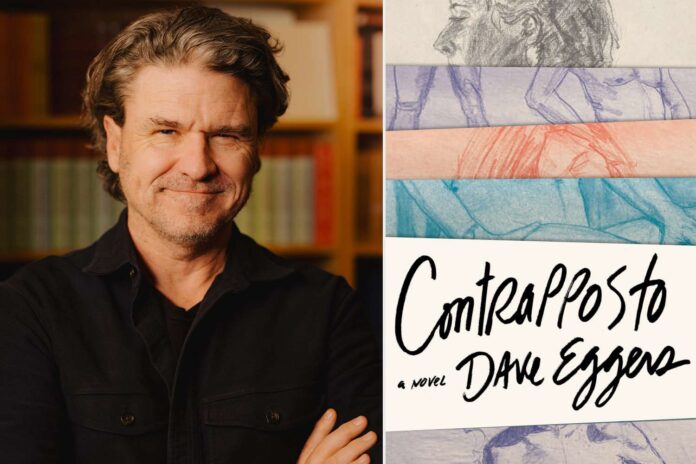
Dave Eggers began writing his latest novel, Contrapposto (Penguin Random House), roughly 20 years ago. The time spent was worth it. Some books pop out like newborns before their due date and astonish everyone. But a novel like this one about friendships, romances, and artistic pursuit, in a story that spans six decades, must gestate—perhaps along with its author’s sensibility.
Now 56, Eggers is primed to shove aside any superficiality and dive into heavier personal matters. Contrapposto’s primary protagonist is Robert Dibb, who everyone calls Cricket. At age nine, his mother and her abusive boyfriend disturb his equilibrium; drawing provides his only comfort. Early on, Cricket displays a natural talent for drawing and, as a teen, begins to acquire skills to paint like a master. He soon meets Olympia Argyros, a charismatic, art-minded angler one year older. Cricket and Olympia begin a lifelong entanglement that moves from wariness to friendship, then competition, sexual adventure, estrangement, and ultimately, profundity.
For a good portion of his young adult life, Cricket’s inner thoughts and anxieties are consumed by his desire to create art. His exterior life is typical: He struggles to understand his mother, lusts for and falls in love over-and-over with Olympia, takes a menial job at a train station cafe to fund his art materials and classes. He makes and loses friends and lovers. But he does not know himself, or the cause of his constant urge to make art, or his overall restlessness.
Over the course of roughly 65 years, Cricket travels from his childhood home in Indiana to Chicago, New York, Thailand, and Paris to pursue his art making—and oftentimes, pursue Olympia as well. Humorous scenes intermingle with tense and tearful ones. Cricket, Olympia, and Jed, a best friend, melt the heart when they, like most people in real life act, repeat their past mistakes ands suffer anew. The actions of their lives come to represent universal conflicts like commercialism versus craftsmanship, retention of individual identity amid mass trends, relationships tainted by competition, pervasive economic disparities, war…
In one of the book’s most subtle and tender scenes, Cricket teaches his mother to draw and glimpses the girl she once was. In turn, she uncovers and begins to understand his yearning to be an artist through her own discovery—a marvelous allegory how we come to see each other through art-making and collaboration.
As an aging man, Cricket’s world view expands as his mind sheds layers hardened by disappointment and trauma. He realizes that with each passing year, his spirit remains “delightable, surprisable, porous, and tingling.” As acceptance—of himself, primarily—invades his perspective, his drawing improves. He finds himself loving all people and students and even strangers, but never a one person more than Olympia—and never any purpose more than making art. Which leaves at the end what was there from the start; a long love story promising to stretch over time and beyond location.
Eggers is a trained artist and provides most of the 18 drawings and paintings included in the novel. He continues to be involved in McSweeney’s, the publishing house and literary journal he founded in San Francisco in 1998, and 826 Valencia, the young writers’ incubator. His most recent “hobby” involves the development of Art + Water, an arts center on a San Francisco waterfront that will provide free studio space for 10 established artists in exchange for instructing 20 emerging artists.
All of which means Eggers is a busy fellow, and a civic institution. No one wants to wait another 20 years for his next book to arrive, but if we must and are lucky to live long enough to read it, wouldn’t that be marvelous?
CONTRAPPOSTO is available now at indie bookstores and Bookshop.org.