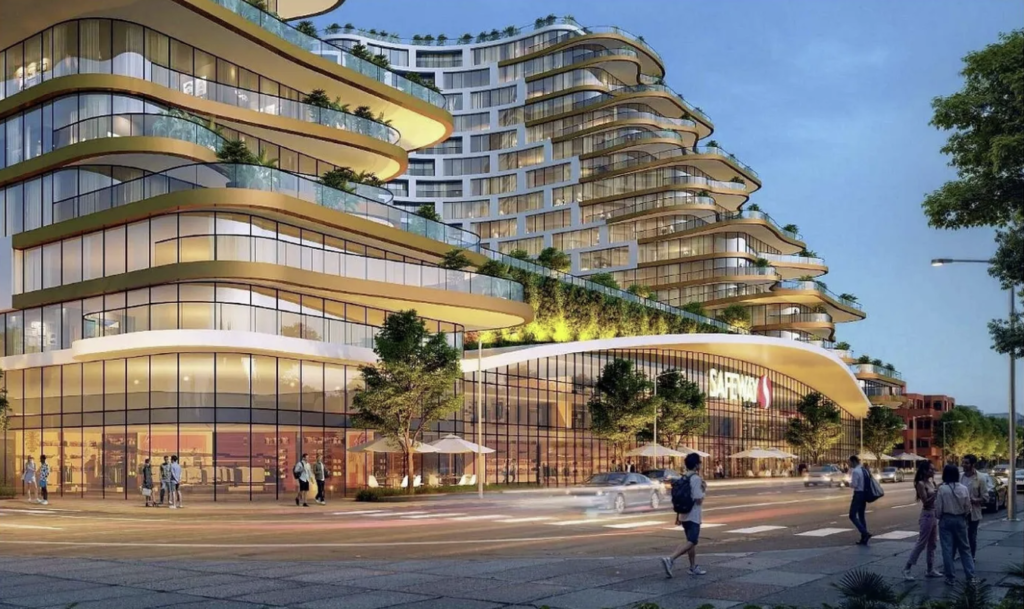
The Marina Safeway project isn’t going to displace any residents; the new apartments, if they ever get built, will be rented by rich people, but the area around it is also mostly housing for rich people and their amenities. This isn’t like the Monster in the Mission.
It is, of course, wildly out of character for the neighborhood, and wildly unpopular, which is why even YIMBYs like Mayor Daniel Lurie and Sup. Stephen Sherrill oppose it. It’s also kind of a fuck-you to Lurie and the supes; the developers filed their application just before the city approved the mayor’s new zoning plan, and used Sen. Scott Wiener’s state law to override any local planning.
But like a lot of these projects we keep seeing pop up, I have to wonder if will ever—or can ever—be built safely, without severe toxic waste issues. Even the Chron is reporting that the site has problems.
The city and the state don’t seem to care.
Consider the history of the Marina Safeway site.
At the end of the 19th Century, that site was a crude, early-generation PG&E plant that turned coal into gas, which provided lighting for a lot of the new Victorians in town. The coal-to-gas process in those days was inefficient and dirty; the gas itself was so foul and dangerous that just inhaling it could cause pretty quick death. The byproducts (used coal that had been heated without oxygen) were also toxic.
The 1906 earthquake so badly damaged the coal-gas plant that PG&E abandoned the site and moved away—but left behind storage tanks and toxic waste that was never properly logged or tracked. So we don’t know what’s really under the Safeway.
In the 1960s, the supermarket chain bought the land, cheap, and covered everything with a concrete slab. Back then, “capping” or “containing” toxics was standard procedure; the nasty stuff, engineers figured, would stay underground as long as a pile of concrete was on top of it.

(I remember covering a story about an old asbestos dump in Torrington, Connecticut in 1979, when I was working for The Hartford Courant. The state’s environmental commissioner said the best solution was not to clean it up, but to allow a new mall to bury it under concrete. Nobody disagreed.)
So the developer has that problem, which under modern standards could be difficult and expensive to remediate, if that’s even possible.
The Marina Community Association, Cow Hollow Association, and Neighborhoods United SF have hired a law firm that sent a letter to the Department of Public Health and the Planning Department warning that the site can’t just be approved without extensive environmental review.
Before Wiener, David Chiu (who was in the Assembly and is now the city attorney) and other YIMBY allies passed “streamlining” legislation, that would have been standard practice: You couldn’t do a project like this without an EIR.
No more.
But the issues are serious. From the letter:
The Site is almost certain to be highly contaminated with toxic wastes from the operation of a former manufactured gas plant (“MGP”) in the Site’s immediate vicinity. And Karina Navarro, the Unit Chief of the Site Mitigation and Restoration Program of the Department of Toxic Substances Control (“DTSC”), has indicated that the results from a number of sampling locations in the vicinity of the Site yielded readings “about twice the commercial screening level, and ten times the residential screening level,” leading her to note “I don’t expect this property to qualify for streamlined approval,” further noting that the Site “might be impacted by MGP contamination in the groundwater.”
DPH asked the Developer why the proposed investigation included no soil samples from within the existing Safeway footprint, stating that the omission could pose a data-gap issue. Langan, the Developer’s environmental consultant, responded: “We know that there is a data gap,” seeking to justify it on the ground that Safeway would not permit drilling while the store remained active and that sampling beneath the building would occur later once the store was closed (i.e., after the Project was moving forward). This means that the City is being asked to advance the Project while a major portion of the site remains uncharacterized at the Developer’s election.
Translation: Nobody knows how bad the toxic contamination is, but the city’s going to let the developer start demolition anyway.
Building housing on toxic waste sites has never been a good idea.
Meanwhile, according to Friends of Mission Creek:
One thing that is missing in discussions of the proposed development is concern about the raw sewage discharged from San Francisco’s combined sewage system onto Marina Blvd and into the homes along Marina Blvd, including some residences only 1 block away from the proposed development. The new development is proposed to substantially increase the residential population of the site which will increase the number of humans actively discharging human waste into the combined sewers in the area. These combined sewers mix both raw sewage and storm runoff in a single pipe system. During relatively modest storms, the sewage system along Marina Blvd is overloaded causing backups of raw, untreated sewage and storm water. Historically this area had not been a flooding concern until the illegal closure of the Pierce St. outfall by SFPUC in Mar 2021. The very first time it rained after this outfall closure in Oct. 2021, raw sewage and storm water gushed out of sewer manholes flooding over 50 homes along Marina Blvd. On New Years Eve, Dec. 2022 a similar storm again caused sewage to flood out of the manholes onto the streets and again into over 50 homes in the area. Even relatively minor storms such as seen 5-6 times in the last 5 years cause the sewers to back up flooding 1-2 homes on Marina Blvd, primarily the homes most affected by subsidence of the unconsolidated sand fill in the area.
Now: To build an underground parking garage, which is part of the project, the developer will have to pump out a lot of water. The water table in the Marina is pretty shallow, maybe 10 feet down.
Once that process starts, toxics from the entire vicinity start to move. PG&E has already had to buy a handful of houses on the perimeter of the project because the homeowners found toxic coal on their land. You start moving around water-borne toxics that have spread over more than 100 years and it’s going to be a mess.
The land under the project isn’t really land. It’s fill, in many cases very bad-quality fill. During the Gold Rush, ships would go aground at the edge of what is now the Marina, the crew would abandon ship and head for the gold fields, and the old timbers would sink into the mud. That’s what a lot of the Marina is built on.
We saw that during the Loma Prieta earthquake, when hundreds of Marina buildings fully or partially collapsed as the fill liquefied.
The city’s record on managing big buildings on loose fill is not great. The Planning Department and Department of Building Inspection approved the Millenium Tower, with “friction pilings” into fill that didn’t go down to bedrock. We all know the outcome.
The idea that this project, that will create only rental apartments for rich people that are not under rent control, is going to do anything for the housing crisis is just insanity. The idea that it can move forward without any real environmental review is a scandal.
And yet, the Planning Department has ruled that this is, under state law, a “ministerial” approval that must go forward. (Thanks to Wiener for making that “streamlining” happen.) The department now says that any environmental dangers must be addressed before the city issues a Certificate of Occupancy—but that’s after the project is completed.
The mayor says he doesn’t like it, but his gee, his hands are tied. The city attorney is doing nothing. Wiener is, of course, running for Congress.
“They are telling us they don’t want the project,” Lori Brooke, president of the Cow Hollow Association, told me. “Then they say, you go raise the money, you hire your own lawyer, you fund the lawsuit. It’s all on the neighbors.”
Brooke told me a lawsuit is going to happen. It might lead to new standards for “ministerial” housing on toxic waste sites.
Or we may get a repeat of what happened in Hunters Point, when people bought houses on top of what the city and the Navy said was land free of toxic waste. Many homeowners ended up suing when they found evidence of contamination.
The assassinations of Mayor George Moscone and Sup. Harvey Milk were a shock to San Francisco’s social and political system. The killings, by right-wing Sup. Dan White, also set back progressive politics for years: Conservative Dianne Feinstein became mayor, and the Chamber of Commerce used the murders as fuel to repeal district elections of supes (it took 20 years to restore that system).
But political scientist and historian Lincoln Mitchell, who wrote an excellent biography of Moscone, has an interesting twist on that time. He argues, in San Francisco Year Zero, that the punk rock movement was emerging at the same time as the assassinations were shaking the city, and that the political and cultural impact of that punk world has lessons for today.

North Beach Now is sponsoring an event Thursday/20 exploring that connection. It features Mitchell and Artist and activist Romalyn Schmaltz, who “explores the role of art and culture – and specifically punk rock – in local political and social justice reform,” according to the group.
More: “Confirmed guests include two folks who were there in the 1978 resistance pit: collage artist Winston Smith, architect of the DKs and Alternative Tentacles’ brand identities, and Val Vale of RE/SEARCH publications.”
The event takes place at the historic Mabuhay Guardens, 443 Broadway, where so many elemental punk shows happened. It starts at 6pm. It’s free but space is limited, so best to register here in advance.