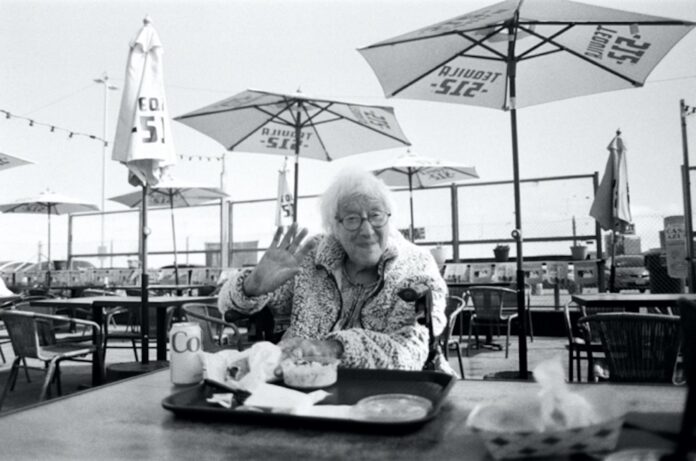
Minnette Lehmann had been on the scene for a very long time before her death in June just a few weeks shy of her 98th birthday. Her 70-year history in San Francisco’s art world, including her incisive and ruthless critiques, gives us a sense of what we once had and what we’ve lost.
Minnette was funny, game, and curious—always thinking, analyzing, and asking how we got here.
For the past three years, I worked with Minnette. Together, we wrote her memoir, which was not finished at the time of her passing. By continuing to show up and participate in the movements of the day, decade after decade, from the post-World War II San Francisco Renaissance to the feminist art movement of the 1990s, Minnette became an emblem of the very best of the City, and the very best of the last century and beyond.
A memorial and celebration of her life will take place on Sun/15 at 12pm at The Lab. All are welcome to attend.
Minnette was a photographer, painter, plus a collage, video and performance artist, as well as a teacher and a mentor to many emerging artists. She showed her work and was a part of many of San Francisco’s important creative institutions, including the San Francisco Art Institute, the Center for the Arts, SF Camerawork, Southern Exposure, Media Gallery, RayKo Galley, and The Lab.
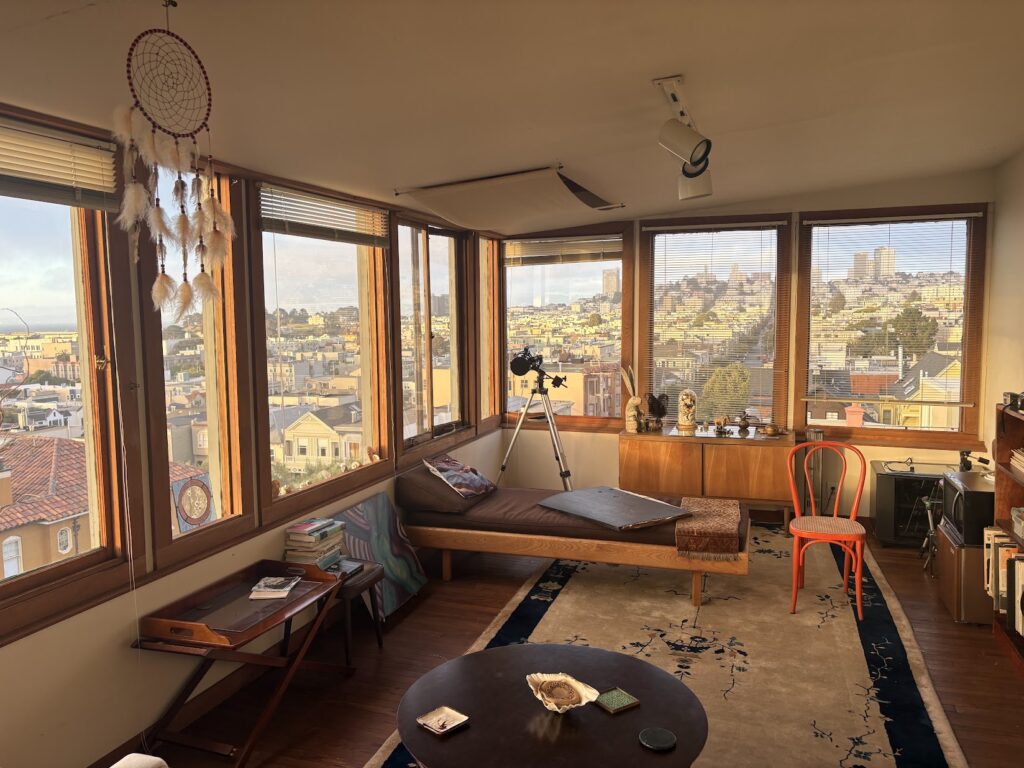
At her home overlooking the San Francisco Bay on Filbert Street in Cow Hollow she hosted parties, salons, board meetings, and visiting artists.
Minnette was born on August 19, 1928 to Barney and Bella Berns, Jewish refugees from Poland who owned a men’s clothing store in downtown Sacramento.
Her very first venture into San Francisco was a ferry trip across the San Francisco Bay, before the construction of either of its bridges. A few years later, her father brought her to the Golden Gate International Exposition at Treasure Island.
Minnette recalled childhood trips to visit family in Calistoga, a town comprised at the time—she recalled fondly—of “Jews, anarchists, and communists.”
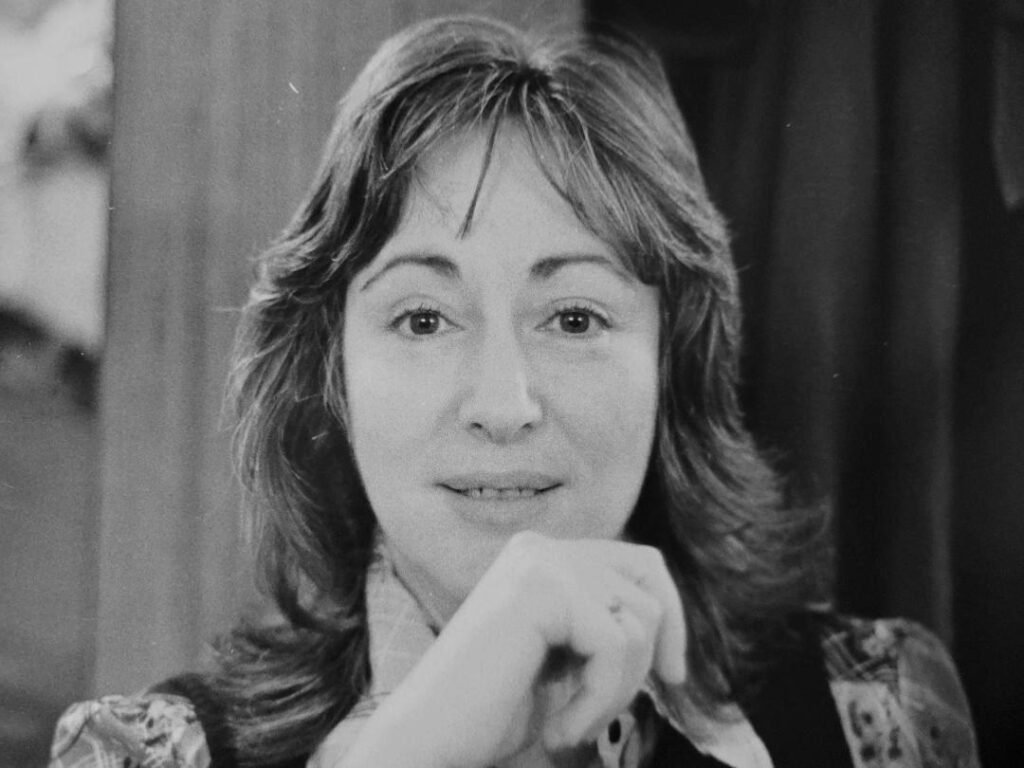
Minnette escaped her hometown of Sacramento by attending UC Berkeley at just 16 years old, starting classes during the fall 1945 semester, when most of the male students were still off fighting in the final year of WWII. She studied sociology, pedagogy, and took music classes with the exiled tonal composer Arthur Schoenberg. She taught kindergarten in North Beach, the Mission, and to farm laborers’ children in Rodeo, California.
As a young Trotskyist, she briefly worked in a Heinz tomato factory during a union organizing drive, and attended weekly dinners hosted by Jack London’s daughter in the Oakland Hills. She married her first husband, socialist student leader Bob Martinson, in a double-wedding ceremony in Carmel alongside Mary and Stan “Red” Weir, a longshoreman union organizer and influential anarcho-syndicalist.
At Berkeley, Minnette and Martinson helped organize the student and faculty protests against the University of California Board of Regents’ requirement that all university employees sign an anti-communist loyalty oath. At the time, they were the largest demonstrations ever held on campus, a foundational precursor to the next generation’s Free Speech Movement.
She relished Berkeley’s café culture, spending “entire afternoons” discussing Kafka, DH Lawrence, and Henry James at Larry Blake’s, at a time when Telegraph Avenue was “one solid wall” of bookstores and cafes.
While working at a Telegraph Avenue record store, she befriended Philip K. Dick, who “blew her mind” by declaring that the US didn’t win WWII.
When Peter Martin (son of slain anarchist Carlos Tresca) opened the original City Lights “Pocket Book Shop” in 1953, she helped her friend, experimental filmmaker Jordan Belson, paint the floor-to-ceiling murals that once covered the store’s interior.
She saw plays at the Actor’s Playhouse, San Francisco Playhouse, and San Francisco Actor’s Workshop, and befriended conscientious objectors working at the Civilian Public Service.
Every Friday night, she went to the Art in Cinema film society’s screenings at the old San Francisco Museum of Modern Art on Van Ness Avenue, where one could see the works of Luis Buñuel, Jean Cocteau, and Maya Deren, among many others. Art in Cinema was something she reminisced about constantly, always with the salient rhetorical question “And why the hell isn’t that still happening?”
Her first introduction to the San Francisco Art Institute, where she would eventually become a student, an instructor, and finally a board member, began with an hourly job as a nude model.
She spent a year traveling Europe alone after graduating from Berkeley and divorcing her husband. When she returned to San Francisco, she met and married German-Jewish psychoanalyst Herbert Lehmann,
who after fleeing from the Nazis to England, became a British intelligence officer.
They lived in the Western Addition, Russian Hill, and Jordan Park neighborhoods before moving into an arts and crafts house in Cow Hollow, during Minnette’s self-described “Wife/Mother period.” They had three children: Barbara Lehmann, who became an artist; Michael Lehmann, the Hollywood director of Heathers; and Stephanie Lehmann, a novelist.
In the mid-1960s, Minnette worked as an assistant editor for Contact magazine in Sausalito with writer Evan Connell (and coincidentally, my other former boss, Jerry Mander.)
Her introduction to photography came when she borrowed her son’s camera to document the police brutality at the 1968 San Francisco State University student strike, where she handed out wet handkerchiefs to combat the tear gas lobbed at protestors.
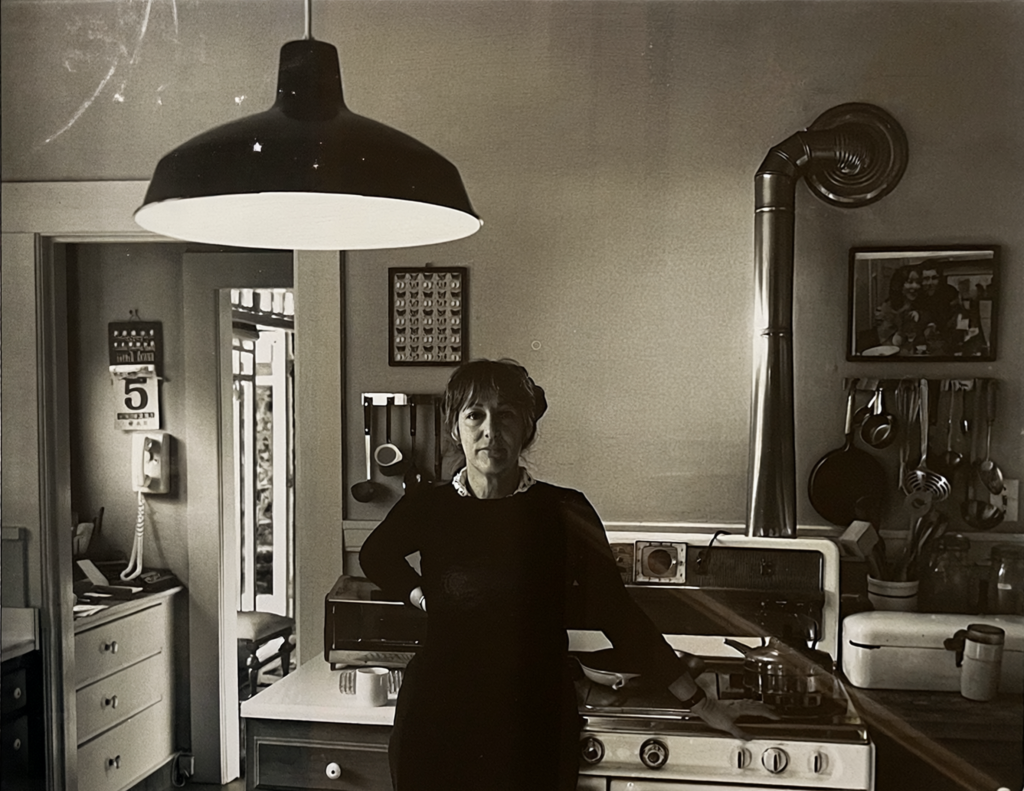
In her forties, she went back to school for photography. At the San Francisco Art Institute, she befriended Harry Bowers, Steve Collins, Mitchell Payne, and Henry Wessel, as well as lifelong confidants Linda Montano and Judy Dater. George Kuchar stayed in her garden shed-art studio when he first arrived in town.
After graduating, Minnette taught a course on the history of photography at the San Francisco Art Institute, SF State University, and the UC Extension program. In 1975, she won a National Endowment for the Arts grant for “Trouble in Paradise”, a portrait series of married couples taken at a time in the culture when marriage was, for the first time, facing major public scrutiny. Hers was one of the first bodies of visual art to “problematize” the institution.
In the late 1970s, Minnette became involved with the Women’s Movement in San Francisco, and in the early 1980s, began working with other feminist artists. Between 1976 and 1980, Minnette exhibited a series of nude portraits of men and women called “The Nakeds.” She hosted women’s consciousness groups in her home and North Beach restaurants. Among their attendees was Eleanor Coppola, whose husband paced nervously during their meeting.
In 1987 with Lutz Bacher, a student-artist at the time, Minnette oversaw and contributed to the creation of Theory and Flesh at San Francisco State, a publication that Art Forum called a “critical and affective project” combining “then-recent critical theories, from semiotics to French feminism, with often aggressive vernacular imagery.” Minnette also mentored student Laura Brun, who went on to co-found The Lab at its original location on Divisadero and Bush streets.
Throughout the 1980s and ’90s, Minnette worked with feminist artists such as Montano, Brun, Pauline Oliveros, Annie Sprinkle, Beth Stephens, Kathy Brew, Christine Tamblyn, Kathy Acker, Yvonne Rainer, Moira Roth, and Margaret Tedesco. At The Lab and other organizations, Minnette helped organize panels on feminist art featuring artists, writers, and thinkers.
Minnette once flew to the UK and presented a paper on Roland Barthes and photography at an aesthetics conference, pretending to be an academic. She reported that her presentation was very well received.
Her work with women’s consciousness and feminist art allowed her to contend with her life’s hardships—sexual violence, failed affairs, the limits of marriage, stymied ambition, the lasting effects of the Holocaust in her childhood and upbringing—with equanimity and analysis.
Minnette’s daughter Barbara—an artist and Shakespearean actress who wrote for the Village Voice and collaborated with her mother, appearing with her in memorable New York party footage taken by Yvonne Rainer—died of Hodgkin’s lymphoma at age 37.
It was then that Minnette stopped taking photographs and shifted to other mediums. Last year, she had her first exhibition of paintings at Adobe Books & Arts Cooperative, at the age of 97.
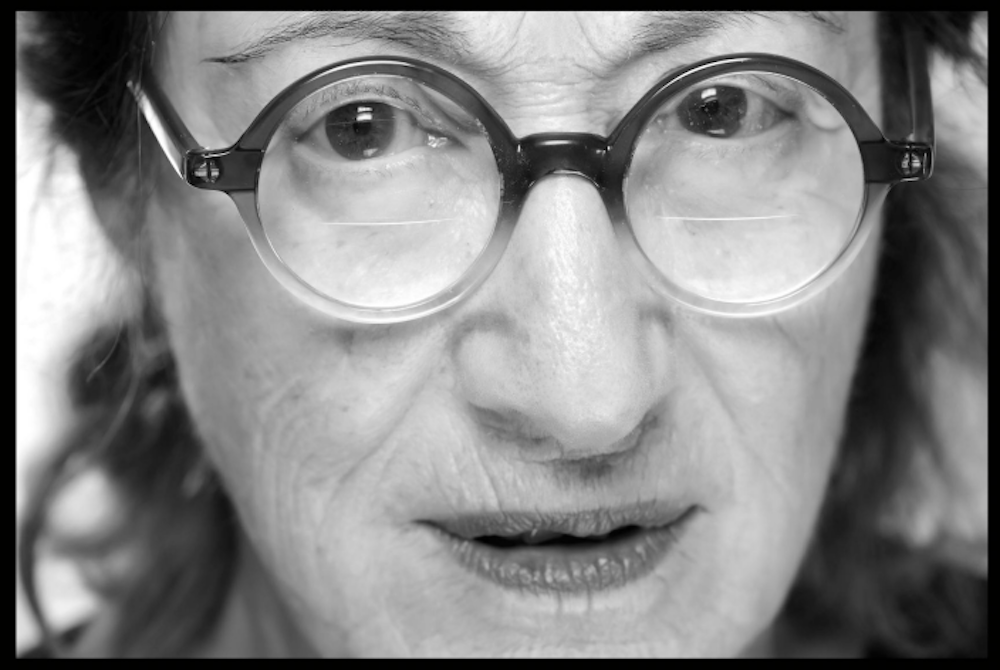
Minette met with her friends, Judy Dater, Jack Von Euw and Dennis Ledbetter for martinis every Friday until her passing. Her door was always open for visits and sleepovers.
Every day, Montano called her on the landline. Minnette would always quickly and politely change the subject when Linda began speaking in her “spiritual language” (Linda’s words, not mine), so Linda was very pleased when Minnette, staunchly unreligious, came around to the possibility of the existence of angels just before her death.
And every Tuesday and Thursday, I would come to Minnette’s house to work with her. I would usually find her seated, having just made herself lunch. There was never a time when we resorted to pleasantries—we always got right to the point.
Minnette outlived many of her oldest friends and members of her milieu, but gained new friends in young photographers, writers, and artists (such as Kyle Knobel, Heather Holt, Lor O’Connor, Ryan Darley, Daniel Pierce, and me) whom she always treated with the utmost respect and seriousness. Minnette did not especially believe in either age or time, and had a way of encouraging others to do the same.
Minnette spoke frequently of fascism, of everyone being quiet collectively and everything disappearing quietly, warning signs everywhere as we slip into a new, more narrowly constructed world. She saw the disappearance of San Francisco’s art world through that lens, and was greatly affected by the closure of the San Francisco Art Institute and the California College of the Arts, among other long-standing and historic institutions in the city.
Thankfully, the creative impulse of the individual and the creative power of the collective is something that never truly dies.
May we all live a little in Minnette’s world. Thank you, Minnette!
MINNETTE LEHMANN MEMORIAL CELEBRATION Sun/15, noon-3pm. The Lab, SF. More info here.