The big upset of the 1982 Academy Awards ceremony was Best Picture going to Chariots of Fire, a modestly budgeted, starless inspirational sports drama about Cambridge student athletes between the world wars. Basically combining the appeal of Rocky and Masterpiece Theatre, it proved a surprise worldwide hit, one the British film industry badly needed at the time. It was also a good movie—though, some thought, a scandalously tame choice for the big prize when films like Reds, Raiders of the Lost Ark, Atlantic City, and The French Lieutenant’s Woman were also in play, to name just a few fellow 1981 releases.
Chariots boosted the careers of all involved. But Oscar is a notoriously fickle indicator of long-term success, and it proved so in this case. Director Hugh Hudson suffered one of the decade’s biggest flops with 1985’s Revolution, a wildly miscast tale of our own nation’s founding; he never quite rebounded. Leads Ben Cross and Ian Charleson, both accomplished stage actors, seized the chance to “go Hollywood,” which didn’t especially pan out for either of them.
By the Eighties’ end, Charleson was in that awkward position of still being known almost exclusively for his “one big hit,” having not had another beyond a supporting part in Gandhi. The offers coming his way weren’t exactly stellar. So he jumped at the chance in 1989 to return to the National Theatre, where Richard Eyre had already directed him in a very successful Guys and Dolls. What’s more: The project was Hamlet. And the part was, well, Hamlet.
Never mind that the role was only open because red-hot Daniel Day-Lewis had inexplicably walked out in the middle of a performance and never come back. For Charleson, it was nonetheless the “Everest” of acting challenges, one he had to climb. That determination was made all the more intense by something almost no one knew: He’d just been diagnosed with AIDS, at a point when that still seemed a near-certain death sentence.
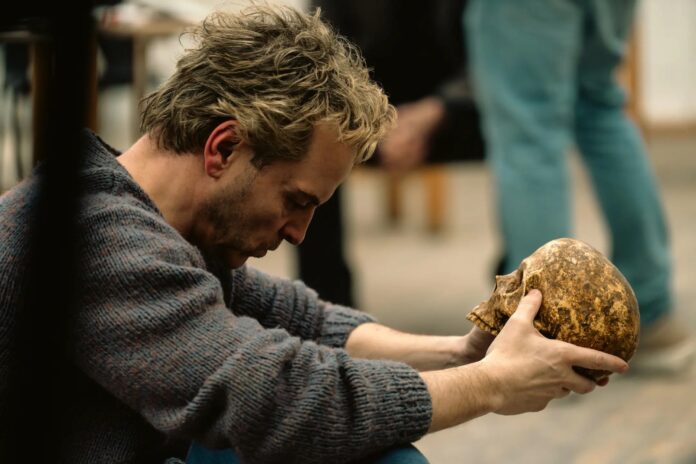
The new film Elsinore from Swiss actor turned theater, opera, and film (The Daughter, The Dig) director Simon Stone and English playwright-scenarist Stephen Beresford dramatizes those events, during which Charleson (played by Andrew Scott) suffered some serious health setbacks. He knew he would soon be dead. The bargain he drove with himself, Eyre (Johnny Flynn), and others was that he be allowed to push himself to exhaustion and beyond in order to end on this peak professional note. He managed it—24 highly acclaimed performances as the Prince of Denmark—albeit at the cost of likely ensuring his demise just six days into a new decade.
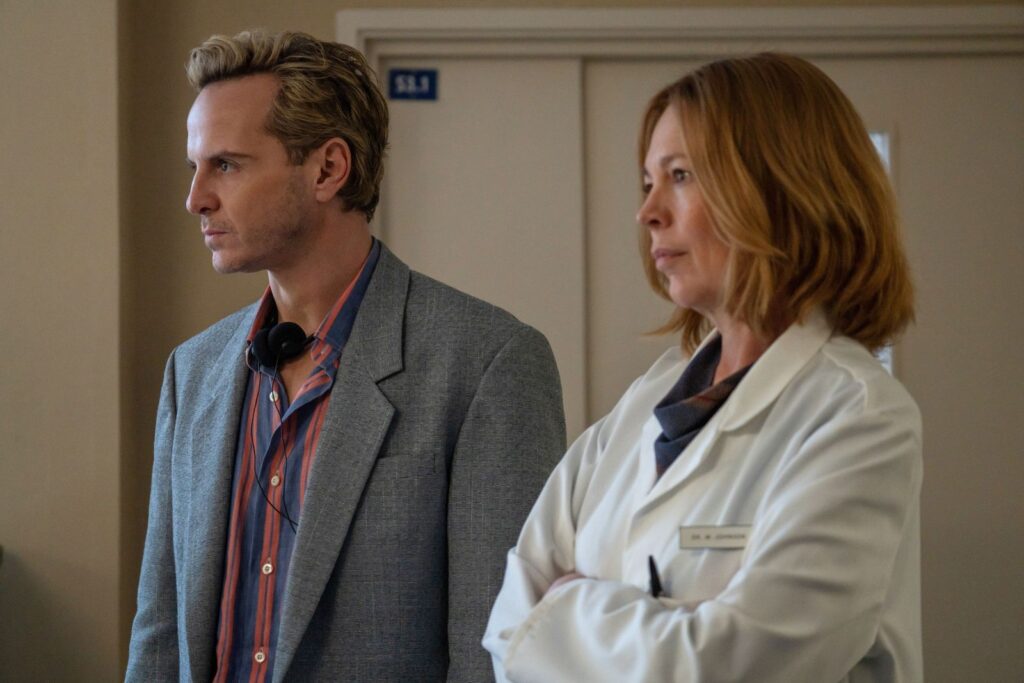
Beresford’s prior screenplays (Pride, Tolkien) were not particularly inspired. But he does very solid work here, and Stone almost entirely avoids the crescendoes of maudlin sentimentality this material might risk anyway. A couple stray moments of histrionic pathos from support players Billie Piper, as a good friend and casting director, and Peter Mullan, as Charleson’s father, are easily forgiven in the larger scheme of things, as Scott essays a skilled, genial if driven professional with no time for self-pity. Charleson’s obstinacy is regularly tongue-lashed by Olivia Colman in a very strong turn as the UK’s first dedicated HIV physician, who cannot understand a patient prioritizing Shakespeare over his own probable lifespan.
The ambition that pushed him into the Dane’s shoes at this juncture also kept Ian Charleson in the closet, publicly if not within his professional and social worlds. He was aware that at the time coming out would get him typed, and he didn’t want to be seen strictly as a “gay actor.” His first film was Derek Jarman’s (David Dawson) punk fantasia Jubilee; here an already ailing Jarman (who died in 1994) is a longterm friend who lambastes Charleson for his lack of political nerve.
But the latter refuses to be coerced, even for this cause. Fine with being identified as a PWA after death, for now he just wants his Hamlet judged on its own terms, not as the brave last gasp of some “poor sick man.” He’s hardly selfish in behavior towards others similarly afflicted, like ex-boyfriend Georgie (Luke Thompson), or the fellow patients in Colman’s hospital ward. It’s just that he really, really needs to prove to himself and the world that he can conquer Hamlet before terminal illness conquers him.
Everything about Elsinore is immaculately orchestrated—seeing it in late September, it seemed the first mainstream movie this year after The Odyssey to truly merit across-the-boards award consideration. (And I greatly prefer it to Christopher Nolan’s film.) It’s also probably the best narrative film about AIDS to date, the passage of time having lifted the mantle of heavy-handed case pleading that made such prior efforts as Philadelphia and It’s My Party best described as “well-intentioned.”
At the same time, it provides a valuable crash course for viewers too young to have experienced that era, bringing back the pervasive urgency around people checking their bodies for lesions, worrying over the slow progress of medical science, hearing about yet another friend who had suddenly fallen ill. It was a crisis atmosphere that for many, by 1989, was just everyday life. Elsinore is all the more potent for making that the backdrop for a protagonist who can’t escape it, and doesn’t try to, yet still insists on making the last months, weeks or days of his life about something else.
ELSINORE opens Wed/25 in Bay Area theaters.