The Gregorian Calendar is a scientific advance, although it was established by a pope. But the idea of January 1 as the start of a “new year” goes back much further, and is probably related to the winter solstice. In some older traditions, the new year started in March, when spring arrived. People in the Chinese and Jewish traditions celebrate the new year in the early fall or in February.
So the Western tradition of Jan. 1 is a random day. But it’s a time that everyone talks about the past year, and the year to come, and that’s not a bad thing: Once a year, at the very least, we should reflect on where we are and where we’re going.
With a nod to Project Censored, let me do my own kind of list: Here are the biggest local stories of the year that you haven’t heard much about.
1. Economic inequality at home, and its impacts on everything from homelessness to public safety.
In a particularly ridiculous oped the Chron ran on Jan 1, Tracy Hernandez, the head of a pro-big-business group funded is part by the Chan-Zuckerberg Initiative, argues that California is failing as a state because there’s too much regulation, and too many “special interests” blocking progress:
Wealthy NIMBYs blocking housing in the name of “community character.” Ideological purists treating compromise as betrayal. Unions that gladly sacrifice the best interests of all workers for the best interests of their members. Companies willing to stall progress for the sake of predictability.
There is a different way to organize the mechanisms of state power — and it starts with reorienting political culture away from ideology and regulatory capture and toward solutions.
Umm … Hernandez left out a few special interests: the greedy billionaires who work to make sure they never have to pay their fair share to taxes. The Real Estate Investment Trusts that have taken over much of the housing market crowding out ordinary buyers (and leaving commercial spaces vacant). The speculators who flip residential properties and evict tenants for quick profits. To name a few.
The reality is that the biggest threat to California, and San Francisco, other than climate change, is economic inequality. And the only solution that works is taxing the rich.
Zohran Mamdani got elected mayor of New York talking about that. (Read his inspiring inauguration speech here or watch it here.) You can watch about 4,000 people at Mamdani’s inaugural rally chanting “tax the rich.”
In San Francisco, nobody in the news media regularly reports on the role economic inequality plays in our social problems.
I have seen nothing in any of the local news media reporting on what is easily the most important economic story of the decade, and nobody makes any effort to apply that concept to San Francisco.
Instead, the media talks about crime.
When Sen. Scott Wiener recently made a pitch for a regional sales tax to fund transit, I asked him: Why not let San Francisco have a city income tax on the very rich? All it would take is an act of the Legislature. A modest tax on the 4,000 richest San Franciscans would solve all of our budget crises—fund Muni, affordable housing, health care—and public safety. No need to decide if a functional bus system is more important than additional cops; we could easily pay for both.
Wiener told me such a bill “would never even make it out of committee.”
If the news media talked about the billionaire and big corporate theft of $47 trillion as much as they talked about far lower level street crime, that might change.
2. The privatization of transit
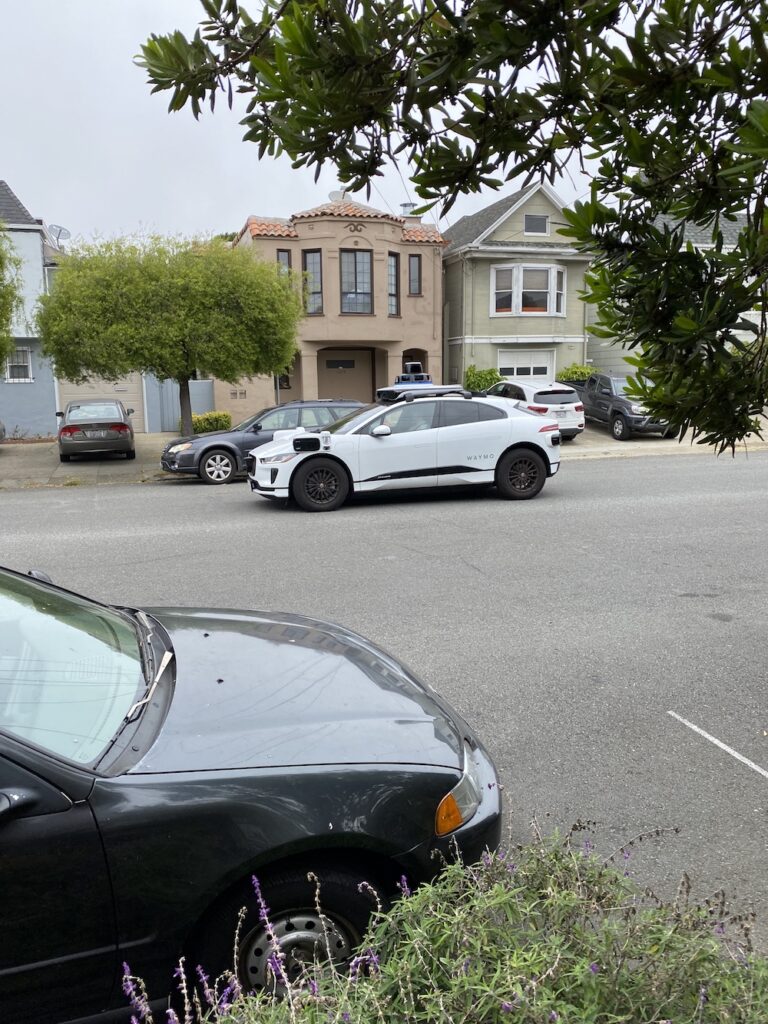
We hear a lot about Waymo: Robot cars running over a cat, stalling at intersections, taking up parking spaces … and by some accounts, offering safer driving than humans.
We hear a lot less about what this trend really represents: The private sector taking over what public transit is designed to do. The result, if this continues, will be a two-tiered system, where people with money will zip around in robocars and everyone else will be stuck with a third-rate transit system that will barely function.
This is not happening by accident. In Security and Exchange Commission filings, Uber made clear that its road to profitability depended on replacing public transit with private, for-profit vehicles. The latest data suggests that the plan is working.
The city and the region are looking at parcel taxes and sales taxes to shore up Muni, BART, and other systems. Nobody is doing anything to prevent giant private companies from destroying those systems.
3. AI and social stability
In his 1952 novel, Player Piano, Kurt Vonnegut presents a terrible future where machines have replaced most human workers, leaving society divided into the small number of elites who operate the machines—and the rest of humanity, which lives in squalor and has little useful, fun, or productive to do.
We read and hear a lot about AI investments, AI saving downtown SF, AI learning how to stop people from turning the machines off, AI making it impossible for teachers to assign essays, and a lot more.
We don’t hear about the roughly 2.1 million people in the US whose job is truck driver, or the 1 million who work in auto manufacturing, people whose jobs will go away in the next decade if we continue at this unregulated pace. They are not going to be “retrained for jobs of the future” because those jobs won’t exist.
What do we do about them?
We could look forward to a society where most people only work one or two days a week, and have time for raising kids, inventing things, relaxing, travelling, and finding ways to be productive that don’t involve a paycheck. A society where health care is free, housing is a human right, and poverty is declining.
To do that, the wealth created by the increased productivity of AI would have to be shared widely, not hoarded by a handful of billionaires.
That would require extensive government regulation and wealth redistribution, which hasn’t happened in the US in more than 50 years.
Why is nobody in the news media talking about this?
4. The Raker Act
Now that PG&E has shown its failure to provide reliable electric power in SF, we’re seeing lots of media stories about a move to public power, and how that would be cheaper and more reliable.
But nobody is talking about the fact that public power in SF is not just a good idea—it’s the law. San Francisco is the only city in the US that is required under federal law to operate a public power system. The Raker Act, which set that mandate in exchange for allowing the city to build a dam for water in Yosemite National Park, has been upheld by the US Supreme Court.
As far as I can tell, the last time the Chronicle even mentioned the words “Raker Act” was more than 20 years ago.
Not one of the other news outlets covers this. A long, detailed MissionLocal story by Joe Eskenazi doesn’t include the words “Raker Act,” although someone brought it up in the comments.
Isn’t this even remotely relevant?
5. A housing “shortage” isn’t driving a lack of affordability
Nothing gets the local media more excited than the so-called “Yimby vs. Nimby” battles. The success of the Yimby movement has been almost daily fodder for local coverage.
The media discussion always makes an assumption: that more housing will bring prices down. The implication, often stated outright, is that opposition to new housing (apparently by the progressives and the “Nimbys”) has caused the affordability crisis.
But the National Bureau of Economic Research, which is not run by radical leftists, begs to differ.
In a dramatic (and largely unreported) study in March, 2025, the NBER concluded that “constraints” on housing development have had little impact on prices. Instead, prices are driven up by an influx of people with high salaries—that is, economic inequality):
The standard view of housing markets holds that the flexibility of local housing supply— shaped by factors like geography and regulation—strongly affects the response of house prices, house quantities and population to rising housing demand. However, from 2000 to 2020, we find that higher income growth predicts the same growth in house prices, housing quantity, and population regardless of a city’s estimated housing supply elasticity. We find the same pattern when we expand the sample to 1980 to 2020, use different elasticity measures, and when we instrument for local housing demand. Using a general demand-and-supply framework, we show that our findings imply that constrained housing supply is relatively unimportant in explaining differences in rising house prices among U.S. cities. These results challenge the prevailing view of local housing and labor markets and suggest that easing housing supply constraints may not yield the anticipated improvements in housing affordability.
I have done a keyword search of the Chronicle’s stories on housing for the past year, and Google keeps telling me: “Missing: NBER.” This went almost entirely unreported, even though it’s the heart of the entire debate. Only one side—the supply-side theory that more housing makes cheaper housing and the “constraints” have driven up prices—is even reported, and it’s treated as if there is no other side to the story. That’s just false. And there are plenty of experts who will say so.
6. Fewer cops doesn’t seem to mean more crime
San Francisco has fewer cops on the streets than it had 40 years ago, 20 years ago, even ten years ago. When I moved here in 1981, the city employed about 1,900 sworn officers; by 1998, that number was more than 2,000. Mayor Daniel Lurie ran on a promise to hire more officers, to get back to those old numbers, and that’s the only area that didn’t get cut in his first budget.
In 1981, according to federal data, the city recorded 111 homicides, more than half of them involving guns. That pattern continued into the 1990s, when the city hired more officers.
In 2025, with only about 1,500 officers on the streets, the city saw 28 homicides.
So: 500 fewer cops, far less violent crime.
Burglaries in 2025 are down by almost 35 percent over 2024.
Criminologists can and will argue forever about what causes crime. (An old college friend of mine got a PhD in criminology many years ago, and after he won his diploma, he came to SF for a conference and we had beers. He’s the only person I knew with that degree, so I asked him what criminologists do, and he told me they study the causes of crime. “So after four years in grad school, what have your learned?” I asked. “What are the causes of crime?” He thought very seriously for a moment, then, in all sincerity, looked at me and said: “poverty.”)
But it seems clear that having fewer cops doesn’t translate into more crime in San Francisco in 2025. You won’t see that in the major news media.