
The Board of Supes Budget and Finance Committee Wednesday sent forward without recommendation a plan to give a private developer $40 million for a hotel project that appears to be a direct violation of the San Francisco Sunshine Ordinance.
Supporters of the plan, including Mayor Daniel Lurie and Sup. Matt Dorsey, say that turning an old, historic office building on Third Street into a modern hotel would help revitalize downtown.
The Hearst Building, which is mostly vacant, once housed the San Francisco Examiner. It’s an exceptionally beautiful building with a Julia Morgan lobby.
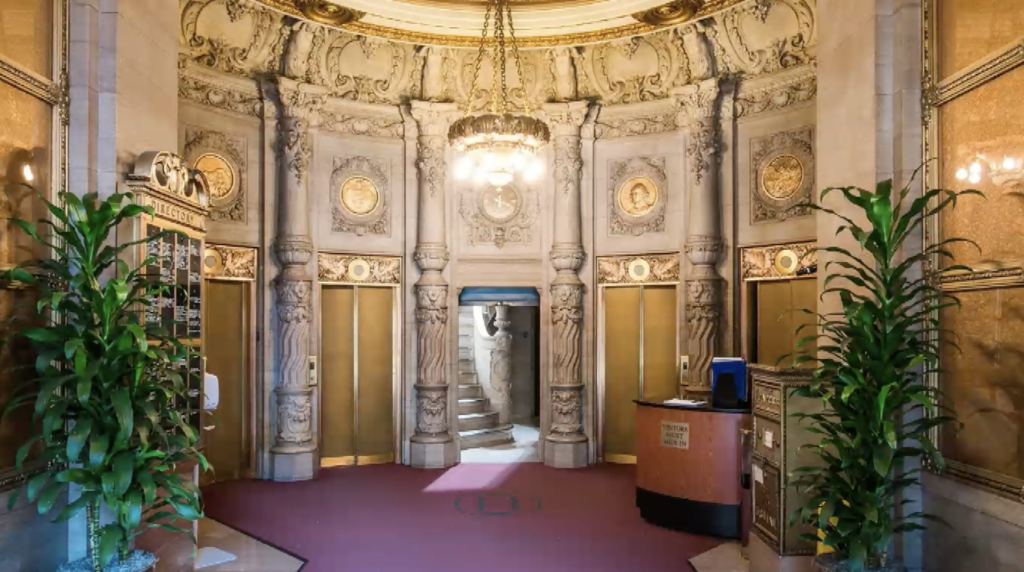
Maybe it should be a hotel.
But under the Sunshine Ordinance, the city can’t give tax abatements to a private developer unless that developer makes public its profit and loss statements.
Maggie Mattson, a staffer with the Office of Economic and Workforce Development, said that turning the building into a hotel would have positive impacts on the local economy. The city would reap $577,000 a year in new property taxes. Leigh Lutenski, director of development for OEWD, told the supes that the overall positive economic impact of the project could be more than $36 million.
Fair enough.
But Sup. Connie Chan noted that past efforts to revitalize parts of the city with tax breaks didn’t work out so well: The Twitter Tax Break was, in retrospect, a total disaster.

She said that this kind of project-by-project tax cut plan is incoherent, and that OEWD should present an overall plan for downtown economic development.
But there’s a larger issue here. Mattson said the project has a “demonstrated funding gap,” and that without the city money, it won’t pencil out. That gap was “vetted by a third party.”
Maybe so. We have no idea if that’s true.
The public has at this point no access to that “third party” report. It’s not in the board files.
By law, the public must see the developer’s pro forma, the profit and loss statements, the information we need to know if, in fact, this project really needs $40 million in taxpayer money, or if that’s just going to pad the developer’s profit margin.
From Section 67.32 of the Sunshine Ordinance:
The City shall give no subsidy in money, tax abatements, land, or services to any private entity unless that private entity agrees in writing to provide the City with financial projections (including profit and loss figures), and annual audited financial statements for the project thereafter, for the project upon which the subsidy is based and all such projections and financial statements shall be public records that must be disclosed.
I asked the Mayor’s Office for that information. The response: We don’t have it; ask OEWD. I asked OEWD for that information. The response?
Because this request is not “simple, routine, or readily answerable” (as stated in Section 67.25 of the San Francisco Administrative Code), OEWD will respond on or before February 13, 2026, as permitted by San Francisco Administrative Code § 67.21(b) & California Government Code § 7922.535.
By then, this will already have gone to the full board for approval.
Dorsey points out that the state has offered $30 million in tax incentives for the renovation of this historic property, and that offer expires in April.
Perhaps this is a grand use of the taxpayer’s money. I am always dubious about tax cuts for private for-profit developers, but there are times when tax-increment financing might make sense.
Just show us the figures. Otherwise, this is a serious violation of a law that was put in place to make sure that developers didn’t scam the taxpayers.