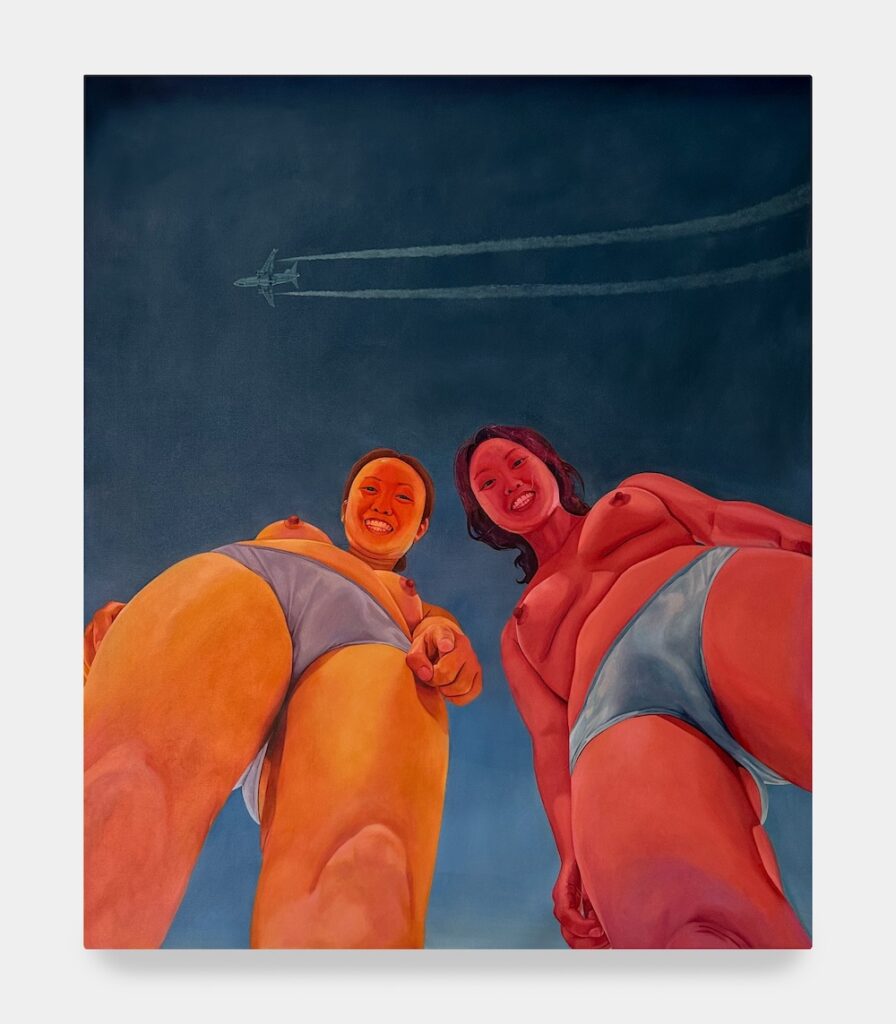
Describing her own work as disquieting, humorous, and kaleidoscopic, L. Song Wu creates paintings that impose a sense of witnessing something that is perhaps more personal than we should be allowed. In her work, Wu questions how to expand the way we define ourselves. She admits to having a fascination with all forms of spectatorship, from surveillance to voyeurism.
“In this day and age, we are all viewers of someone and being viewed by someone else. There are so many artists, writers, and scholars who think about this, so I am rife with resources,” Wu said.
Wu grew up in Tampa Bay, Florida and came to the Bay Area to study at Stanford where she completed a BS in Mechanical Engineering and a BA in Art Practice. She considers herself primarily a self-taught painter but with an emergent ceramics and installation practice, she aspires to become a more interdisciplinary artist. Currently living and working in the South Bay and staying in the loop with the art community of the greater Bay Area, Wu also spends time in Italy where her partner lives.
During the pandemic, Wu says she observed artists like Sasha Gordon and Amanda Ba rise to prominence in New York right out of college, which gave her the confidence to pursue painting more dynamically.
“I didn’t know anything about the art world or how to actually get works of art into the market, but seeing them become full-time artists broke some sort of barrier in my head. Of course, reality is much more complicated, but I discovered a lot from peeking an inch behind the thick art world curtain. Much of what I learned is too hindering to care about, but that was very transformative for me, and it gave me the momentum to figure out how the gallery system works,” Wu told 48hills.
Her influences are numerous, though Wu distills it by saying she is deeply inspired by artists whose lives reflect the way their art is made. Wu gathers eclectic perspectives as a reminder that there are countless ways to live.
“I look to figures like Nikki de Saint Phalle, Veijo Rönkkönen, Octavia Butler, Lauren Lee McCarthy, and the Beijing East Village artists. These are individuals who truly embodied their work in how they lived. I find it aspirational to live your art, which can mean so many things. It is perhaps the greatest privilege an artist can have,” Wu said.
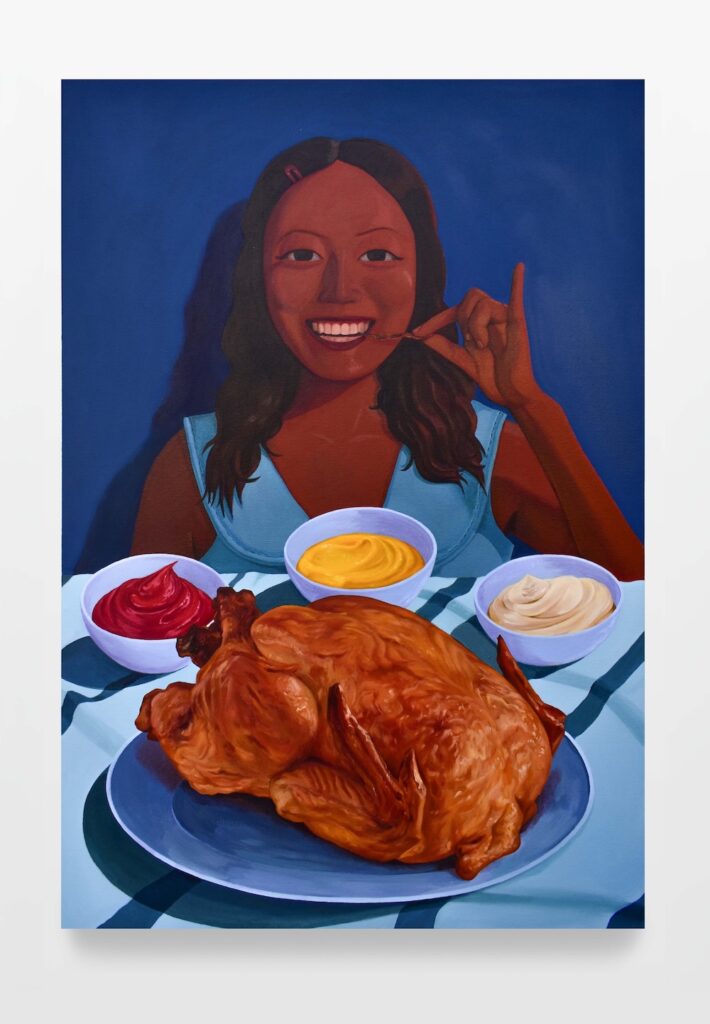
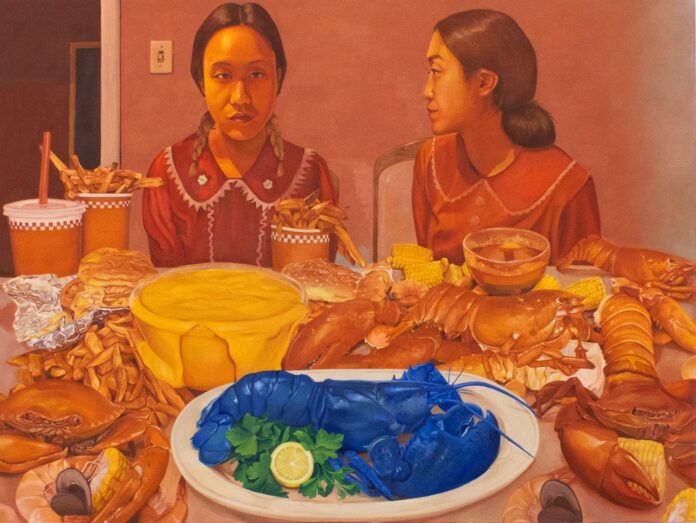
In talking about her recent solo exhibit Feast, which closed in January at Johansson Projects in Oakland, Wu references what shaped the work for the show and how she draws inspiration from mukbang influencers—a eating-based performance genre she describes as driven by an insatiable demand for consuming the largest quantity, the most expensive, or the rarest of items.

“Sometimes I think mukbang creator Nikocado Avocado might be the greatest performance artist of the decade,” she said.
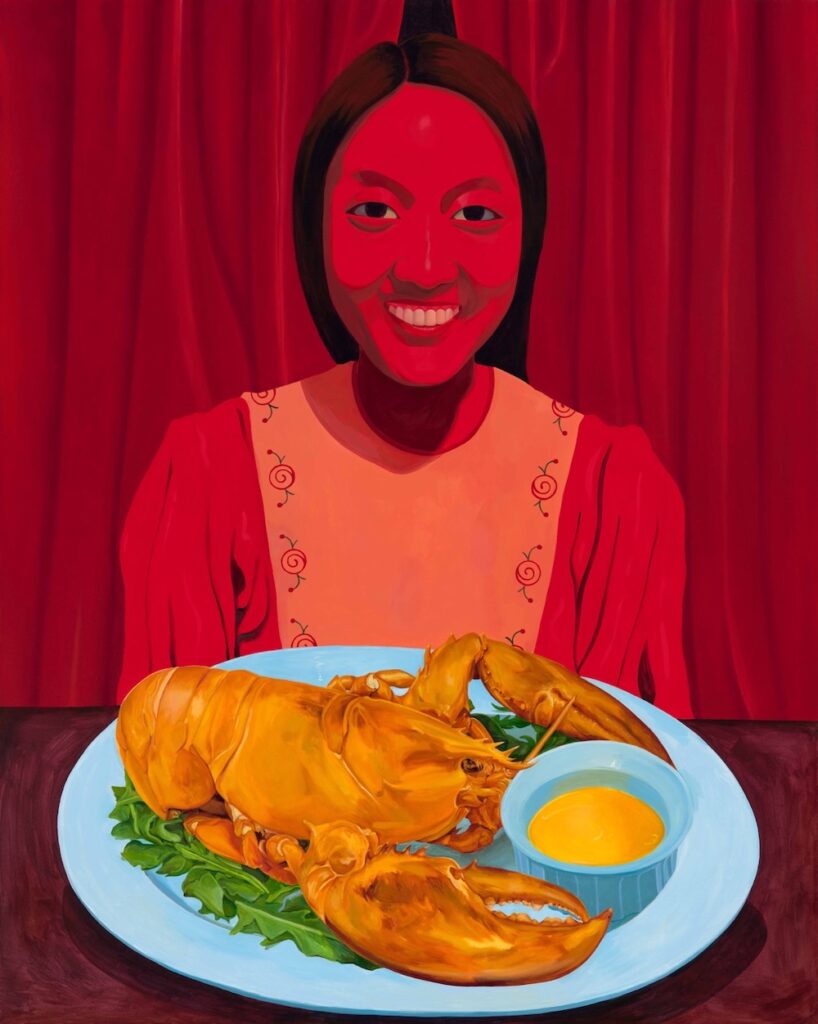
She goes on to say how her two recent paintings, Blue Lobster and Gold Lobster, were fueled by mukbang, in which seafood is a popular feed.
“I encountered a video of a blue lobster—a natural occurrence in just one of every two million—and was struck by the thought of a food streamer attempting to eat one. The same fascination applied to the even rarer gold lobster. The popularity of such spectacular seafood speaks to a broader cultural obsession with scarcity and the exotic, a theme that permeates everything we consume. Like much of contemporary life, mukbang and content creation at large often reflect a cycle of uninterrogated, Faustian growth,” she said.
Wu has been a consumer of vast amounts of internet content from a young age, and many of her compositions are also influenced by YouTube thumbnails.
“They are perfect, if you think about it, because they are engineered to be the most eye-catching tiny rectangle you will encounter. Beyond that, while making this series I thought often about the works of Koak, Julien Ceccaldi, Nicole Eisenman, Candice Lin, and Kerry James Marshall, to name a few,” she said.
Wu is most drawn to figurative and representational work, and likes to explore the expansive emotional landscapes of femininity and contemporary internet culture.
“More specifically, my work investigates alienation, spectatorship, fetishization, and the tension between objecthood and personhood,” she said.
Wu’s preferred media are oil and acrylic paint, which she values for their practical convenience.
“I am also compelled by how much I have yet to learn about the materials. This ongoing discovery keeps our relationship fresh and exciting,” she said.
Wu has been working from the living room of her one-bedroom apartment since she graduated from college and says that everything revolves around making room for her art, even if it means clutter. Because the environment is not ideal in terms of space and ventilation, she paints on unstretched canvas and avoids unnecessary chemical modifiers.
“A neat trick I learned in undergrad is to keep and clean your brushes in canola or safflower oil as an alternative to solvents,” she shared.
Wu says that her position as program coordinator at the Institute for Diversity in the Arts at Stanford University has greatly influenced her as well.
“It is easy to become cynical about people, but working at IDA has reminded me that it is so much more rewarding to be open, generous, and curious,” she said.
Wu keeps an intense schedule, especially if preparing for a show. After putting in hours at her day job, she paints from 8pm until 1am, largely on the weekends. The first time Wu created a solid body of work was in 2022, after finishing the book Ornamentalism by Anne Anlin Cheng.
“It prompted me to begin thinking about how the anime girl acts as a vessel for our desires, and Cheng’s question, ‘What does it mean to survive as someone too aestheticized to suffer injury but so aestheticized that she invites injury?’ It gave me a lot of material to work with,” she said.
She admits that it was a lot of fun to create those paintings, but that she ultimately decided to shift away from the subject of anime girls because she felt like the criticisms she was making about spectatorship and East Asiatic femininity were being lost.
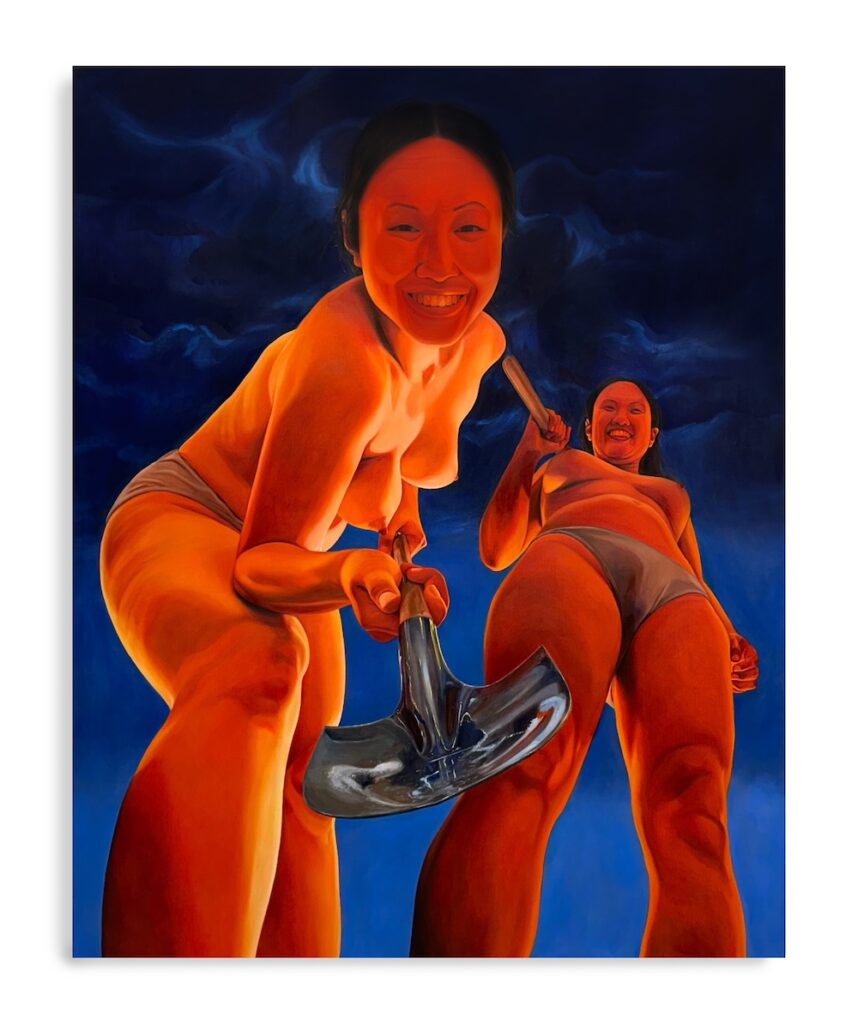
“It felt uncomfortable to be making paintings that some people saw as arousing, so I decided to make even more uncomfortable and confrontational paintings, like DIGGERS (2024) and Just Friends (2023),” Wu said.
Wu acknowledges that her work changes drastically from one series to the next, which used to concern her. She has since decided that she prefers to do work that is more specific to who she is in the moment and, therefore, impossible to replicate.
“My idea of what an artist’s life should be has also changed so much and continues to change. As I see more art and visit more places, I gain more perspective. I just want the ability to keep making work around whatever is interesting to me at that moment and trust that when I zoom out on my career after a couple of decades, there will be a really interesting story to see,” Wu said.
After a rigorous December preparing for her solo show, Wu is jumping straight into new projects. Along with fellow artists Bhumikorn Kongtaveelert and K. Sid Zhang, she organized a speculative storefront that takes place in the year 2100 at Bathers Library in Oakland, under the umbrella project Future Finds, which runs through February 22. In addition to the exhibit, it brings together artists across the Bay Area to show work, give talks, lead workshops, and present performances around the topic of climate change and the environment. On February 7, Wu co-facilitated a talk with her friend Elias Aceves (founder of Plurinational Land Reform In California Working Group) addressing the question of how we would purchase food if grocery stores no longer existed.
Currently immersed in a winter residency at Upstream, near Yosemite National Park, Wu has been provided with an opportunity to connect with other artists and have dedicated time and improved space for artmaking. Consequently, she has three new projects underway.
“I want to deepen my exploration around food, disasters, interiors, and play more with subject versus viewer dynamics. I have to take deep breaths, remember that an artist’s oeuvre spans decades, and remind myself that I have time!” Wu said.
As L. Song Wu continues to dive into fresh ideas aiming to inspire awe, she says her ambition is that the emotions people experience upon viewing her work are not too straightforward, and that they stay open to unexpected complexities.
“Perhaps they’re humored but uncomfortable, or delighted yet repulsed. I understand that my work is not for everyone. But for the people that it’s meant for, I hope that it sits in their psyche, and that they spend time trying to figure out what it could mean, like the vision of a specter. In an aspirational sense, I hope that my work produces the same sensation one feels when witnessing pure magic,” she said.
With regard to garnering courage within the creative process—for herself and others—Wu advises that if you don’t see anyone doing the things you want to do, remember that the future is constantly making itself.
“Also, take the work seriously but don’t take yourself so seriously.”
For more information visit her website and on Instagram.