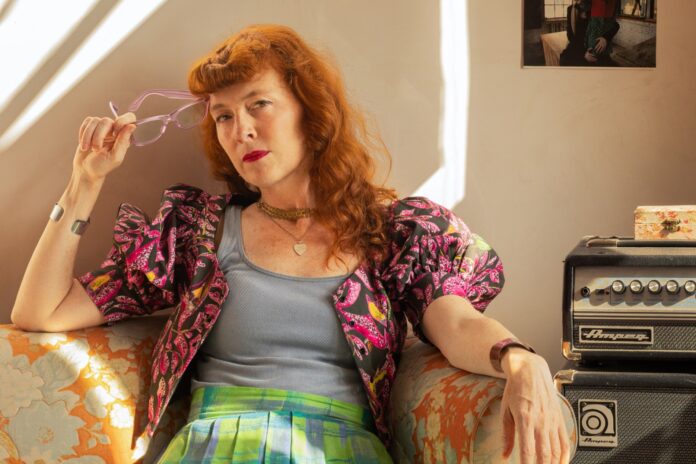
Melissa Auf der Maur does not speak about the ‘90s like someone trapped in nostalgia. Instead, the former Hole and Smashing Pumpkins bassist dives into the decade as if she were trying to rescue a few sacred things from the wreckage.
“I just realized that I had been running from the ‘90s in many ways,” she tells 48 Hills from the Dublin, Ireland, stop of her Even the Good Girls Will Cry book tour. “As much as I loved my wild and chaotic life, I stored a lot away to deal with later.”
Her memoir, which she’s promoting locally at two readings at Booksmith (Wed/22; 7pm and 9pm), opens not in her native Montreal or in Courtney Love’s birthplace of San Francisco, but backstage at the Reading Festival in England in 1994, with Hole about to play for 65,000 people.
Love is in a backstage trailer wearing a white lace bra and fishnet stockings, cigarette dangling from her mouth, spray-painting a giant pink heart on a Marshall amp. Auf der Maur, then only 22 and just weeks into her tenure in the band, is nearby in a children’s T-shirt, suede miniskirt, and combat boots, quietly applying lipstick before stepping onstage.
In the book, the politically minded, artistically restless kid from Montreal—raised by a feminist mother and a larger-than-life journalist-and-politician father—describes herself as “an absurd grunge Cinderella” who had suddenly found herself at the center of a rock-and-roll myth in progress.
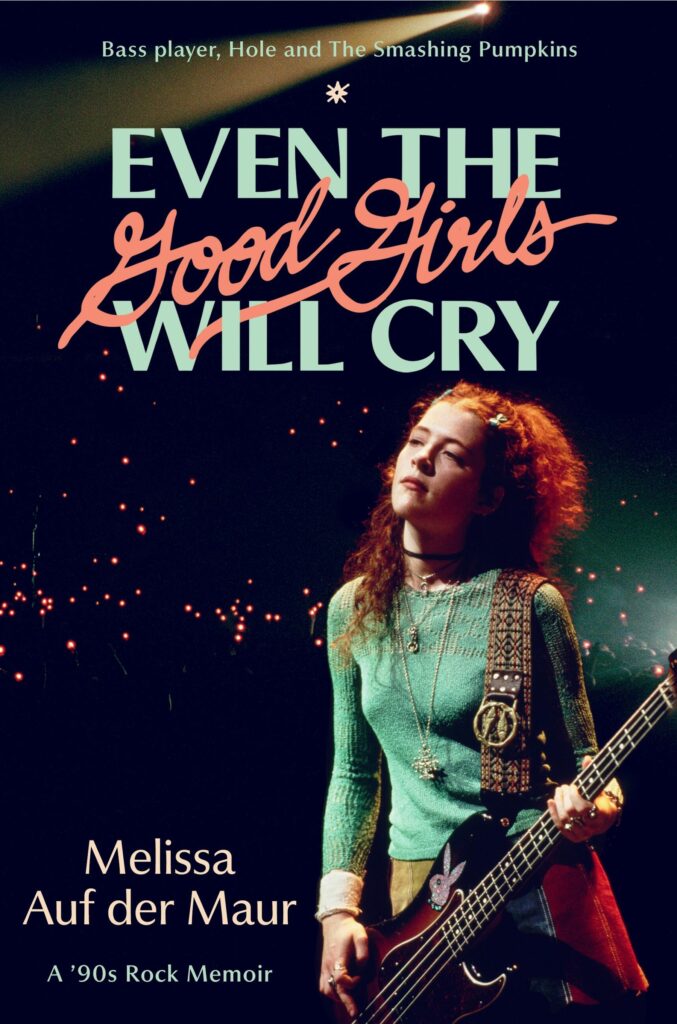
Auf der Maur had joined Hole only weeks earlier, replacing bassist Kristen Pfaff after her heroin overdose death at 27. She entered a world already defined by grief, chaos, addiction, and the enormous shadow of Kurt Cobain’s recent suicide at the same age, making Pfaff and Cobain tragic members of the so-called “27 Club.”
She writes that joining the band “created an intensity that made me feel I had to honor both the living and the dead.”
That moment becomes the memoir’s emotional and spiritual launching point.

Before going onstage at Reading, she slips into a bathroom stall and photographs herself, trying to mark the moment before her old life disappears.
“This was meant to be,” Auf der Maur tells herself in the book, to quell any lingering anxiety. “They found me for a destined reason. Through the David Lynch looking glass I go. I am ready. I am here with you.”
That dreamy, mystical sensibility runs throughout the memoir. Long before Auf der Maur joined Hole, she believed there was something bigger guiding her life. The book includes dream sequences, including a terrifying vision she had at 19 in which a sinister figure delivered the phrase that would eventually become the book’s title.
“The truth is, a demon did give me the title of this book,” says the bassist. “When I wrote this dream down that I had when I was 19, when a demonic force whispered, ‘Even the good girls will cry’ as a strange warning in my ear, it terrified me.”
The experience becomes a kind of mission statement for the book, initiating “a new way of seeing” for the bassist.
The memoir is dedicated “For my daughter River, and all the girls,” and Auf der Maur says becoming a mother is one of the reasons she finally confronted the decade she spent years trying to outrun.
“When people ask me, ‘Why did you write your memoir now?’ it’s very micro and macro,” she says. “The tiny answer is for my daughter. So that I, as her mother, could unpack, purge, heal, and move into my middle age in a graceful, well-processed way. The larger one was just for all women in the history of women being treated like shit in the world.”
That anger and purpose run through the entire book. Auf der Maur repeatedly frames the ‘90s as a transitional moment, when underground analog culture collided with predatory capitalism, celebrity obsession, and digital life.
“The book is a love letter to the last decade,” says the bassist. “I do feel very much that Gen X not only had the analog world but also the digital world. We get to live half and half, and we get to develop as analog creatures while experiencing this new transhuman cyborg world we’re entering.”
In the book’s opening pages, she writes that she and her peers were “warning and mourning simultaneously,” sensing that the world they loved was already disappearing.
Looking back on the losses that haunted her generation—Shannon Hoon, Brad Nowell, Layne Staley, Scott Weiland, Chris Cornell, and so many more—Auf der Maur sees the deaths as part of a larger collapse.
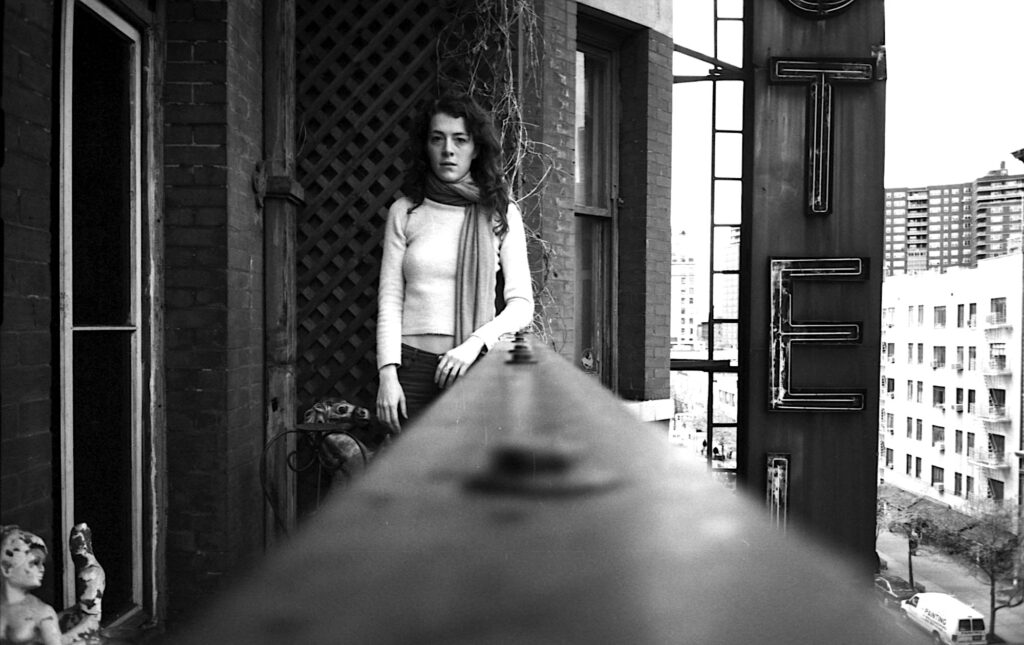
“Our generation is remarkable and tragic because we witnessed the end of the world as we knew it,” she says. “The broken poets of our generation felt that. I think the pain of witnessing our generation become pawns of predatory capitalism was debilitating as we approached the painful birth canal of the 21st century.”
No city represents that lost world for Auf der Maur more than San Francisco.
“The thing I love about San Francisco is that it’s a city like Montreal,” she says. “San Francisco is magic, the way Montreal is magic. I’ve always said there are two kinds of cities: cities that shape you and cities that are blank slates. San Francisco shapes you.”
The city appears in the memoir as a place of accidents, origin stories, and strange collisions. It is where Love spent her goth years, where Joe Mama—Love’s oldest friend from those days—reappears backstage at Reading holding a can of spray paint “like a trophy,” ready to help her through one of the darkest moments of her life.
It is also one of the places where Auf der Maur first learned how scenes are built: not by corporations, but by weirdos, clubs, bookstores, promoters, and cheap apartments.
In the book, she describes arriving there in December of 1991, at the age of 19, on a one-way Greyhound bus ticket with only $200 in her pocket and no place to stay.
“I spent Christmas Eve seeing a Flipper concert [at Paradise Lounge] and talked my way backstage at the Cow Palace’s New Year’s Eve show, featuring Red Hot Chili Peppers, Pearl Jam, and Nirvana,” says Auf der Maur. “Staying in a squat, San Francisco instantly felt like home.”
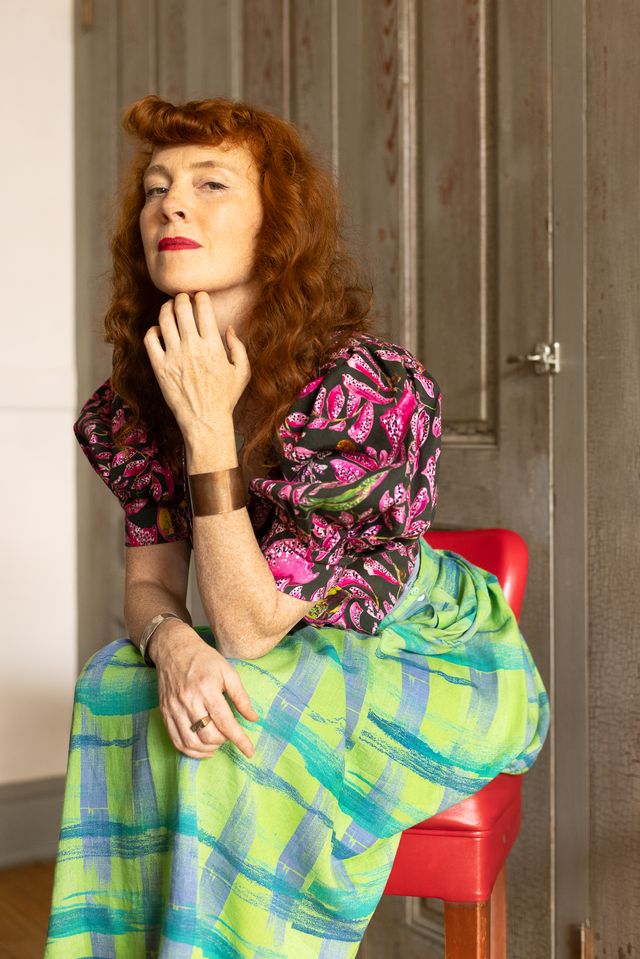
In the book, San Francisco exists as part of a network of independent cities—including Montreal, Seattle, Portland, and Olympia—where local music scenes still had room to breathe.
“My commitment to taking the book on the road is to be an ambassador for analog, not in the form of nostalgia, but in the form of future power,” she says. “When we are coming together as a people to make art and to make magic, there’s got to be an in-person version.”
That is why she feels grief about what has happened to San Francisco.
“I haven’t had enough San Francisco in my life, but now I am concerned about what has happened to it,” says the bassist. “We’ve watched tech bros, property values, and corporate interests wipe out a wonderful city.”
She sees San Francisco’s transformation as part of the same larger story that runs through her memoir.
“It’s the equivalent of the Industrial Revolution burning our planet down,” she says. “But it is the tech revolution that is mining our attention and souls.”
Auf der Maur’s feminism is inseparable from that critique. She rejects the easy idea that the ‘90s were a golden age of female empowerment.
“From afar, between ‘Oprah,’ ‘Sex and the City,’ supermodels, and Lilith Fair, it looks like female power, but it wasn’t, actually,” says the bassist.
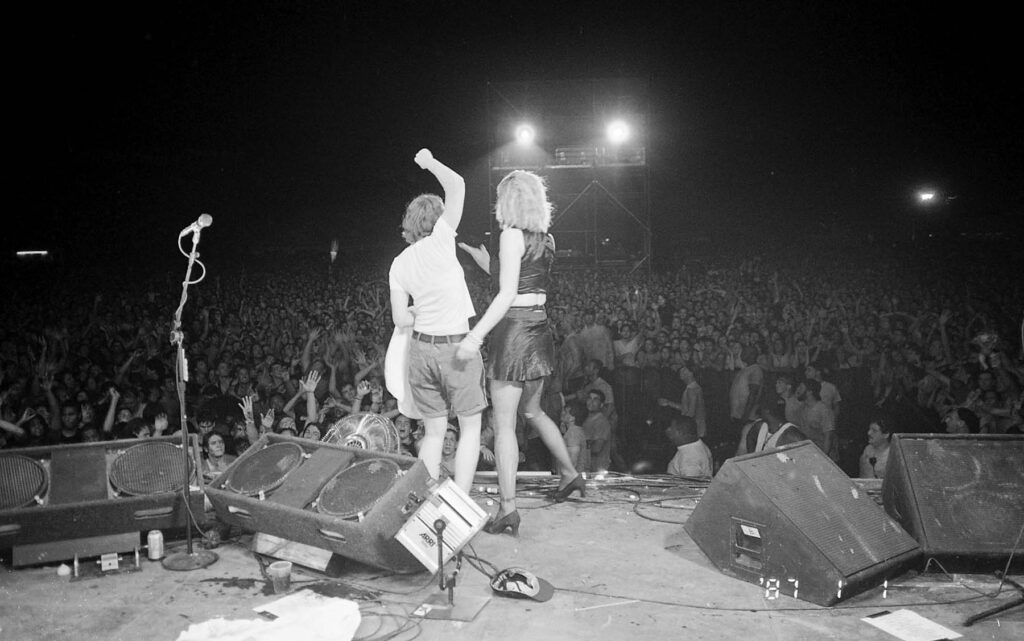
She remembers being surrounded by incredible women musicians—L7, Babes in Toyland, and Sonic Youth—but says that by the time Hole became mainstream, they were still often the only women on festival stages alongside Marilyn Manson, Korn, and Limp Bizkit.
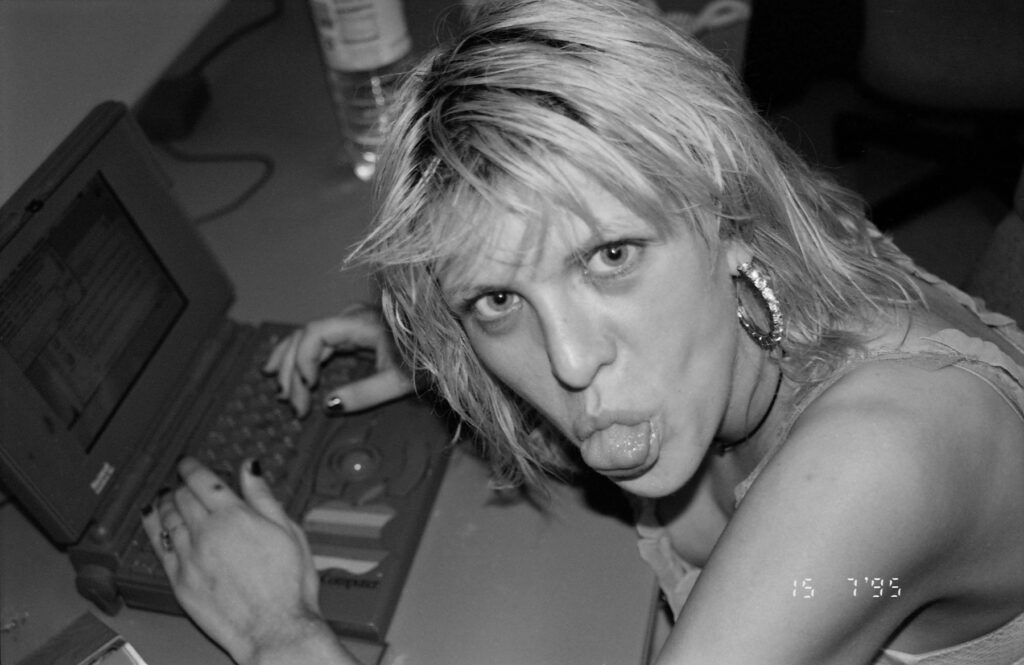
She remains especially angry about the way Love was treated.
“Courtney was treated like a Medusa monster,” she says. “She was a mentally unstable drug addict, yes, but she was also an abandoned single mother. There was just no place for human compassion back then.”
Auf der Maur says one of the reasons she survived the endless public feuds between Love and Billy Corgan and former Nirvana members was because she refused to get pulled into them herself.
Even though she had an unusual vantage point inside multiple worlds—playing with Hole, later joining The Smashing Pumpkins, and dating Dave Grohl—she says she was never interested in these battles.
“I stayed off social media,” says Auf der Maur. “I never stooped down into the drama. All those Twitter wars are literally power struggles. I am zero interested in power. I am only interested in the authentic truth of self and kindness.”
Her complicated relationship with Love is still unfolding. Auf der Maur says Love’s new solo record is “fantastic.”
“I sang all over it,” she says. “I came in at the end to give the siren call around her amazing growl. I left that five-day session electrified by being able to admit how much I miss wrapping my angelic voice around her wild growl.”
Love hinted at the possibility of taking their act on the road in an Instagram post last month, captioned: “So do we tell the kids about the tour @xmadmx?”
“If we’re lucky, it will line up, and we’ll be able to share a stage again,” says the bassist. “But there are no details.”
At the center of the memoir, though, is not celebrity gossip or music-industry mythology. It is grief.
“By all means, the most painful thing, and one of the motivations for writing the book, was to heal myself from the traumatic death of my father,” she says.
The book traces the collapse of her father’s health—he died in 1998 at 52 from addiction-related illness—and the unraveling of drummer and Roddy Bottum associate Patty Schemel after Hole pushed her out.
“I aim to show in this book that you can’t escape challenge and pain, and that they make you bigger, better, and stronger,” says the bassist. “That’s what I think all artists do well: if you can spin magic out of garbage, you’re living a better life.”
That phrase may be the closest thing Auf der Maur has to a personal philosophy.
In recent years, she has focused more on photography, filmmaking, and arts advocacy, including founding the New York arts space Basilica Hudson. In 2016, she returned to San Francisco for the San Francisco International Film Festival with her husband, filmmaker Tony Stone, whose documentary Peter and the Farm screened there.
Her memoir is ultimately not about fame or tragedy, but about trying to hold onto magic in a world determined to flatten it.
“The bass, in particular, connects with the actual way that people are throbbing in a riot of crowds,” she says. “That is the most sacred thing I will ever have done in my life, other than create life in my belly, which is my daughter.”
BOOKSMITH PRESENTS: MELISSA AUF DER MAUR / EVEN THE GOOD GIRLS WILL CRY Wed/22. The Booksmith, SF. More info here.