
Senator Bernie Sanders and Rep. Ro Khanna warned this week of the profound dangers of AI—but also offered proposals to ensure that the explosive new technology benefits all of us, not just a tiny cadre of billionaires.
Speaking at a town hall at Stanford, Sanders was blunt: We are facing, he said, the “most profound technological revolution in history.” (He noted that some AI leaders say that before long, the technology will be smarter than humans—”although that’s not a very high bar.”)
Given the stakes, he said, Congress should be asking questions that it is almost entirely avoiding: “Who is pushing this, who benefits, and who gets hurt. Will a handful of billionaires benefit, or will the general public benefit?”
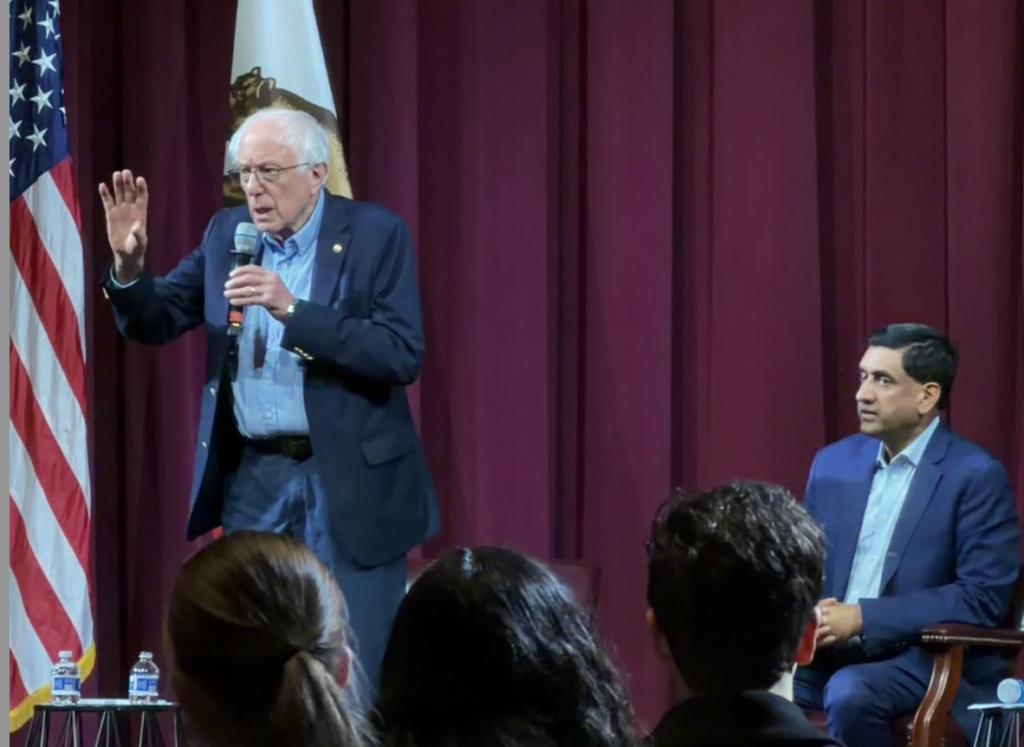
Sanders asked whether the likes of Elon Musk, Mark Zuckerberg, Larry Ellison and Peter Theil were working for the benefit of humanity, as they often insist, or for their own personal benefit. “I know these guys,” he said. “I don’t think so.”
He asked that we as a society slow the technology down a bit, so that our regulations can catch up. His simple pitch: A moratorium on new data centers.
Khanna said that it’s critical to “keep humans in the loop.” If AI leads to substantial increases in productivity, those gains should be shared by all workers, not just the investors and tech lords.
(As UC Berkeley Professor Robert Reich is fond of pointing out, the fundamental problem with the US economy is that 100 percent of the wealth gains for the productivity increases in the past 30 years have gone to the top 10 percent, most of it to the top one percent.)
He also called for a Future Workforce Administration, to do what the federal government did during the New Deal.
Khanna added: After every losing election, the Democrats do an “autopsy,” and talk about “messaging,” and “charisma,” when they need to talk about policies that will matter—like taxing the billionaires to pay for education, health care, good jobs, and affordable housing. “We don’t want to offend the corporate interests,” he said.
And that model hasn’t worked.
Now that the state Democratic Party convention is over, the local democrats will hold their endorsement meeting Wednesday/25, with the local party, controlled by corporate democrats, deciding on who to back for supe in D2 and D4. The Democratic County Central Committee will also decide who to endorse in the School Board race and the one judicial race.
The party establishment is controlled by the billionaire slate that won over a progressive slate last year. The San Francisco party is now the right wing of the state party.
That means the incumbent supes will likely get the endorsement.
For the challengers, “no endorsement” would be a big win. The DCCC endorsement carries the party label, but also gives the candidates prominent mention on the Democratic Party slate card, which goes out to every registered dem in the city. More than 50 percent of the voters in both D2 and D4 are registered democrats.
No endorsement means no name on that card.
School Board president Phil Kim is on the ballot because he was appointed and hasn’t yet faced the voters. He’s a charter school guy who worked for years for KIPP, a big national charter school chain. His main opponent, Brandee Marckman, works for the San Francisco Education Alliance, which opposes charter schools. Interesting to see where the billionaire slate comes down on that one.
Same with the judicial race, which pits a prosecutor, Phoebe Maffei, against a public defender, Alexandra Pray.
Oh, and there’s a weird resolution congratulating Another Planet Entertainment on the reopening of the Castro Theater. Not clear why this is on the agenda, but it lauds “8,000 individuals who … wrote letters to the Historic Preservation Commission, Planning Commission, and Board of Supervisors.” A lot of those people were against APE’s remodel.
That meeting starts at 6:30 at the Milton Marks Auditorium, 455 Golden Gate.
A measure that would undermine the city’s limits on chain stores (and undermine the hotel workers) is back at the Land Use and Transportation Committee Monday/23 after a delay of several months. The bill sounds harmless: ” Ordinance amending the Planning Code to allow additional uses as principally or conditionally permitted in Historic Buildings citywide.”
In reality, it would undermine the city’s laws limiting chain stores and would hurt the ability of labor unions to demand project-labor agreements for new hotels.
Former Sup. Matt Gonzalez, who wrote the chain-store limitation law, is opposing it, as is former Sup. Aaron Peskin. From our original breaking story:
Former Sup. Aaron Peskin, who has reviewed the legislation, said that North Beach generally doesn’t allow chain stores, which are known in the code as “formula retail.”
“If this passes, you could put in a Starbucks,” he said. “In the Sunset, you could put in a cannabis dispensary without any public hearing.”
In some cases, the building owner wouldn’t even have to go through the Historic Preservation Commission; the planning director has the right to approve “temporary” retail uses.
Former Sup. Matt Gonzalez, who wrote the original legislation back in 2004 that required a conditional use hearing for formula retail outlets, told me Lurie’s bill could create an incentive for owners to push out local businesses and replace them with higher-paying chains.
Another element: In San Francisco, building a hotel requires the cooperation of labor, what’s known as “card-check neutrality.” If the workers want a union, management can’t interfere.
“That goes out the window with this bill,” Peskin told me. Put a hotel in an historic building and all the rules are off.
Meanwhile, Sup. Rafael Mandelman, who voted for the mayor’s Rich Family Zoning plan while winning some protections for historic buildings, is seeking to landmark 26 buildings in his district.
That meeting starts at 1:30 pm.
The Board of Supes will hold a final vote on a plan to give a downtown luxury hotel $40 million in tax incentives—although the Mayor’s Office has refused to make public data that is required under the Sunshine Ordinance.
In essence, the supes and the public are supposed to take the word of the developer that the project won’t work without $40 million in public subsidies.
In the discussion Feb. 10, Sup. Matt Dorsey said that “whenever we’re doing something that is committing resources or in this case denying ourselves resources we have an obligation to be transparent with the finances.”
That hasn’t happened.
From the Sunshine Ordinance:
The City shall give no subsidy in money, tax abatements, land, or services to any private entity unless that private entity agrees in writing to provide the City with financial projections (including profit and loss figures), and annual audited financial statements for the project thereafter, for the project upon which the subsidy is based and all such projections and financial statements shall be public records that must be disclosed.
When I asked for that data, here’s what I got:
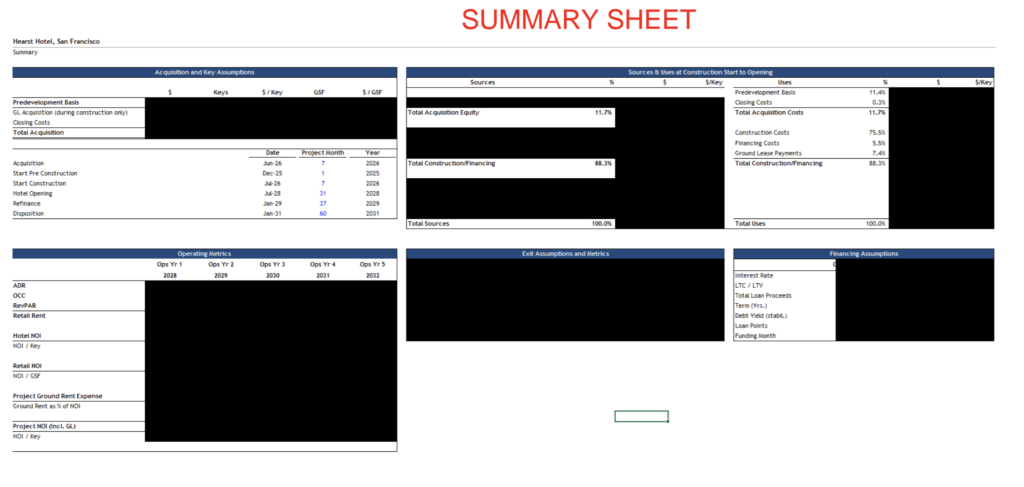
Sups. Connie Chan and Jackie Fielder voted against this proposal on first reading, but nobody has mentioned the serious Sunshine Ordinance violation.
The full board will also vote on a resolution affirming the city’s intent to take over PG&E’s assets and create a public-power system. It will pass; I wonder if anyone will vote against it, and if the mayor will veto it.
The full board meeting starts at 2pm.