48 Hills hit up the annual Noise Pop festival (February 19-March 1) to sample the indie music feast. Check out our full coverage here.
Less than a week after Christopher Owens at Noise Pop, another performer from Peak San Francisco Garage Rock appeared who’s been through hell and back.
I first became aware of the platinum-blonde bassist and powerhouse vocalist Shannon Shaw when she was part of Hunx & his Punx, answering Hunx’s mosquito-voiced ululations with a brassy contralto. Her own band Shannon & the Clams would emerge as one of the most successful bands to emerge from the SF rock scene circa 2009-12. Despite their nautical name and bubble-blowing imagery, there was always an element of intense grief under the Clams’ music; their best song is “Ozma,” about a dead dog, and their most recent album The Moon is In The Wrong Place came on the heels of the death of Shaw’s fiancé in a motorcycle crash in 2022, just weeks before their planned wedding.
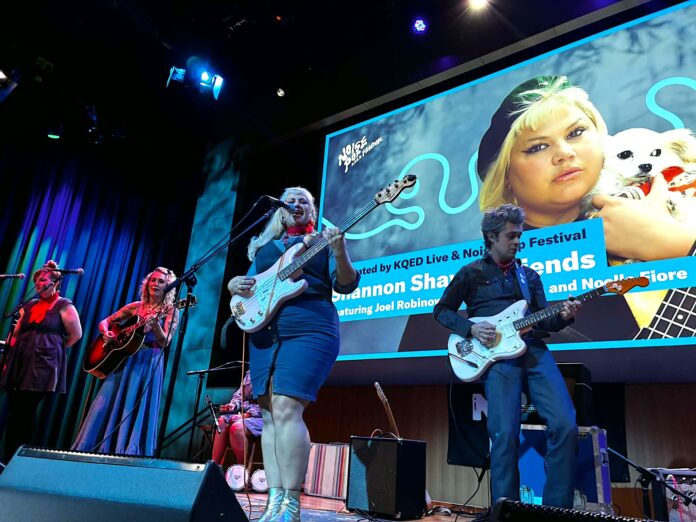
You wouldn’t know any of that from Shaw’s low-stakes KQED Live set on February 27, a light-hearted celebration of community that featured buddies like Joel Robinow (Once & Future Band), Noelle Fiore (Noelle & the Deserters), and singer-songwriter-trumpeter Anna Hillburg. All of these luminaries kicked off the evening with solo sets before Shannon and her omnipresent dog Spanky Joe sat down for an interview with comedian Baruch Porras-Hernandez.
Shaw’s subsequent set consisted almost wholly of songs from her only solo album to date, 2018’s Shannon in Nashville, the product of a fruitful collaboration with the Black Keys’ Dan Auerbach and a host of pros from country music’s first city. The title is of course a nod to Dusty Springfield’s Dusty in Memphis, exactly the kind of ‘60s pop reference in which Shaw delights. Just as that album let the London torch singer catch a secondhand spark from all the great blues and soul musicians who recorded in Memphis in the past, so did Shannon in Nashville inspire a balmy, nostalgic spark in the singer; songs like “Goodbye Summer,” with its fond reminiscence of jumping in rivers, and the grand American road song “Leather, Metal, Steel” feel more Southern than Cali.
The absence of the session cats who made Shannon in Nashville pop—and undoubtedly the hangaresque minimalism of the KQED hall, which couldn’t be different from the dive bars where she cut her teeth—meant the music felt just a touch drier than usual. The most distinctive feature of the Shannon & Friends band was the violin of Everyone is Dirty’s Sivan Lioncub, which trilled and shrieked like a singing saw or a theremin, adding a bit of Victorian cabinet-of-curiosities flavor to Shaw’s already potent blend of ‘60s bubblegum and John Waters thrift-store trashiness.
There was nothing to complain about with the sound, and though Shaw didn’t turn her voice inside-out with that sandpaper rasp of hers as often as she does with the Clams, she remains arguably the most distinctive vocalist to emerge from the garage-rock world in the last 15 years.
* * *
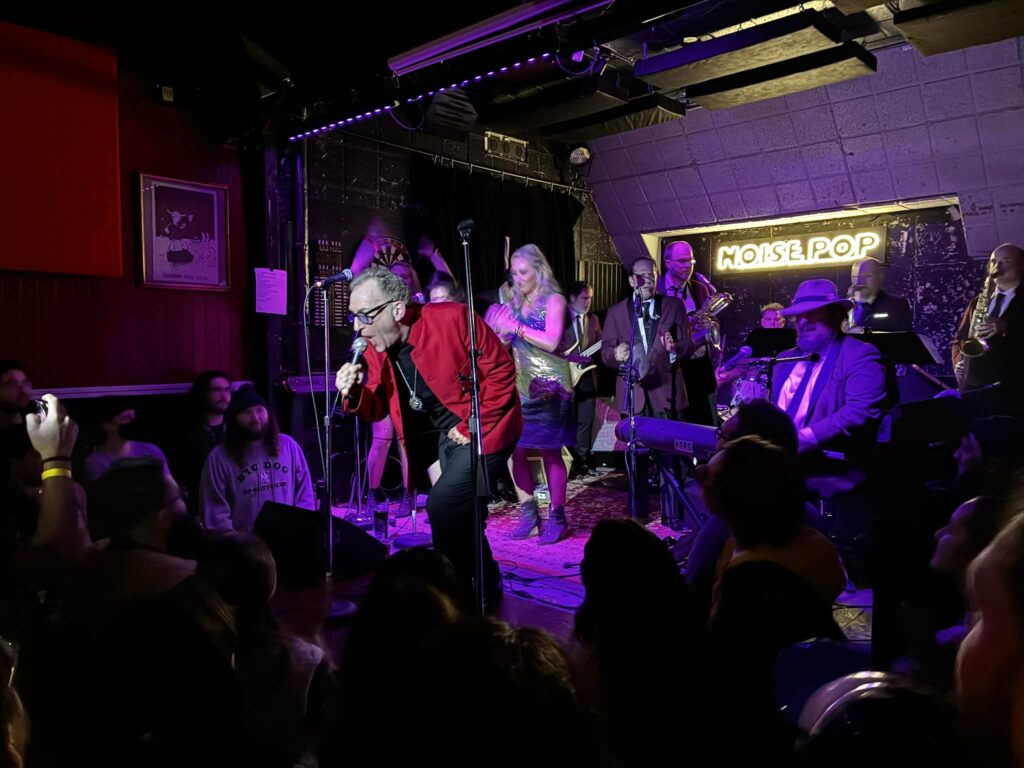
The night was still young, and I craved something looser and beerier after sitting under the glare of live cameras for so long, so after the set ended around 8:30 I hopped on the 22 and made a surprise appearance at the Tom Kenny & the Hi-Seas’ Kilowatt show.
Tom Kenny, as he was aptly introduced when he took the stage, is “the voice of a generation.” He’s been the voice of SpongeBob Squarepants since 1999, and he played the crabby and lovelorn Ice King on Adventure Time, as whom he got to sing some great ballads by the show’s resident bard Rebecca Sugar. Voicing cartoons with the same vigor as Kenny must require incredible lung capacity and the ability to scream your ass off, and Kenny proved he was gifted at both after he took the stage at Kilowatt.

The Hi-Seas’ canvas is classic R&B and soul songs—really vintage shit, like “Double Shot (Of My Baby’s Love).” I would love to see this guy’s record collection. There’s a curious junction between the world of cartooning and the deeper realms of music geekdom; recall R. Crumb’s endless days in front of the record player drinking in one hokum 78 after the next, or the fact that SpongeBob Squarepants is essentially an animated elaboration on Ween’s dark-nautical baroque-pop masterpiece The Mollusk.
I’ve really started to develop an appreciation for this kind of thing—the pre-Beatles world of horn sections, backup singers, dance crazes, and professionalism. I’m almost always more moved by a great party band than by someone trying to convince the audience that they’re a genius. When I’m listening to music at home or on my headphones, I’m more than happy to enter the slow, druggy world of ideas that took hold of pop music in the mid-1960s. When I’m at a concert, I want to be surprised, excited and exhilarated, and sometimes an outfit with zero original songs but plenty of dedication does the trick.
Kenny is a great performer, never mind the fearsome set of lungs required for his day job. Now 63, he looks like a cross between Bill Nye the Science Guy and Philip Baker Hall in Hard Eight, a weathered pro and a living hunk of Flubber rolled into a ruby-red jacket. He gave an enthusiastic shout-out to Bad Bunny for flipping the middle finger to “Bad Bondi,” and when someone handed him a Smitty Werbenjägermanjensen helmet (“he was #1!”), he finally obliged and did his SpongeBob giggle. It hardly seemed necessary at that point—he could’ve done anything and the crowd would’ve gone nuts.