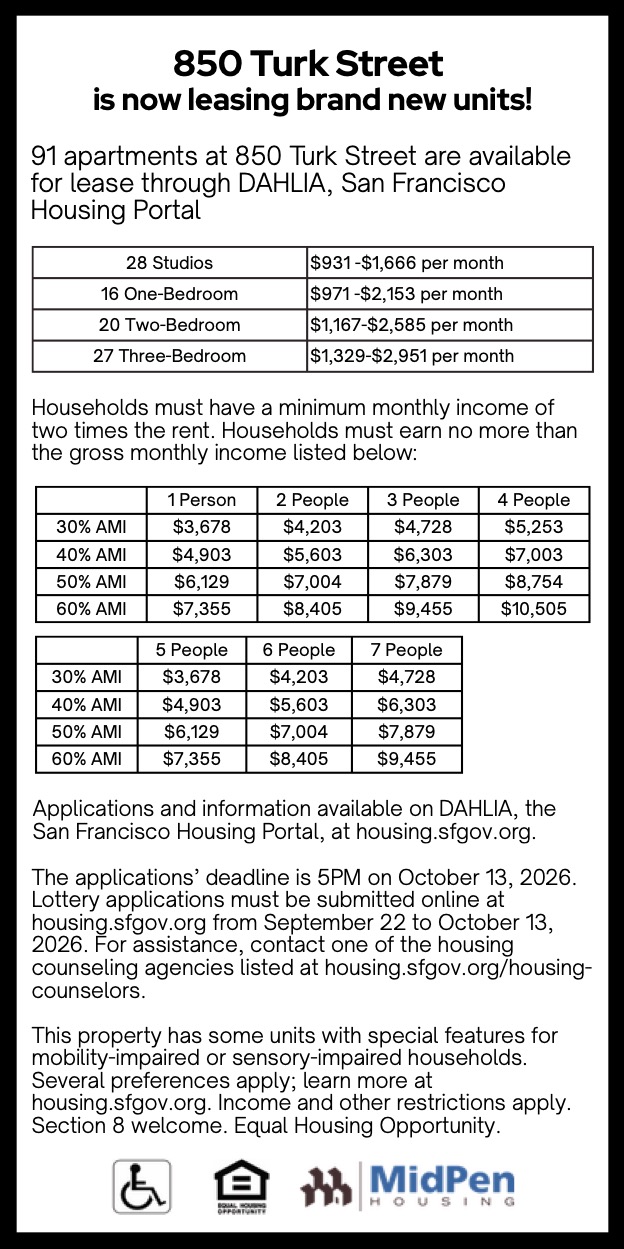
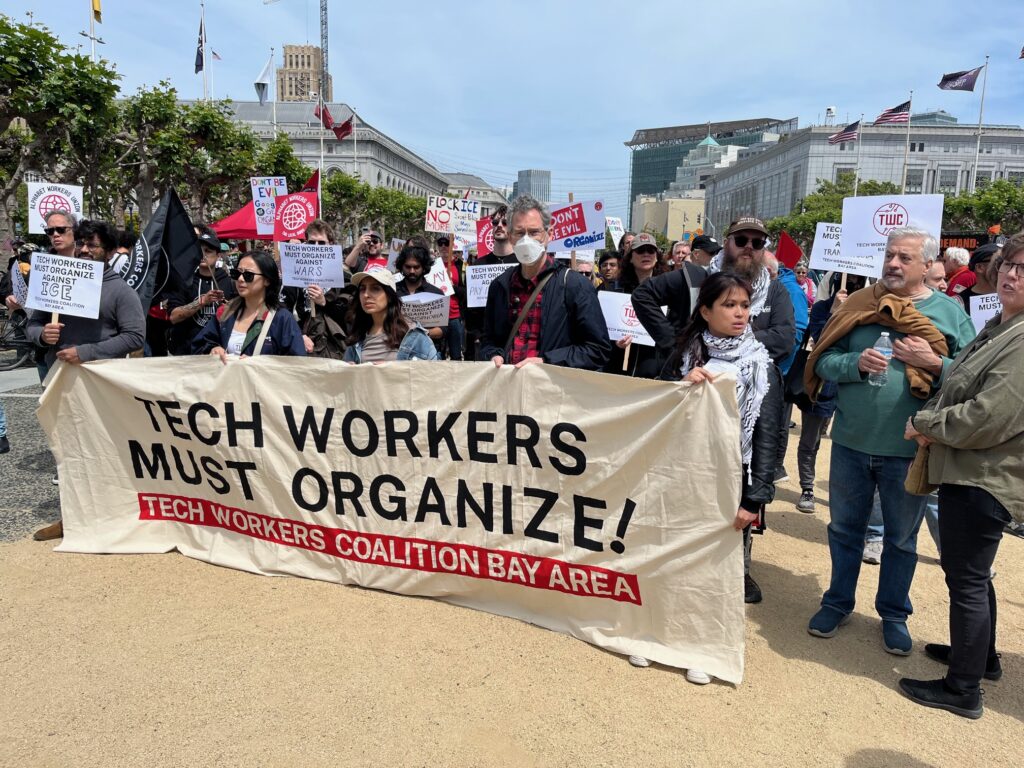
I saw plenty of energy, and plenty of young people at City Hall on May Day; maybe that’s because the high school and college kids all skipped class to go to the 2pm rally and march. Labor was out in force. So were tech workers who oppose the way some of their companies were sucking up to Donald Trump. A pretty broad coalition.
I also saw various socialist and communist groups, some of them pretty new and some of them sectarian orgs I hadn’t seen or heard from in decades.
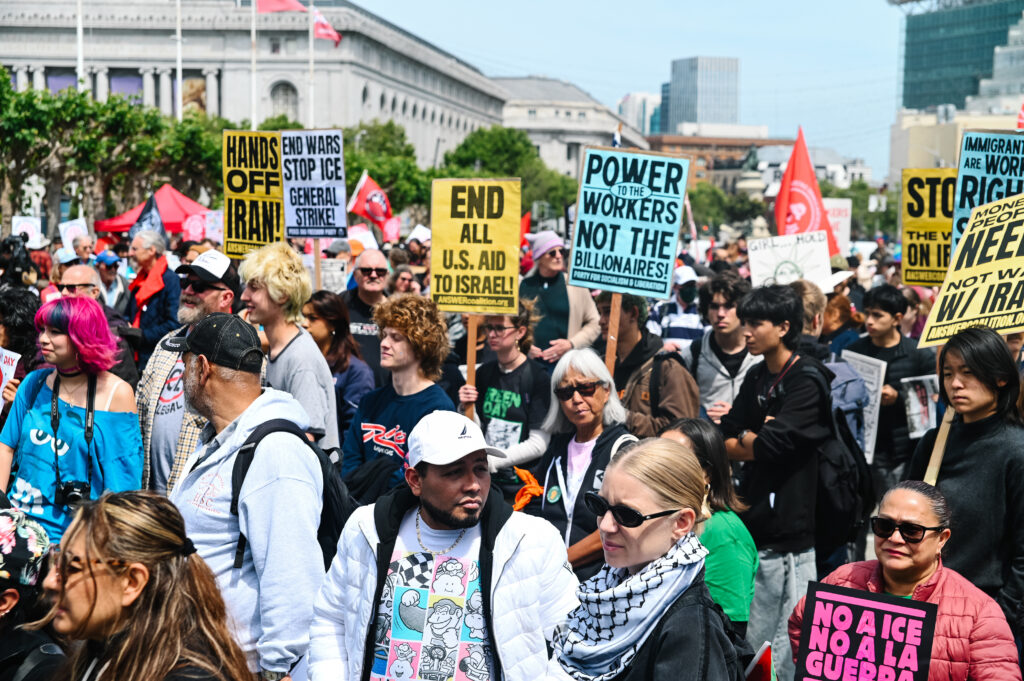
I learned that the Spartacists League (the last time I saw the Sparts at an event was in the 1990s) doesn’t like the Green Party, because the Green Party is working with the Peace and Freedom Party on statewide candidates, and P&F has some members who are affiliated with the Party for Socialism and Liberation, but the Green Party isn’t revolutionary enough. (Seriously, from a Spart flier: “Adding environmental justice to the list isn’t going to help.”) I saw the Revolutionary Communist Party (Maoists, sort of) and the Communist Party of America (Marxist-Leninists) on opposite sides of the Civic Center plaza; they don’t get along either.
Three different newer and smaller socialist organizations had tables, and none of them wanted to work with the Democratic Socialists of America, which has actually been effective in electing people (like the mayor of New York and former Sup. Dean Preston). DSA, as one person told me, is “too much of a big tent.”
So: A small tent is better for mass mobilizations and revolution? I love the fact that the left is not monolithic, and we all have different opinions and approaches, but rejecting a Big Ol’ Socialist Tent seems like a bad strategy to me.
I argued with one of the CPA folks about Lenin’s interpretation of Marx, particularly the concept of the role of the State, which is always a fun academic discussion. She told me I clearly didn’t understand Marx because I am not sufficiently indoctrinated into revolutionary theory (which is true, I suppose; god help me, I’m a registered Democrat and a huge fan of Thomas Piketty, who is more of a traditional European democratic socialist.)

The last time I saw the Sparts and the RCP at an event, most of the members were from my generation or older. May Day, 2026: Lots of young people. Polls consistently show that younger generations in the US are intrigued, not disturbed, by socialism, which makes sense. The Democratic Party, frankly, hasn’t offered them a lot. Few leading Democrats have been talking seriously about student loan forgiveness or free higher education, taxing the rich, or dramatic action to address climate change, among other issues that matter to the generations that soon will be running this country.
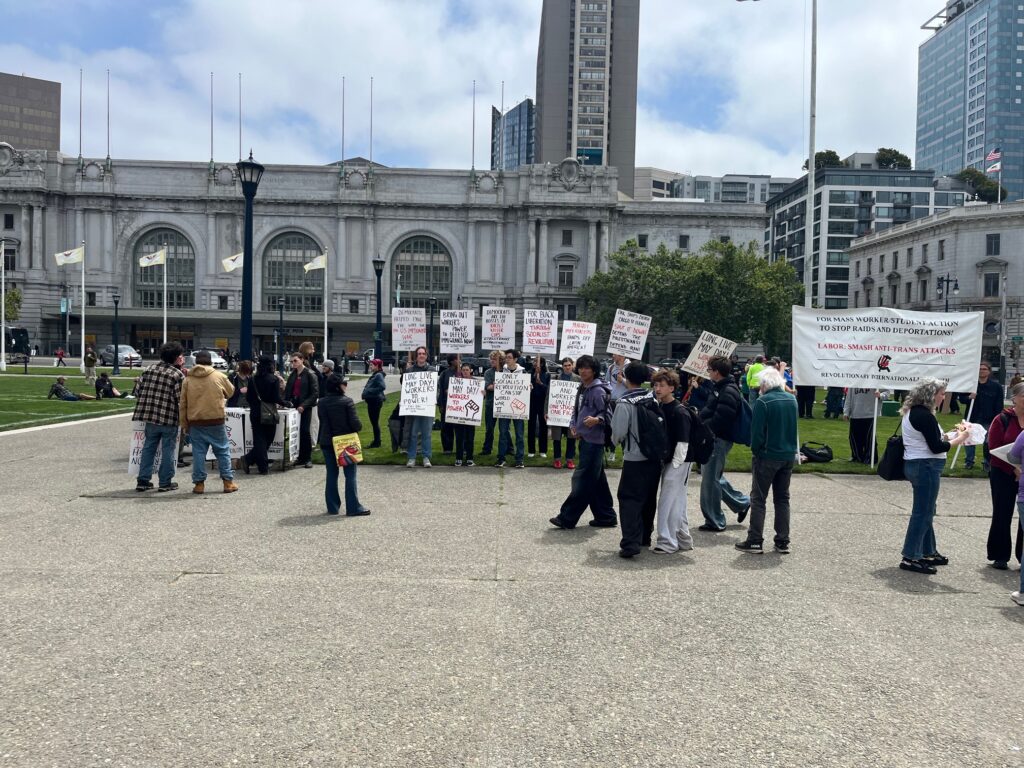
At one point, after chatting with all the groups (and I am always happy to talk Marxism and political theory with folks on the left, whatever flavor they prefer), I asked one of the newer socialist groups why there were three tables with a few people at each of them when they all pretty much agree on most things, and the disagreements are healthy and can be debated. Why not (gasp) one big table for everyone? You know, kind of like the DSA.

“That,” a guy staffing the table told me, “is a very good question.”
The voters will get to weigh in on lifetime two-term limits for supervisors and the mayor June 2. They won’t get to decide whether members of city commissions should be limited to three terms.
Instead, that will come before the Rules Committee Monday/4, when the panel considers a proposal by the Streamlining Task Force to cut some commissions, restructure others, and generally give the mayor more power. Snuck into the language:
generally establish the term and term limits of bodies, with four-year terms and three-term limits for Commissions, three-year terms and four-term limits for Advisory Bodies, and generally limit holdover service by members of bodies.
That would mean some of the best and most experienced commissioners (think Kathrin Moore at Planning) would be forced to step down—again, giving the current mayor and supes the ability to appoint members who are more conservative and more willing to do what the mayor says.
But wait, there’s more: Under the Charter Amendment that created this task force,
the Streamlining Task Force may introduce ordinances to effectuate its recommendations, and such ordinances shall go into effect 90 days after the introduction is published unless two-thirds of all Members of the Board of Supervisors vote to disapprove the ordinance.
When the task force creation was on the ballot, nobody talked about commission term limits. Now, there’s nothing we can do, since the mayor has enough call-up votes to guarantee this goes into effect.
That meeting starts at 10am.
The Government Audit and Oversight Committee will consider Thursday/7 a measure that would allow suspend the law limiting behested payments and allow the
Mayor, members of the Mayor’s Office, and the Executive Director of the Office of Economic and Workforce Development and each of their direct reports to solicit donations from nonprofits, private organizations, grantmakers, foundations, and other persons and entities for the purpose of supporting the continued economic revitalization of San Francisco.
That’s a pretty broad mandate. In essence, it says anyone in the Lurie Administration can ask any rich person or special interest to help the mayor with anything he can possibly define as “economic revitalization.” The behested payments ordinance passed as a way to curb rampant corruption. This might not be such a good look.
The full board will consider Tuesday/5 Sup. Matt Dorsey’s plan to fundamentally change housing policy in San Francisco. Dorsey wants to eliminate the concept of Housing First, the idea that the most important solution to homelessness is to get people into homes, even if they are still struggling with substance use issues. Dorsey wants to ban city funding for any permanent supportive housing that isn’t free of “illicit” drugs. That meeting starts at 2pm.