In over 40 years as an activist, writer and communications person for assorted advocacy groups, I’ve seen the news media operate from nearly every angle, a lot of that work having to do with some aspect of health and health policy. And I’m here to tell you not to depend on the mass media as your go-to source for critical health information.
That’s not to say there’s no good reporting out there. There is, but it’s inconsistent and not nearly frequent enough, and that situation continues to get worse. But don’t despair: You can find reliable health policy and medical news if you know where to look, and we’ll get to some specifics in a little bit. But first, because I’m just a ray of sunshine, let’s run through what’s wrong. (You can scroll to the end for the list if you like.)
OLD BAD HABITS MEET NEW TECHNOLOGY AND FEWER RESOURCES
For as long as publishers have wanted to maximize profits, newspapers used sensationalized reporting, eye-popping headlines (“Headless Body in Topless Bar”) and simplified storylines to snag readers. Radio and then TV added new possibilities. Now it’s online clickbait. The technology evolves but the basic approach barely changes because it works: Tell a vivid, gripping story that grabs the attention of readers/viewers/listeners and holds onto it.
Unfortunately, a clear, gripping storyline often has little room for subtlety and nuance, and medical research is all about subtlety and nuance. As a result, complex but important concepts either get dumbed down or, too often, left out entirely. Crucial caveats get downplayed or omitted.
This can manifest in all sorts of unfortunate ways. For example, highly preliminary and tentative research can be presented as much more important than it really is. I can’t tell you how many times I’ve seen studies of potential new treatments for serious illnesses like cancer or ALS presented as if they represent a huge breakthrough in patient care. But somewhere buried halfway through the story there’s a brief mention that the research was only done in mice, or even laboratory cell cultures, with zero evidence yet that the new approach will work in actual humans. That’s just not a stage of research that rates a screaming headline.
And then there’s the now-infamous tendency of mainstream media to both-sides things, simulating the dubious concept of objectivity via balance: Quote both sides and let the audience make up their own minds. That works fine if both sides are dealing with reality, but not when one side claims the earth is flat when it manifestly isn’t. Happily, in relation to Trump administration health policy—and the sanewashing of Health and Human Services Secretary Robert F. Kennedy Jr. that I complained about last year—that appears to have diminished a bit. Media reporting has become a bit more willing to spell out just how far out in left field many of Kennedy’s statements and actions are, even if unfortunately sanitized descriptions like “vaccine skeptic” still show up too often.
Added to the mix, sadly, has been a drastic cutback in newsroom resources across the industry. Media consolidation, often centralizing ownership in the hands of a few big corporations frequently controlled by billionaires, has decimated reporting staffs across the board. A recent commentary in STAT laid out the grim picture: Roughly 3,500 newspapers shut nationwide in the last 20 years, leaving many communities with no local newspaper.

Even newspapers that have survived, like the recently rescued Pittsburgh Post-Gazette, have faced staff cuts, leaving health and science coverage in peril. Top-tier newspapers haven’t been immune. The Washington Post lost a couple crack health reporters in its recent Jeff Bezos-induced staff cuts. Californians have felt the effects of cuts up and down the state, from the Chronicle to the Los Angeles Times and beyond. Some science-focused publications have struggled, too, with National Geographic implementing cutbacks and Popular Science having dumped its print magazine 2023.
The devastation extends to broadcast as well, with cutbacks announced in the last year at, among others, CBS as well as NBC and CNN. I could go on.
A number of nonprofit outlets, national and local, have sprung up and are attempting to fill some of the gaps, this one included. Many do fine work, but thus far they don’t exist at anything like the scale that’s needed to replace what’s been lost.
Add to all this the manic news environment that’s been with us throughout Trump 2.0. From trade wars to real wars to mass federal layoffs to dismantling entire agencies without congressional OK to federal agents gunning people down in the streets and on and on, the parade of insanity would be hard to keep up with even if news outlets were fully staffed across the board. In this environment, even something as big as a week of congressional grilling of RFK Jr. gets covered, but the coverage is often lost in the shuffle. It’s tough out there.
CAN WE TALK ABOUT COMPETENCE?
Alas, even before staff cutbacks and the arrival of the second Trump administration, a disturbing amount of health reporting simply lacked basic competence. To illustrate, let me tell you a story from my very first communications job, at the Marijuana Policy Project early in the George W. Bush administration.
The very first media call I got after taking that job came from a health reporter at a major newspaper in the middle of the country. Knowing my organization advocated for medical marijuana laws, she asked if I could react to a newly published study, wondering if it might represent a setback for the movement.
The study, she explained, involved a pharmaceutical formulation of THC, the psychoactive component of cannabis, used as an appetite stimulant in late-stage cancer patients. Compared to another drug used for the same purpose, it didn’t do as well.
I said, roughly, “I’m happy to take a look and comment. Could you send over a copy of the study?”
Somewhat sheepishly the reporter replied, “I only have the press release.” I told her to send that over, which she promptly did. It quoted one of the researchers saying the study would likely “dampen enthusiasm” for marijuana-related substances in this category of patients.
It took me all of about two minutes of searching to find the actual study online, and happily, I was able to access it for free, often not the case with scientific journals (another barrier). I quickly read through it and learned a couple of salient facts not mentioned in the press release. First, the study used a minimal amount of THC, a starter dose that’s often inadequate and frequently must be increased to get any benefit, and second, the research was funded by the makers of the competing drug.
While those elements didn’t quite prove the study worthless, they sure made any sweeping conclusions from it highly suspect, which is precisely what I told the reporter when I called back. While she quoted a bit of what I said, she made no mention of those two essential facts, and I’d bet money she never took time to read the study.
But the point I want to make here is not about one reporter or one article, it’s that this happens more often than you may realize. At least once this year, in my capacity as volunteer media guy for Defend Public Health, I’ve found myself talking to a reporter who’d called to interview me about a document they clearly hadn’t read, or a misleading press release. As newsroom resources get stretched thinner, this problem will likely only get worse.
SO WHERE CAN YOU TURN?
None of the above is meant to convey that no good health or health policy coverage happens in the mass media. The New York Times, for all its well-documented faults, has done some excellent work. Pro Publica has put out some fine investigative stories. The US edition of The Guardian regularly approaches RFK Jr.’s reign of error with the necessary skepticism. Somewhat surprisingly—to me, at least—tech publications like Ars Technica and Wired have done some very good pieces on vaccine policy and other key issues. Other outlets come through here and there.
But the massive flow of important health-related news right now is more than any of these outlets are likely to be able to cover consistently and thoroughly. For that, you need to look to news organizations that focus specifically on health. For the most part I’m focusing on the newsier sites, not ones that deal mainly in opinion, though some of those are definitely interesting (and at times grimly amusing), and the ones I list do include commentary and analysis. I’ve also limited the list to sites covering a fairly broad array of health-related issues, rather than outlets focused on individual conditions or groups, which would make the list enormous. Most, even the ones behind a paywall, offer a free newsletter. Here are a few places to start:
KFF Health News: A solid, nonprofit health newsroom with content and multiple newsletters available at no charge, and that also makes its original reporting available free for other outlets to reprint. It’s straightforward, newsy, consistently competent, and written for lay audiences. If you have no budget and no tolerance for medical terminology, this is a good place to start.
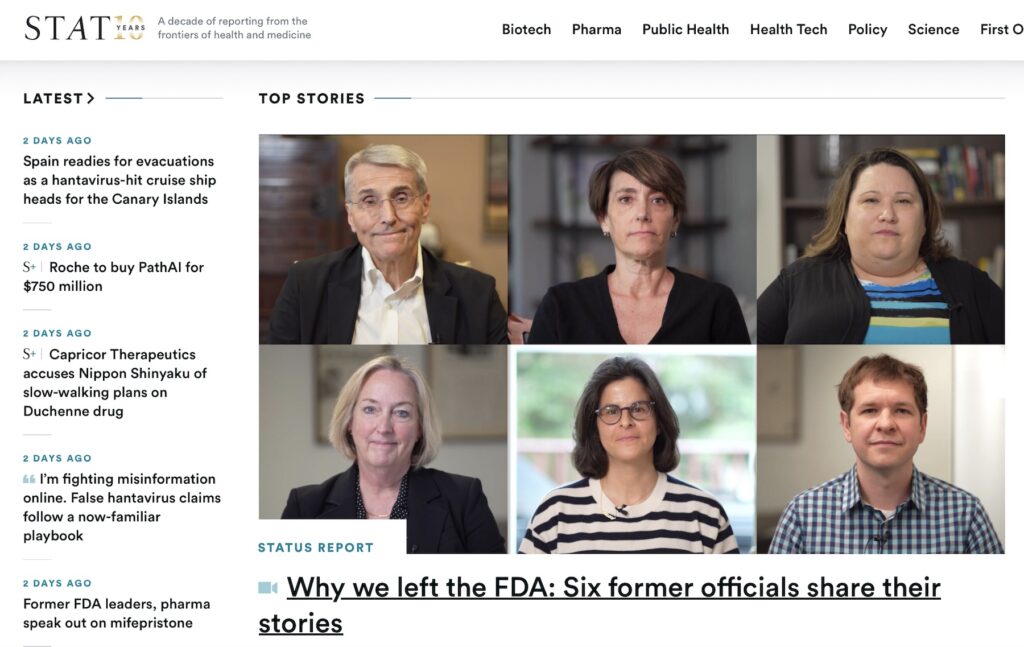
STAT: This is written primarily for health professionals, so you’ll have to cope with some technical terminology, but much of their material is reasonably comprehensible. Unlike others listed here, this is paywalled, alas, but if you give them your email address (yeah, I know, I hate that too), you get three free articles a month plus a newsletter with decent summaries of the morning’s main stories.
MedPage Today: A good, comprehensive site of medical and public health news and opinion with no paywall. Written largely for health professionals, some articles get a bit technical, but much of the content, like an excellent recent opinion piece on systemic racism in healthcare, is perfectly user-friendly for lay people.
Inside Medicine: This Substack site/newsletter, put together by MedPage Today’s editor-in-chief, Jeremy Faust, M.D., gives his personal take on key issues, and sometimes gets some major scoops. Faust, a hospital emergency medicine physician, clearly has some well-placed sources, making this a must-read. For example, in late April, he was the first to publish a paper on the effectiveness of the most recent COVID vaccines that the RFK Jr.-dominated CDC had censored.
CIDRAP: Produced by the University of Minnesota Center for Infectious Disease Research and Policy, this is a great source for solid, science-based information on infectious diseases, vaccines and related issues.
Your Local Epidemiologist: This Substack site/newsletter put together by an epidemiologist and a small team zeroes in on a handful of issues a week, offering useful insights on a variety of issues, ranging from new COVID variants to gun violence. It’s usually pretty light on medical jargon.