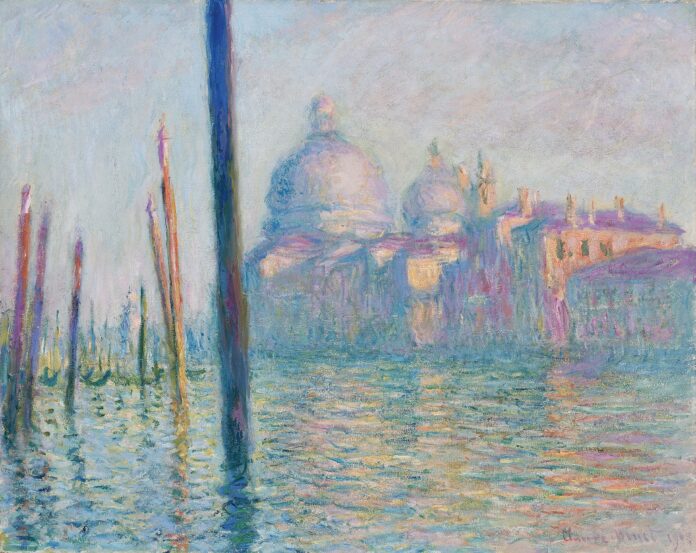
The de Young’s Monet and Venice (through July 26) is a luminous and expertly curated exhibition, as much about affirmation as art. Something about the idyllic city paired the artist’s painterly eye with a transportive pacing, matching his mastery off texture and times passage with an exhalation of joy. Long looks at Monet’s 20 canvases on display reward viewers with not just transcendent art, but the simple pleasure of travel through another’s excited, nostalgic eyes—especially comforting on a blustery April day’s viewing.
Because Monet was not the only artist attracted to “La Serenissima,” the nickname attached to the Republic of Venice due to its peaceful atmosphere, the exhibit also incudes significant paintings, watercolors, and prints by Canaletto, John Singer Sargent, J. M. W. Turner, and James McNeill Whistler. A number of paintings Monet completed before and after his single sojourn to Venice in 1908, along with vintage postcards, historical photographs, and a collection of other artifacts from the era expand the context in which his artwork based on the city is considered.
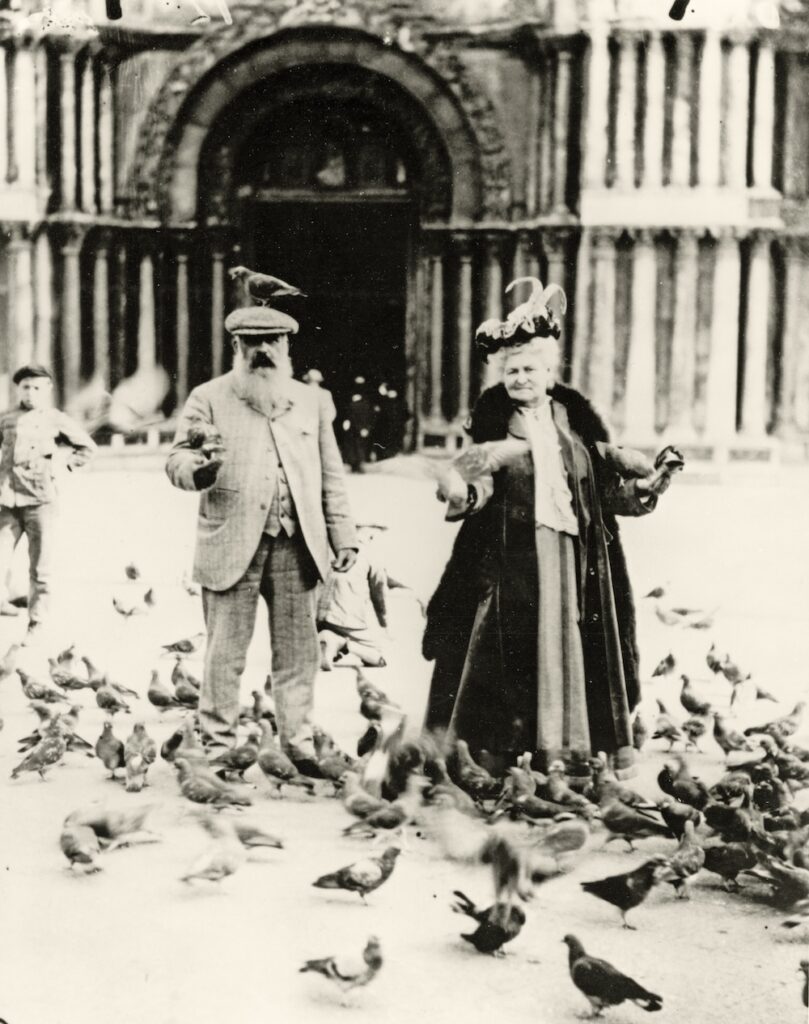
Art scholars and experts, historical documents, and letters written by his wife Alice Monet assert that Monet traveled to Venice reluctantly, but benefited significantly from his first and only time in the city. At age 68, having recently received poor response to his water lily paintings from a trusted advisor, Monet was at a low point in his career.
Encouraged by his wife to leave France temporarily to work in Venice, Monet agreed to take a two-week trip with her. They ended up remaining for two months. Text on display at the de Young reveals that Venice rejuvenated Monet, who went on to exhibit 49 magnificent water lily paintings in Paris in 1909—two water lily paintings are shown here—that received enormous, critical acclaim. “Without Venice,” says de Young curator Melissa E. Buron, “the work for which Monet is best known might not have reached the height of its creative expression.”
Monet himself asserted that his Venetian journey helped him “see his canvases with a better eye.” And his paintings of the city not only show Monet in full command of his technique and artistry, but in their various brush strokes, color choices, and compositions. They are precursors of future directions in art, and foundational to artists such as Henri Matisse, Wolf Kahn, Milton Avery.
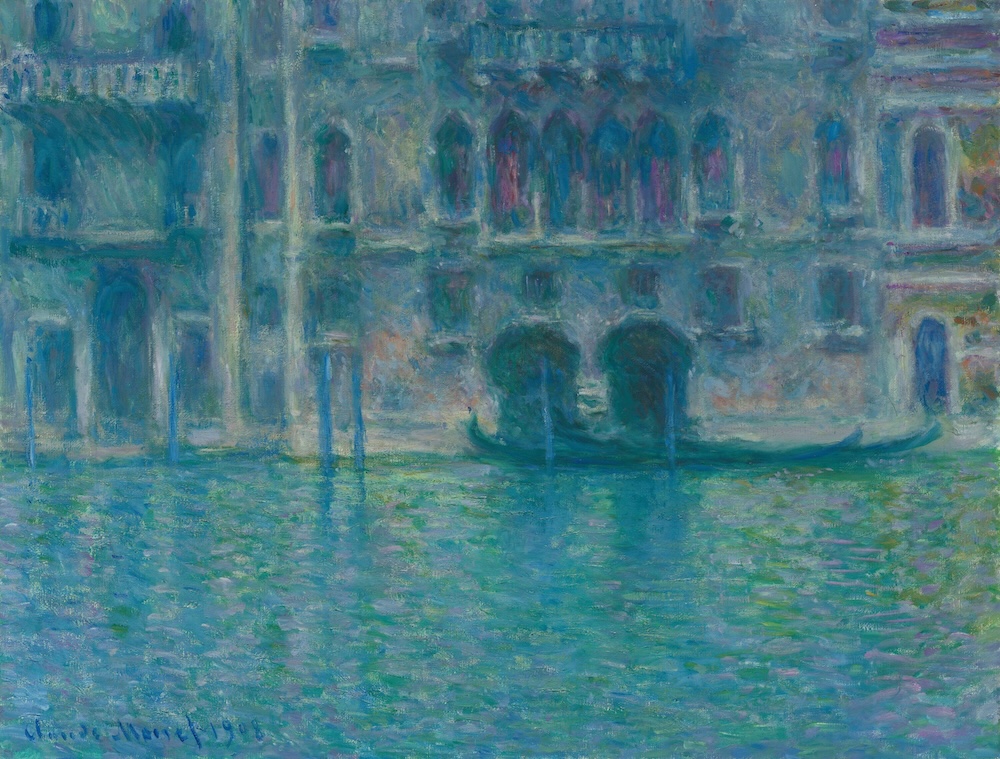
In one of the exhibit’s first galleries, a series of paintings Monet created in 1903 prior to his trip feature London’s Houses of Parliament. Capturing the combined effect of city fog and sunlight on building facades, canal water and the sky above, the notably thin layers of paint nevertheless result in deep, rich shades of purple, blue, gray, and off-white. In another work from the same year, “Waterloo Bridge: Effect of Sunlight in the Fog,” Monet shows his glorious subtlety while maintaining powerful visual impact. (The water lily paintings in the exhibit’s last room feature much thicker paint, showing the artist’s versatility.)
On a different front, “Rising Tide at Pourville” from 1882 utilizes energetic dashes of animating red, visible on the small waterfront cabin’s roof and exterior walls. That smoky red tone reaches full expression more than two decades later in “The Red House,” one of the most fascinating paintings in the Venice collection. The house in the latter painting is unabashedly bold; the red aggressively expressed, the gestures with brilliant purple and blue hues stand out amid nearby structures’ olive green walls, an overcast, gray-white sky, and deep blue-green water, gondolas, and foliage. Monet’s excursions to the side streets to capture the houses of Venice might seem a footnote to other works. In its making, “The Red House” forecasts that Monet would influence and change the trajectory of art history.
Among the most profound impacts of the Venice painting series is the way they invite a viewer to slow down. People choosing to resist the rush-rush of contemporary life to contemplate several paintings of the same location for more than two to three minutes may reap their full rewards.

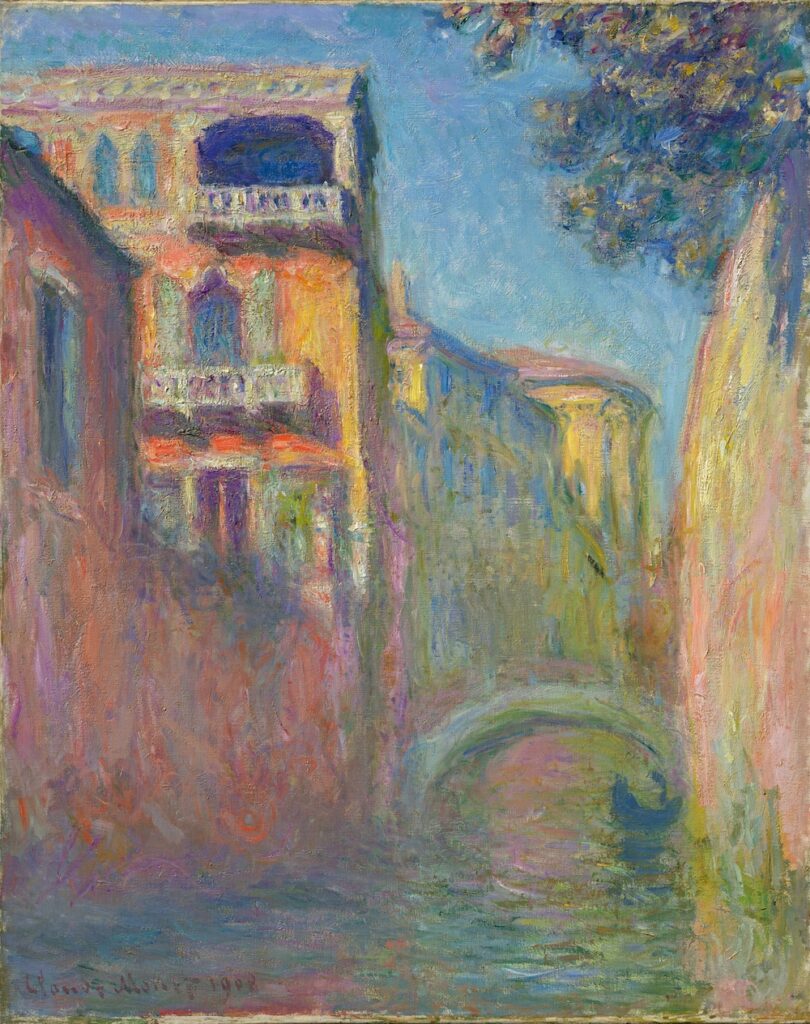
For examples, the longer a person looks at “The Grand Canal, Venice” paintings or the “San Giorgio Maggiore” series, the more subliminal awareness rises to its maximum effect, and variations emerge. It might be what is noticed is a single brush stroke in bold purple on the edge of a canal walkway in one work and not in another painting of the same scene. Or tender, tiny, and supremely simple vertical gray lines that at a glance could be overlooked. Upon closer examination, they leave no doubt they indicate human beings in the distance.
In the San Giorgio Maggiore series, the last painting with “at Dark” attached to the title glows attractively. Beyond “oohs” and “aahs,” a slow-paced onlooker might realize it is as if the world, having been bathed by the sun’s rays for hours, is set afire as day gives way to night. Time, this artwork suggests, does not stand still, but travels. Appreciating time’s passage requires patience, persistence, and lengthy, purposeful gaze.
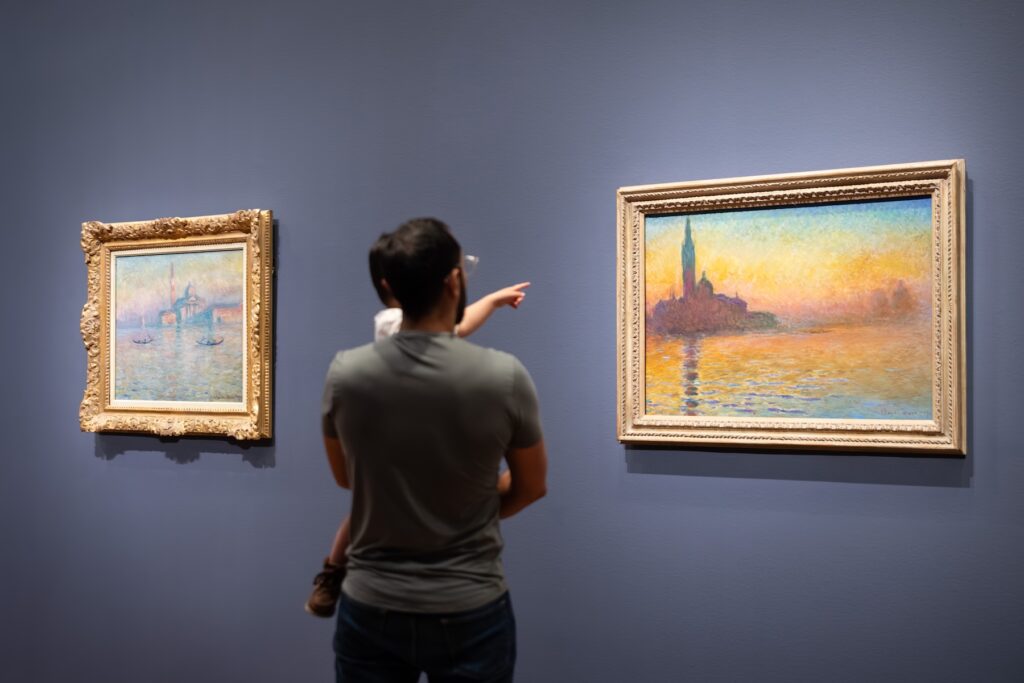
Among the special treats on offer in the exhibit co-organized by the Fine Arts Museums of San Francisco and the Brooklyn Museum are the attributes of the aforementioned art of Monet’s contemporaries. There is Canaletto’s tight precision, Turner’s delicacy and softness, Whistler’s “Nocturne,” a brooding etching of vessels on the water and the city’s distance shoreline printed in brown ink on paper. And the complexity of the compassion in a watercolor and graphite work by Sargent, “Santa Maria della Salute,” that is rendered with clarity and grace, avoiding the too-tight trap of being overly detailed, but entirely different than Monet’s atmospheric artwork.
Notably, there is one humorous piece amid all the seriousness that is not to be missed. “Self-Portrait on the Surface of the Water Lily Pond, Giverny” (1905), is a photograph believed to have been taken by Monet. Taken from the vantage point of the Japanese footbridge in his garden of the water lilies below, the photo includes the shadow of his head. Reflected on the water, the dark silhouette might be considered an early iteration of a selfie. Once again, Monet is an artist both before and of his time.
MONET AND VENICE runs through July 26. de Young Museum, SF. More info here.