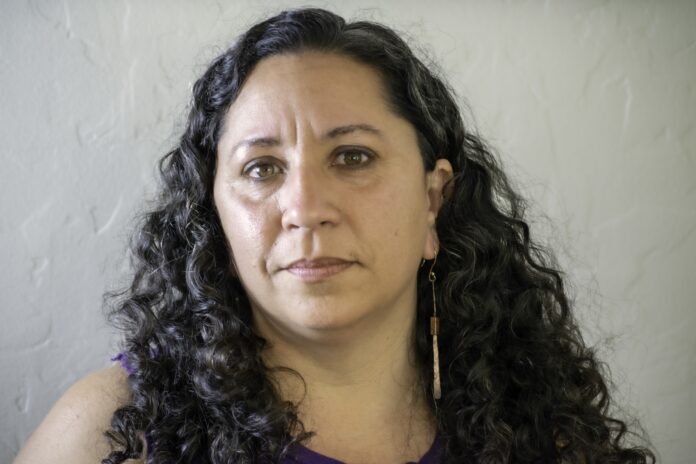
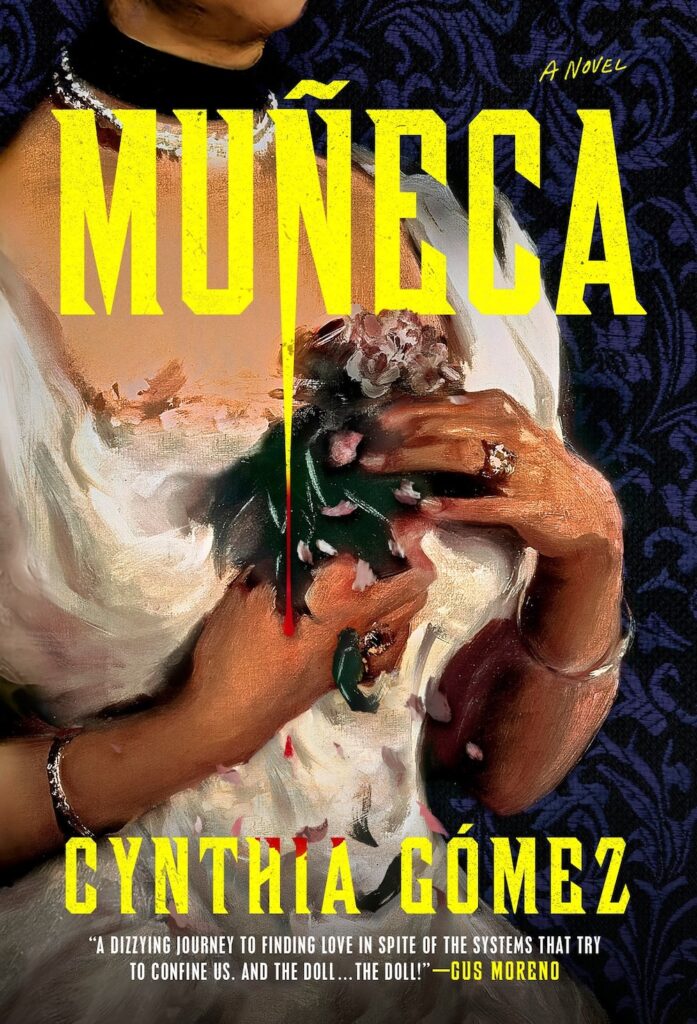
I’ve known Cynthia Gómez for about nine years through the labor movement, where she uses her formidable research skills to support mostly hotel workers in San Francisco. The past few years have been extremely prolific for her, with the publication of a book of short horror stories, a novella and now, Muñeca (G.P. Putnam’s Sons, $30). The city that we both live in, Oakland, is going through a nice literary and cinematic renaissance in which authors like Gómez are leading the charge, subverting old themes, and entirely rewriting others. Through it all, she remembers to let the reader have fun, despite the horror. Cynthia will be in conversation with Tamika Thompson, Fri/12, 7pm at Pegasus Books Downtown, Berkeley (more info here).
48HILLS Tell me a little bit about yourself and your writing.
CYNTHIA GÓMEZ I am a union researcher and writer who lives in Oakland, California. I have lived in Oakland for the better part of the last 27 years. It’s my adopted home. My writing is what I would call feminist, anti-capitalist, dark horror, with fantasy streaks in her hair. I really love writing about resistance, rebellion, resistance to oppression, and the occasional revenge. I’ve wanted to write since I was seven. I remember how I would take my little handwritten sheets and fold them over and draw a picture and staple together the whole thing and call it a book. I copied a blurb from one of my older sister’s books because I knew books had blurbs, but I didn’t really know anything more than that. I just copied the actual text of a different blurb and pretended it was a blurb for mine.
And I didn’t know what the word “hilarious” meant, but that’s how I described my book! I started writing seriously in 2019. My partner at the time just kept saying, “Hey, you’re talking about all these ideas you want to do, but you don’t ever do them.” At a certain point, that landed. And then COVID came, and all of a sudden, I had a lot more solitude and a lot more time to do nothing. And I started going to workshops, and that was kind of the push I needed. I’ve been seriously dedicating myself to it for about six years.
48HILLS That sounds like one of the best uses of the lockdown ever. You’ve got two books written during that time, right?
CYNTHIA GÓMEZ Technically two-and-a-half! My first book was a novelette in this really cool series called Split Scream. Novelettes are stories that are too long for most magazines, but too short for stand-alone. Then I had a short story collection that came out two years ago, and then Muñeca.
48HILLS In addition to your book being a horror novel, it incorporates a lot of East Bay history, and especially around the themes of land theft and loss. What other events and places shape this world?
CYNTHIA GÓMEZ It’s fascinating how much the Oakland Museum was actually a seed for this book in two completely different ways. One was that they had this exhibit on 1968, and it really just underscored my wish to write about that year. I was describing this in another source by badly quoting what’s apparently a misleading translation of Gramsci, the one about this being a time of monsters when the old world is dying and the new world is struggling to be born.

You saw that in ‘68 in really wild ways. You saw Martin Luther King gaining class consciousness and then getting murdered, and then people uprising in response to it, right? You saw student rebellions, and then we saw student rebellions being massacred. It was a really pivotal year. I always wanted to write a book set in that time. I remember reading this bit of the California history exhibit in the museum about land theft and loss. And I remember just being struck by how, yes, it was really unfair and racist and wrong that all these Californios, these people who’ve been living iin what’s now the state of California, had their land just stolen from them wholesale. At the same time, there was no room for the irony that they’d stolen the land in the first place. I wanted to write about that, but couldn’t figure out a way to do it.
48HILLS What is the function of horror fiction when real life horror is so in our faces today?
CYNTHIA GÓMEZ I myself don’t tend to like extreme horror. Some people really find extreme horror comforting when life is extreme, because it can be kind of cathartic. It can be kind of like a microdose, when to exist and walk around in the world is a macrodose. For me, that’s not comforting, but I completely get why people find that comfortable, and more power to them. For me, what’s more comforting is a tiny fictional version of the bad guys getting a little bit of what they dish out. I wrote an essay about [Stephen King’s] Carrie where I said the bullies get turned into ash in the book, but in the real world, they get elected president. We can pour all of our wishes into that! The reader can get really excited about the possibility that the bully might get turned into ash in real life, even when we know that that may not happen.
48HILLS How do you approach weaving themes of class and queerness into your work in such a nuanced and compelling way?
CYNTHIA GÓMEZ In terms of queerness, when I was first cooking up this book, I knew that I was gonna have a woman who was paralyzed in her bed. How did she get that way? Is it possible to save her, to release her, free her? And I realized pretty quickly, okay, we’re in Sleeping Beauty territory. I actually wrote that in my notes. In Sleeping Beauty, the one who goes in to rescue the damsel is a dude, and I decided I was not at all interested in that. That’s been done. That was a chance to bring in queerness. That let me kind represent the opposite pole to the Miramontes family in every possible way.
They are the nuclear family and the bloodline being used to pass on property through their class. They’re doing that, but also, her family represents, like, all that is perverse and awful about the heterosexual nuclear family. At a certain point, I also realized that I was writing a book about class. You have the Miramontes family as the dying breed, the dying class of like, the landed aristocracy. And then you have Andrés representing the ascendant bourgeoisie, with all his capitalist investments. He’s got his fingers in various different investment pies around the world. And they’re both monstrous. Their whole class are monsters. And then you have [Nati’s] mother, who represents the moral pole of the whole book, even if, in my mind, she’s a little rigid in some places. She is the moral core. It’s not an accident that she’s the proletarian.
And then you have Natalia, who is still a little bit class conscious, although, you know, we know she’s not a movement person. She doesn’t have the same level of politics that her mom did. But that’s what informs her worldview. And she’s got, you know, this slightly revolutionary edge. I think we think that she might, like, open up a Red Book every once in a while—everyone’s carrying them around, but she’s not. And then you also have Grandma, who’s the lumpen. She’s a hustler, right? She just wants to get ahead. She doesn’t live in a fancy house. She’s got an ancient Chevrolet. She has got her little one-bedroom apartment. She’s only in it for herself.
It was really fun to realize that that’s what I was doing. You know, the Gothic is about class tension. Not every single Gothic book is about that, but you have these stock characters. You have the liminal class figure. You have the companion, the governess, the figure who’s not part of the family, she’s definitely not considered part of the working class. Class was already there, but it was really fun to be explicit in my mind that I was contrasting the different moralities of the different class figures. The reason why Andrés is monstrous is not just because he’s a monstrous person. His whole worldview actually demands seeing everything as profit and loss.
48HILLS I noticed how you approached class from the first few pages, when you are talking about stealing. That’s a form of class conflict.
CYNTHIA GÓMEZ When I was talking about her stealing, I actually just wanted to give her something that was a little bit, uh, self-destructive and a little bit interesting, and it wasn’t until later that I thought, well, yes, but [the class angle] too. Like, that wasn’t conscious at all. I wanted to give her a character trait that I thought would be fun to write about.
48HILLS I think it would have been really easy for a different writer to under-develop Violeta by making her only stand in for the rich, but she’s actually really well fleshed-out. How do you develop a relationship to the characters that you have the least in common with?
CYNTHIA GÓMEZ Mrs. Miramontes was also originally just supposed to be a stand-in for the monstrousness of her class. I thought, it’s more interesting for me if I’m going to spend time in this woman’s head. I wanted to ask how she justifies to herself what she’s doing? Even if I, of course, wouldn’t ever do the same things; I wouldn’t be faced with the same set of choices. If I got parachuted into her brain, I would make different decisions, but I did want to explore how she justifies her choices to herself. I think that that’s more interesting for those of us who encounter people like Mrs. Miramontes in our lives. We sure as hell have scenarios where people try to justify privilege, and they make decisions that will bolster privilege rather than weakening it. And they justify atrocities to themselves because, well, who wants to make a fuss, right?
So that was how I made her more interesting to me. And then Violeta… I wanted to root for their relationship. And if Violeta’s loyalties lie only with her own class, she isn’t that interesting of a person, because she’s been raised to just marry rich. I don’t think that the readers would root for the relationship, but I wouldn’t either.
48HILLS What are you working on next?
CYNTHIA GÓMEZ I’m working on historical fiction, because I just really love historical fiction. The heart of it is going to be about a dress that is possessed by the spirit of the woman who made it. And she lived in 1913 and was a garment worker and unit organizer, and in 2013, a woman buys the dress and starts getting increasingly psychically connected to the spirit of the woman who’s haunting it and has to figure out how the hell she’s gonna get free.
CYNTHIA GÓMEZ: MUÑECA in conversation with Tamika Thompson. 7pm, Fri/12. Pegasus Books Downtown, Berkeley. More info here.