A few thoughts from Pride Weekend:
The Trans March turned into a police riot, and while I wasn’t there, it seems from everything I have read and seen that the cops escalated a confrontation when they didn’t need to. From the BAR:
“At the end of the march, SFPD escalated a situation, detaining, pepper spraying, and pulling guns at members of our community. The resilience of our community was tested given that we have endured violence from police historically, but we remained organized and unified. We unequivocally condemn police violence, and have support mobilized for affected community members,” he continued.
Storment said the Trans March safety team de-escalated the situation, helping keep attendees safe and allowing the event to proceed. He also thanked volunteers for their efforts Friday and encouraged continued investment in community safety.
“Though the SFPD behavior today was disheartening given the high note of our amazing march and park event, we remain committed to ensuring the furthering of trans safety – here and everywhere,” he wrote in a follow-up email.
Spray painting graffiti on public property isn’t a crime that warrants pepper spray, guns, and arrests. (And I fear District Attorney Brooke Jenkins, who was present and lauded at the Alice B. Toklas Pride breakfast, will seek the maximum possible penalties for something that is easily fixed and not by any definition violent.)
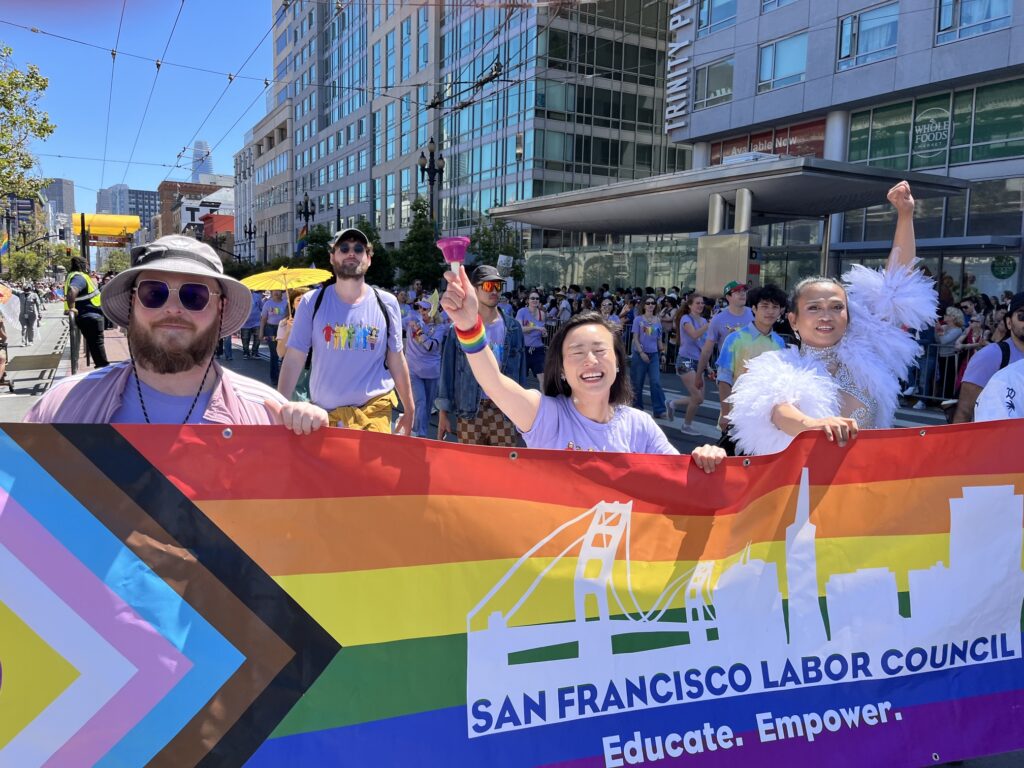
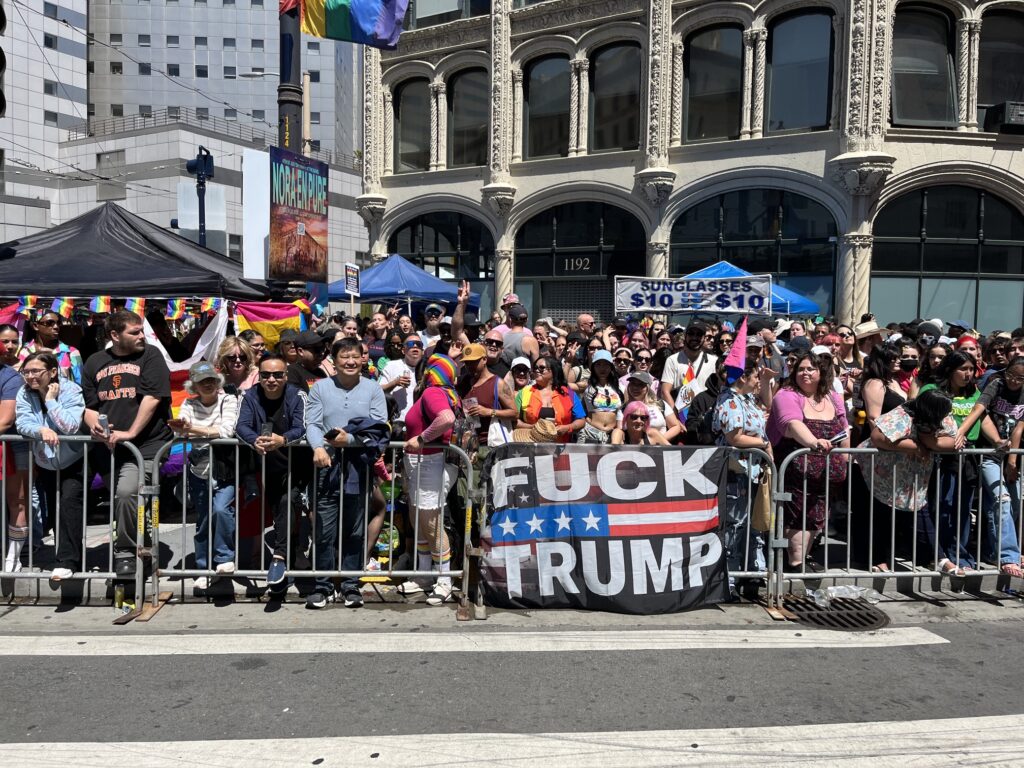
Pride Sunday was much more chill—festive on a perfect San Francisco day, with a few anti-Trump signs, but not as much politics as I saw last year. After everything everyone has been through, I think a lot of folks just wanted a day to celebrate.
I was happy to join in. I ordered a Corona from a very cute and friendly young man at the beer booth, and he asked for my ID. His older supervisor reminded him not to worry about people who looked over 30, but I guess the Irish age well. At 68, you take the compliments you can get.
A Board of Supes committee will consider this week a major reduction in affordable housing funding, but it won’t be the Land Use and Transportation Committee, which typically handles planning issues.
Instead, the measure is going to the Government Audit and Oversight Committee, which has only two members, both from the board’s conservative wing.
It will also be heard on July 2, the day before the Fourth of July weekend starts, when a lot of people will be out of town.

The impacts are potentially deep—and the argument for the reduction makes no sense. The deal here, between the mayor and Sup. Myrna Melgar, involves Mayor Daniel Lurie backing a City Charter amendment that would lock in minimum funding for the Affordable Housing Trust Fund, and in exchange the supes would reduce the requirement that luxury developers provide some affordable units in their projects.
But there’s no guarantee that Charter amendment will pass. As Planning Commissioner Kathrin Moore noted:
“It took my breath away what we are giving away. You can be really excited about going skydiving, but what if the parachute doesn’t open?”
There’s also no guarantee that cutting affordability requirements, or cutting the city’s transfer tax, or any of these other giveways will convince developers and the speculative capital that funds them to build more housing:
Housing activist Calvin Welch pointed out in testimony that when the city’s affordability requirements were at their highest, in 2017, developers built twice as much housing as they’ve built since those mandates were reduced.
Even if we assume that more luxury housing will help address the affordability crisis, which is a huge logical leap (see this city-sponsored study), the real issue is the price of materials, labor, and capital—and when the capital markets change, and investors decide to put money into luxury housing in SF again, the city will be giving up millions in money that can pay to blunt the impact of that development.
Board President Rafael Mandelman told me that since the measure has “fiscal impact,” it can’t go to the Land Use and Transportation Committee. It could have gone to the Budget Committee, chaired by Sup. Connie Chan, who might have had some questions, but that committee isn’t meeting this week. Sups. Bilal Mahmood and Stephen Sherrill at GAO will no doubt pass it along, on the fast track, with little change.
The Land Use and Transportation Committee will consider Monday/29 a move to reduce the requirements of large institutions, primarily hospitals and universities, to file an institutional master plan every ten years.
Lurie and Sup. Matt Dorsey say they want to make it easier for post-secondary educational institutions—that is, colleges and universities—to move into and expand in San Francisco. Vanderbilt, for example, is taking over the old California College of the Arts campus at the foot of Potrero Hill.
But the requirement isn’t that onerous—all of these institutions are doing internal master plans anyway. The rules just require them to share with the city and the public, so planners (when they are actually doing planning) and neighbors have an idea what to expect.
Thanks to housing activists, an institution will not be exempt from the rules unless it
declares under penalty of perjury, on a form prescribed by the Department, that the institution will not demolish or convert any structure in San Francisco that is used or occupied as housing as of the effective date of the ordinance in Board File No. 260239, or for which the last legal use was residential. The institution must also declare under penalty of perjury that its development will not result in the elimination of any rent-controlled housing unit.
But Vanderbilt is moving into an area with a lot of light industry and arts use, and now if this passes it can expand and displace those uses with no notice to the public.
That meeting starts at 1:30pm.
The San Francisco Giants so badly bungled Pride Day, and it’s been so widely reported, that I don’t need to add much, except a couple things. This from the always great Tom Ammiano (via facebook):
Yeah right cut AIDS funding, Lurie, get rid of domestic partners, and harm reduction. Dorsey clutching pearls over Giants. There’s a difference between Gay pride and Gay liberation, between pandering and commitment. Pride: celebrate, visibility, affirmation all good. Pink washing not liberation: intersectionality, recognizing class differences, need for housing, health, education, police and criminal justice reform. Bitch please!
And this:
Senator Hawley, of Missouri, said that Major League Baseball was punishing players for “expressing their Christian faith.” Hawley, according to his bio, went to a Jesuit high school, but his Bible study was apparently a bit faulty, or maybe he’s forgotten. I studied with the Carmelites in junior high, and while I’m by no means a Biblical scholar, I know enough to realize he made an embarassing mistake.
The Biblical phrase the Giants players wore was from the Old Testament, the Hebrew the Book of Genesis. That particular text is considered sacred to all three major Abrahamic religions, Christianity, Islam, and Judaism. In fact, it’s the first book of the Torah, the most sacred Jewish text (and most Reform and Conservative Jewish congregations are welcoming to LGBTQ+ people, and there are plenty of queer rabbis.) So quoting from Genesis isn’t a sign of Christian faith.
(I don’t know much about Rockhurst High School, where Hawley got his diploma, but all the Jesuits I have ever met or worked with, starting with friends of my parents in the 1960s, would have vociferously rejected Hawley’s homophobia. That includes the last Pope. For the past eight years I’ve been teaching at USF, where the Jesuits are exceptionally welcoming to all people, including LGBTQ+ people. At USF we have a rabbi who ran a queer congregation and a university chaplain who wrote a book about the inclusion of the gay community in a Castro Catholic church. Maybe Hawley missed that part of his Jesuit education.)
The message the Giants players used is also theologically wrong. From MS Now:
But something is missing from this tired narrative of gays vs. God: These players committed an unforced theological error. Genesis 9:12-16, the verse players inscribed on their hats, teaches us the opposite of the condemnation these de facto anti-LGBTQ activists wanted us to hear.
Let’s actually read the Bible, instead of using it as a prop:
And God said, “This is the sign of the covenant that I make between me and you and every living creature that is with you, for all future generations: I have set my bow in the clouds, and it shall be a sign of the covenant between me and the earth. When I bring clouds over the earth and the bow is seen in the clouds, I will remember my covenant that is between me and you and every living creature of all flesh, and the waters shall never again become a flood to destroy all flesh. When the bow is in the clouds, I will see it and remember the everlasting covenant between God and every living creature of all flesh that is on the earth.”
I get the simplistic take here: reclaiming the rainbow as a Christian symbol and prying it out of the hands of the godless LGBTQ movement. The rainbow, in this view, is a zero-sum game that is either a symbol for or against the dignity of LGBTQ people.
But what this ancient and holy passage actually teaches is that God creates a covenant with all of God’s creation and promises never to destroy the Earth again like in the Great Flood. “Every living creature of all flesh” is about as universal as language gets. It’s the opposite of exclusion and zero-sum thinking. God’s love is for everyone. Who are we then to limit it and make exceptions?
Just for the record.