Some holiday periods attract a lot of moviegoers, some do not—and apparently the 4th of July is definitely in the latter camp, since almost nothing of significant commercial appeal is opening this week. The only notable exceptions are franchise family ‘toon Minions & Monsters, and historical drama Young Washington. The latter is a patriotic flashback (albeit taking place before our nation’s founding) from Jon Erwin, one of the better filmmakers producing “faith-based entertainments” these days, with William Franklyn-Miller in the lead and veterans including Ben Kinsley, Mary-Louise Marker, Andy Serkis and Kelsey Grammer in support. Neither title was available for preview by deadline… so you can BBQ in peace, on the assumption that you’re probably not missing anything amazing.
Still, there are some more under-radar alternatives worth checking out, from a new documentary at the Roxie to various fun streaming arrivals, plus a three-day Balboa tribute to a familiar face from myriad big- and small-screen roles over the last forty-odd years. The Roxie film opening Fri/3 is ASCO: Without Permission, Travis Gutierrez Senger’s lively portrait of a East L.A. art collective that for 15 years (1972-87) roiled the cultural waters with artistic and political provocations inspired by the Chicano Power movement. When it played Cine+Mas’ SF Latino Film Festival last fall, we wrote about it here.
Also of interest are two different revivals. Starting this Thurs/2 and running through August 28, BAMPFA in downtown Berkeley will host “Some Nostalgic Place: The Films of Isao Takahata,” a retrospective of works from the late director who co-founded Japan’s fabled Studio Ghibli. It stretches from 1988’s Grave of the Fireflies, a tale of children in wartime that is one of the most uncompromisingly adult uses of the animation form, to his 2013 final feature The Tale of the Princess Kaguya, a delicately visualized traditional folktale. Info on the entire series is here.
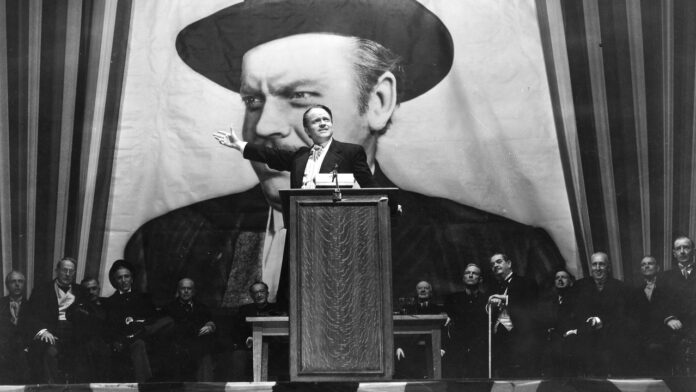
Returning to theaters for two days only on Sun/5 and Wed/8 via Fathom Events are 85th-anniversary showings of Orson Welles’ Citizen Kane. This biopic of a fictional multimedia tycoon is often considered the greatest directorial debut ever…even the greatest movie ever made, period. It was not a box-office success in 1941, however, at least partly because real-life model William Randolph Hearst took great offense at his thinly-veiled depiction. He did everything he could to suppress it, and as the nation’s preeminent newspaper publisher, his resources were considerable.
Welles would never again enjoy a major studio’s more-or-less unlimited resources. Between his perceived uncommercial tilt and difficulty bending to any authority figure (or budget limit), nearly all his later screen projects would suffer difficulties of one sort or another. But Citizen Kane will always remain as proof of what he was capable of. It plays Bay Area theaters including SF’s AMC Metreon, Cinemark Daly City and AMC Bay Street in Emeryville; go here for a full list of locations and showtimes.
Elsewhere:
Julie Carmen Retrospective
Though she’s been more active as a psychotherapist than as an actor in recent years—her most recent appearance was a guest spot on Tales of the Walking Dead four years ago—NYC-raised, LA-based Carmen has an impressive screen resume. You’ll get your chance to ask her about it at this three-night Balboa Theatre event showcasing some fan-favorite vehicles, all of which she’ll be in attendance for. She started out in the 1970s as a dancer and choreographer, received theatrical training from Sanford Meisner, did plays Off-Broadway, and made a couple TV appearances. Then in 1980 she made a fairly auspicious dual screen debut with substantial roles in John Cassavetes’ Gloria and the thriller Night of the Juggler, both very much set in the Big Apple.

The latter film, which plays here Wed/8, didn’t attract much notice at the time. But over the years, particularly since a recent home-formats release, it’s acquired new appreciation as a vivid way station between the Me Decade’s gritty urban cop thrillers and Reagan Era’s more exploitative NYC-is-a-degenerate-hellhole genre films. James Brolin plays a divorced working-class father in hot pursuit of the psycho (Cliff Gorman) who’s kidnapped his teenage daughter (Abby Bluestone), mistaking her for a wealthy slumlord’s child. Hitherto a director of Disney features, Robert Butler dives into this lurid assignment with such zest that the film steamrolls right over its absurdities of plot and action.
Playing the mother of the kid who gets handed over to Gena Rowland’s titular ex-gun moll for safekeeping, Carmen didn’t survive the first reel of Gloria. In Juggler, by contrast, she doesn’t appear until the last half hour or so—but is nonetheless the de facto female lead (juvenile Bluestone aside), as practically the sole non-abrasive Noo Yawker who crosses Brolin’s frantic path, and decides to help him regain his imperiled offspring. It’s not much more than an ingenue role, yet Carmen lends the character an air of streetwise independence as well as empathy.
Apparently a personal favorite for the performer was her much more flamboyant turn eight years later in Fright Night Part 2, sequel to the tongue-in-cheek 1985 sleeper horror hit. It was much less widely seen, apparently in part because of the infamous Mendenez Brothers—their father was involved with its distribution, and his murder ended up complicating the planned release. Young hero William Ragsdale is back, alongside Roddy McDowell’s camp TV horror-flick host, as they face a new supernatural menace: Carmen as “Regine Dandrige,” a mystery lady whose sinister eccentricities get explained by her being a “performance artist.”
Of course she’s really a vampire, seeking revenge for our protagonists’ prior vanquishing of her bloodthirsty brother (the first film’s Chris Sarandon). She’s got a paranormal posse that includes a gender-blurred, rollerblading fellow bloodsucker (Russell Clark), a horny werewolf (Brian Thompson), and a brawny Renfield type (Jon Gries). Directed by Tommy Lee Wallace, who’d previously done cult favorite Halloween III: Season of the Witch, and would later helm the original TV-miniseries version of Stephen King’s IT, this slick and silly diversion provides Carmen with plenty of opportunity for glam ham, plus a brief showcase for her dance chops.
Wallace was a frequent collaborator of John Carpenter’s. Arguably that director’s best movie after his original hot streak (from 1974’s Dark Star to Starman a decade later) was In the Mouth of Madness, which kicks off this short series on Tues/7. It provided a rare chance for the always-impressive Sam Neill to go bonkers like he memorably did in Zulawski’s prior cult classic Possession, playing a cynical insurance investigator hired to locate an MIA author of bestselling horror fiction. That scribe’s publisher (Charlton Heston) insists his editor (Carmen) accompany Neill’s search, which leads to a New England town somehow not on any map. There, Lovecraftian weirdness abounds, eventually driving our male lead nuts—and lending Carmen’s character an interesting transition from put-upon professionalism to creature-mutation. It’s a movie with more promising (if borrowed) ideas than it can comfortably develop in 95 minutes, on probably a tighter budget than would have been ideal. Still, Carpenter and his cast seem to be enjoying themselves, and the viewer will too.
Without ever quite becoming a household name, Julie Carmen went on to rack up some pretty impressive further credits, including films for Robert Redford (The Milagro Beanfield War), Nicolas Roeg (Cold Heaven) and others, as well as appearances on a wide array of TV series, from Cagney & Lacey and Falcon Crest to NCIS. To find out if she has a commensurate expanse of anecdotes to share, you’ll have to attend the Balboa shows, their full info listed here.
Home viewing roundup: ‘She’s the He,’ ‘Hold the Fort,’ ‘Fiume o Morte!,’
Three movies just released to On Demand platforms this week each offer some inventive amusement. Two are independently produced U.S. comedies that won’t win any prizes for sophistication, but do provide some solid laughs. Siobhan McCarthy’s She’s the He, which just finished a run at the Roxie (albeit on too-short notice for coverage here), has what sounds like a horrendous premise: Two high school boys (Misha Osherovich, Nico Carney) are so inseparable, their classmates assume they’re a gay couple, so to quash that notion and hopefully attract hot girls…they decide to pretend they’re both trans. That somehow does rivet the attention of the hottest mean girl (Malia Pyles) and her clique, who’ve decided having a trans bestie or two is the coolest accessory a trend-conscious teen can boast today. Needless to say, hijinks and confusion ensue, particularly once one of the lads decides he (or rather she/they) might have some gender-identity issues, for real.
This starts out as an update on the crass queer youth comedy template of Another Gay Movie, becomes more like Superbad, then gets semi-serious. Its high energy does ebb a bit in the last 15 minutes or so, despite a locker-room fight climax set to “The Time Warp.” But the writer-director and her able cast mostly manage to successfully walk a high wire between grounded emotions and cartoonishly absurd situations, making for a movie with surprising heart as well as some hilarious moments. She’s the He released to VOD this Tuesday, June 30.
Already on those platforms is Hold the Fort, a sort of smaller-scaled Ghostbusters in which a hipster couple (Haley Leary, Chris Mayers) move from the city to a newish subdivision. She in particular is dubious about this, especially upon learning that it’s controlled by a persnickety HOA. Nonetheless, they reluctantly accept neighbors’ invite to an annual “Equinox Party,” assuming it’s all in good fun when they’re told “Once a year a portal from Hell opens and monsters come rushing up.” Oops: Turns out the joke is on the newbies, who are not expected to survive the night.
A very fast learning curve is required as those now barricaded once more in the community clubhouse battle off witches, kung-fu zombies, a werewolf, “kamikaze bats,” and more. Coping mechanisms are various, alcohol and drug consumption not at all frowned upon—though you’d be advised not to eat too many of those muscle-relaxant-flavored cheesestix. This is one of those movies in which you suspect nearly every cast member has a background in standup or sketch comedy, since their timing is so sharp—as is that of writer-director William Bagley. Even with a short runtime of just 74 minutes, Fort’s inspiration occasionally flags.
Still, it is cheerful, fast-paced, resourceful (just don’t expect ILM-level FX), and steadily amusing.
On a whole different plane of conceptual imagination is Fiume o Morte!, which Icarus Home video releases to digital Tues/30 and on DVD July 7. It’s an unclassifiable sort of documentary in which Croatian filmmaker Igor Bezinovic recalls a bizarre historical back chapter shortly after the end of WWI: When Italian poet Gabriele D’Annunzio decided to seize the town of Fiume. Until just recently it had been under Austro-Hungarian rule, and was now part of newly-minted Yugoslavia, while sporting a considerable Italian-heritage population. But it had long been a multicultural, multilingual city, going way back to the Roman Empire, with its own singular Italian dialect (Fiumano) just one of many tongues commonly spoken.
It was part and parcel of D’Annunzio’s vainglorious nationalism that he simply decided the place should be under Italian control—well, his control, as occupier and dictator. This reign did not last long, particularly once the actual Italian government decided it wanted nothing to do with the tragicomedic farce, whose leader was apparently high on cocaine much of the time. Credit is due, however: He did managed to “create his own country,” however briefly. That megalomania, with its proto-fascist philosophies, would prove a great influence on emerging actual fascist Mussolini—though the latter found D’Annunzio (who died just before WW2’s onset) a giant pain in the ass, one whom Il Duce had to hush up with monetary and aristocratic-title bribes.
It’s a grotesque saga remembered by few present-day Croatian nationals, though the few who do know the story consider it a shameful invasion by outsiders. Bezinovic utilizes archival photos and film footage, in addition to views of the city today, myriad voiceover narrators, latterday interviews—and reenactments, ranging from tableaux to full-on battle scenes, peopled by amateur thespians mostly drafted from street encounters. There’s not much effort to whip up a persuasive period illusion.
But showing the seams of artifice only adds to Fiume or Death!’s playful, essayistic qualify. And when we see the streets littered with corpses as result of D’Annunzio’s stubborn, ultimately pointless pipe-dream, our awareness that these are living 21st-century residents playing make-believe somehow doesn’t reduce the poignancy of the original victims’ sacrifice. This is an adventurous and unusual enterprise well worth a look for history buffs, as well as fans of extravagant cinematic experimentation.