Climbing the mountainous body of work created by Bay Area-based artist Mildred Howard in her decades-long career exercises body, mind, and soul. You can take a significant first step at the Oakland Museum of California’s new exhibit, “Mildred Howard; Poetics of Memory” (through October 18). Installed in the museum’s Great Hall, it’s the her first retrospective in a major museum and highlights pinnacles of Howard’s five-decade career.
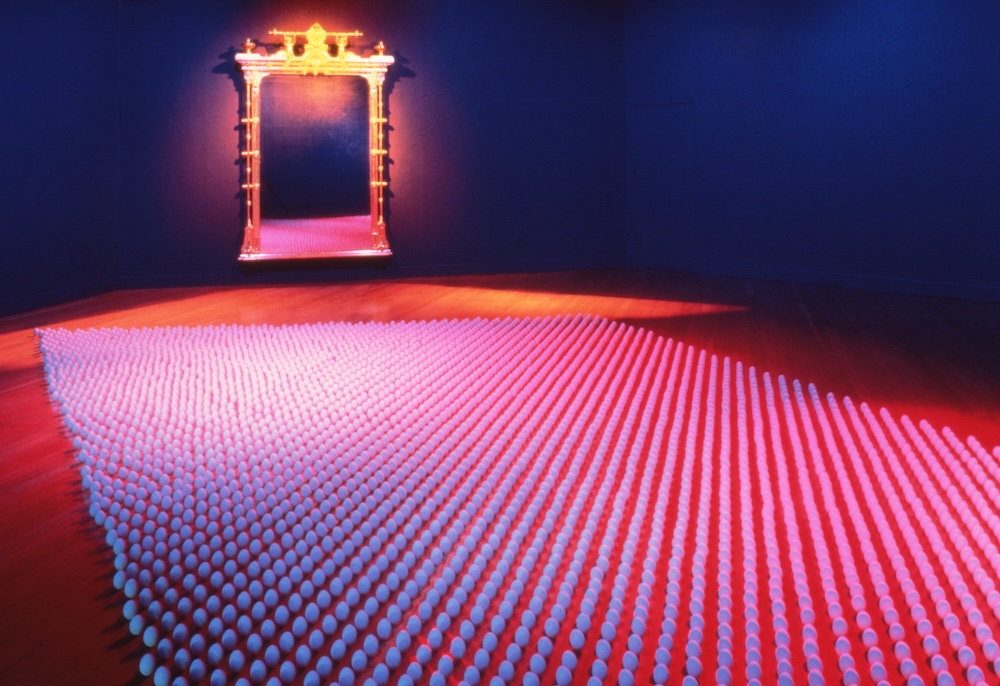
Among the artworks are collages, sculptures, and several immersive installations involving dozens of bottles that form a house, ceramic eggs spread like a carpet in a busy hen’s pantry, and glass apples that float under luxurious dim lighting in a pool of rippling water. Multimedia pieces and assemblages on display often emphasize a signature Howard feature: found objects used in combination with common items like doors, a kitchen stool, a long-handled kitchen pan, buttons, and the artist’s ubiquitous bottles. Historic photographs, flyers from past exhibitions, audio recordings, and projected stills from a film Howard made at age 14 on a train trip she took to the American South complete the exhibition’s sweep.
If not for the design team’s admirable restraint (Howard participated in their every choice) and the usual constraints of time, money, and access, it is likely her work could have taken over the entire museum.
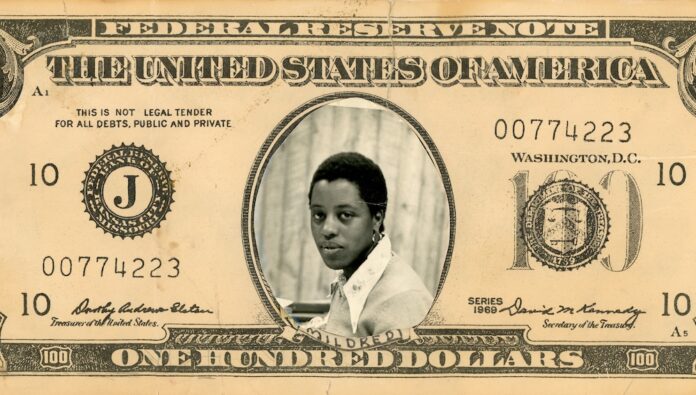
Born in San Francisco, Howard’s parents were dockworkers at the Hunter’s Point shipyards before pivoting to become founders and owners of an antiques business they operated from the family’s South Berkeley home. Curiosity and courage course through Howard’s veins and apparently, her family’s DNA. Her parents were also activists—her mother led the organized resistance opposing BART’s underground track plans that would cut through a predominantly Black neighborhood in Berkeley.
Howard paired her life experience with copious academic experience. Among those credentials are an Associate’s of Arts Degree and Certificate in Fashion Art from the College of Alameda and an MFA from Fiberworks Center for the Textile Arts at Berkeley’s John F. Kennedy University. Howard has taught at Stanford University, the San Francisco Art Institute, and the California College of Arts and Crafts, in addition to establishing the Institute for Inquiry workshops and other curriculum at San Francisco’s Exploratorium.
Upon entering the Great Hall, three full-scale prototypes of the Locks and Keys for Harry Bridges series (2001-2008) have immediate heft. Fabricated at Berkeley’s Artwork’s Foundry, the bronze sculptures were created to be placed along a high-traffic sidewalk. An oversized swing-and-clasp lock is displayed horizontally, becoming a bench that begs to be sat upon. (Discreet signage indicates touching is not allowed.) The keys dig vertically into the floor, suggesting value lies out of sight, under the surface.
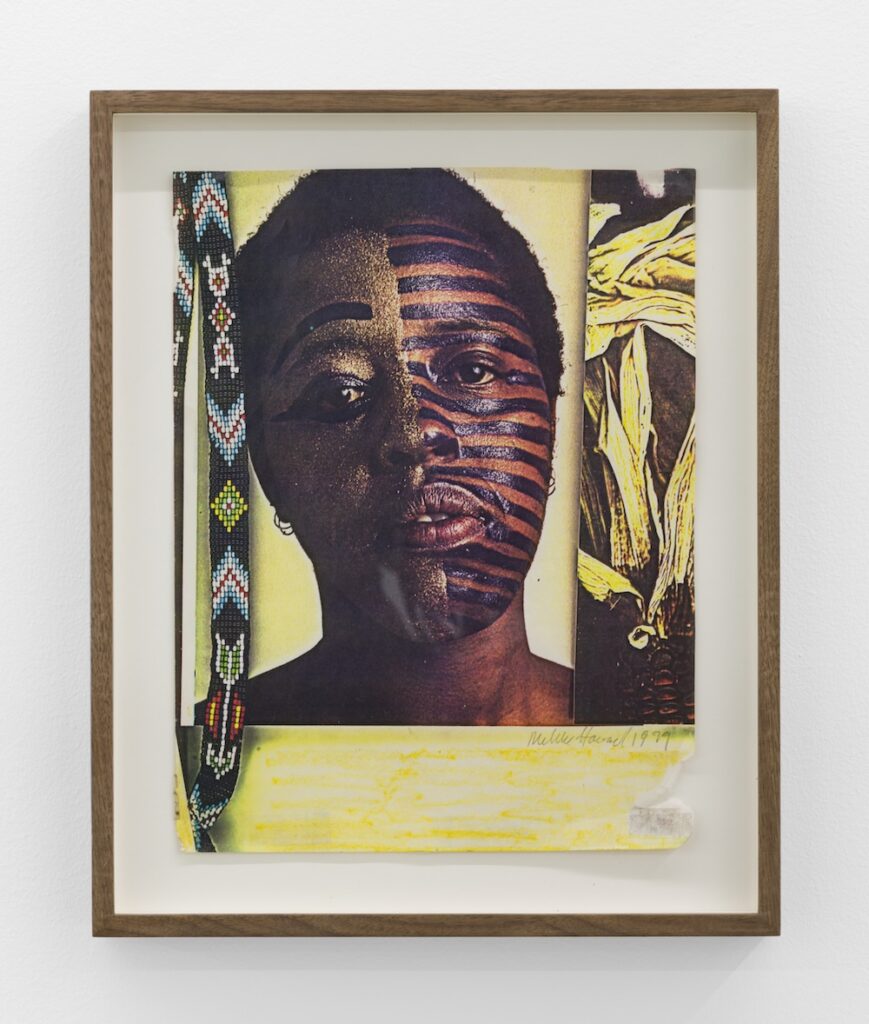
Steps away in the next gallery, Untitled (1979), is representative of Howard’s investigations of the earliest Xerox machines. Color copies of collages in which she manipulated feature her self-portraits—early, non-digital selfies, her face painted with ancient iconography—and items such as lace, paintings on paper, and more. The elements combine to tell the story of a life, ancestry, identity.
Howard’s multifaceted, clever sense of humor is abundantly clear and undeniable in works such as Another Hook with a Ho (2024). The piece plays with language, offering intriguing innuendo to the sculpture of a toe of a bronze, high-heeled shoe kicking into a granite cranial form that tops a farm hoe, the work is seriously funny—the topic implied, seriously serious.

Riding the edge of clever, creative commentary, Howard lays layers upon layers that engage the viewer’s imagination and curiosity. An assemblage from 2001, A Salute to Sojourner: Still Waters Run Deep, tops an old-style pedestal drinking fountain with a marble slab on which “Listen, still water runs deep if you make it to the other side… she’ll be waiting,” appear written by hand. A tiny shoe form above the words bursts with spiky “claws” and a worn book and framed photo of Howard’s enlarged left eye add complexity while maintaining the connection to Sojourner Truth and the Underground Railroad.
Volume I & II: History of the United States with a Few Missing Parts (2007) toys with language by cutting out quarter-size holes from two history books. Looking as if shot by enormous pellets from a Civil War era musket, their pages are not only visually arresting, but an expression of erasure. If entire personal histories and collective memories subject to the forces of racism, gender stereotypes, cultural blindness, and ignorance disappear, what do we sacrifice?
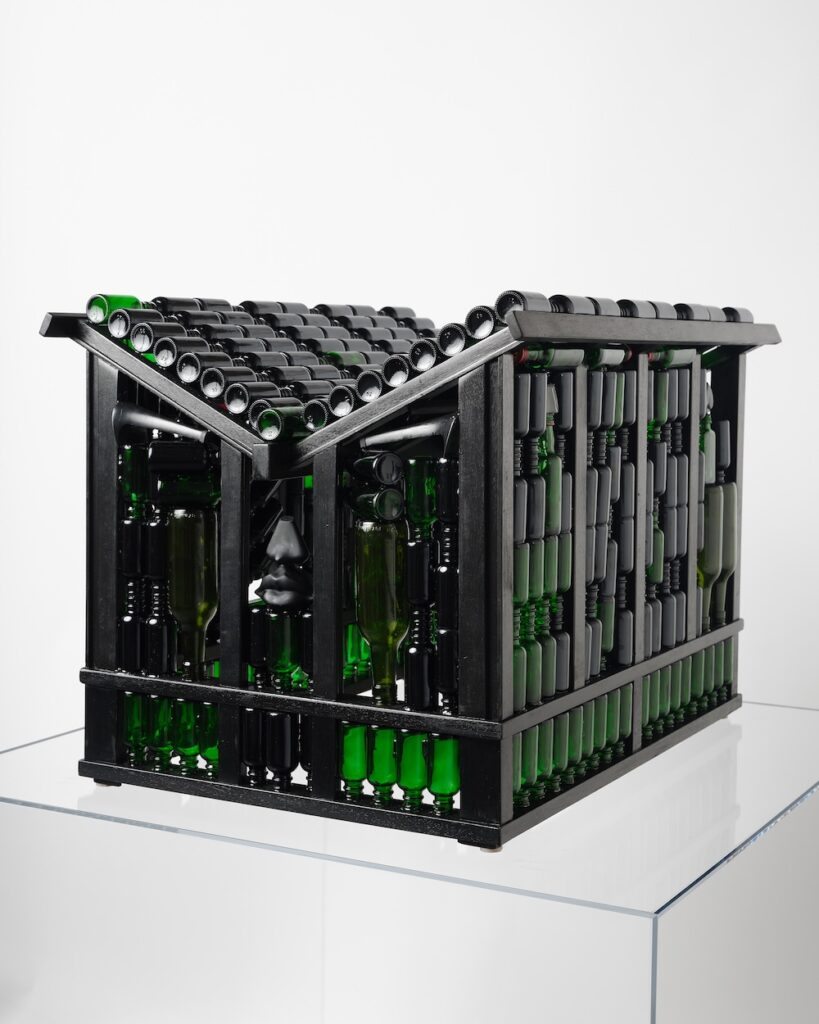
Howard is also a master of color, using it effectively in the dozens of green-black bottles, single red bottle, and a few, scattered red bottle caps of Black Has Always Been a Color (2024). This subtle use of red in the house-bottle sculpture leaps into full force in a nearby gallery with William Gwin: Untold Histories/Hidden Truths. The three monumental sculptures present historical figures: Peter Burnett, the first governor of California; William Gwin, a California state senator; and composer Francis Scott Key. In answer to the men’s connections to slavery and dubious hero status, Howard wraps each figure like a mummy in strips of material that looks as if it had been soaked in the blood of thousands of enslaved people. Casting bright light from above introduces welts of dark shadows into every crevice.
Blackbird in a Red Sky, (a.k.a Fall of the Blood House) (2002) employs deeper shades of red in a llife-sized shotgun house whose glass simultaneously flashes brilliantly and appears charred. Nearby, glass apples the size of grapefruits float in a large, dimly lit wading pool. Ambient air moving in the room causes ripples on the water’s surface that cast an echoing, moving shadow on the wall behind the work. The total effect conveys the tension, mystery, movement, and sense of enormous peace that often co-exist in a home.
Visitors to OMCA intrigued and interested in moving farther up the Howard “summit” will value the comprehensive hard-back catalogue edited by senior curator Carin Adams, available in the museum shop. Its essays by Makeda Best, Lori Fogarty, Lian Ladia, and Lizzetta LeFalle-Collins; an interview with Howard; and images drawn from her complete body of work are superb. Adams has curated a mesmerizing profile of the artist, her influence in the field, and her artistic practices and philosophies.
The book’s images, especially those of Howard’s public art projects, might propel a person to jump on public transit or in some way travel to view her art on location. Among other projects that have special community connections, Salty Peanuts (2000) pays homage to the Bay Area’s jazz history inside the San Francisco International Airport; Frame (2015), a 22-by-20-foot Rococo bronze structure, stands imposingly and emphasizes the grandeur of a vista at San Francisco’s Hunters Point Naval Shipyard; and a Richmond transit hub serves as home for Moving Richmond (2014), a steel sculpture that salutes the area’s industrial, maritime history.
For an extended road trip, hop over to Delivered, Mable’s Promissory Note (2024), a sculptural tribute to Howard’s mother, the activist Mable Howard, which sits near the Ashby BART station. Then head to San Francisco’s Stevenson Street to visit the aforementioned Locks and Keys for Harry Bridges, which honors Bridges, the founder of the International Longshore Warehouse Union. Close out the journey with a stop to see The Music of Language (2008), a permanent text art installation at the Glide Memorial Church family housing project at 125 Mason Street in San Francisco.
MILDRED HOWARD: POETICS OF MEMORY runs through October 18. Oakland Museum of California. More info here.