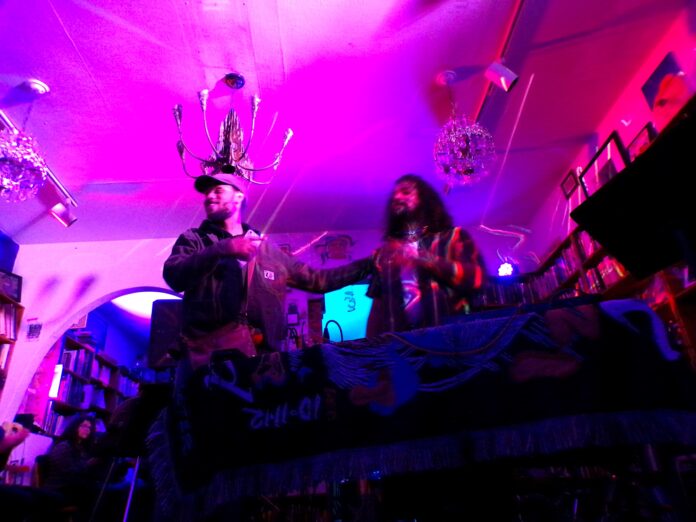
Before the music began on July 25, people greeted friends, found places to sit on the floor, and lingered outside the storefront. Then the room settled. Conversations softened, the musicians began to play— and a small, independent bookstore became a space for sounds that refused to stay inside any one genre.
The latest installment of string of shows at Adobe Books brought together Bay Area artists Roco Córdova and Julian Lopez, whose performances moved through electronic music, jazz improvisation, funk backbone, and some more that was sometimes difficult to place.
The series continues Adobe’s tradition of supporting cutting edge arts alongside slinging literature. Put on by local musician and recording engineer Tonko and unassumingly titled “community,” the concerts are barely advertised other than appearing on Tonko’s own website and San Francisco Explore page of the Partiful app. (You can also ask about them at the store itself, and pick up a few books while you’re there.) A 10th installment is scheduled for August 22
From outside the bookstore on this occasion, the music had the muffled, distant quality of those “[song], but you’re standing outside the club” videos. Bass and drums carried through the walls, while flashes of saxophone and synthesizer escaped each time the door opened. People listened from the sidewalk and waited for a natural break between songs before stepping inside.
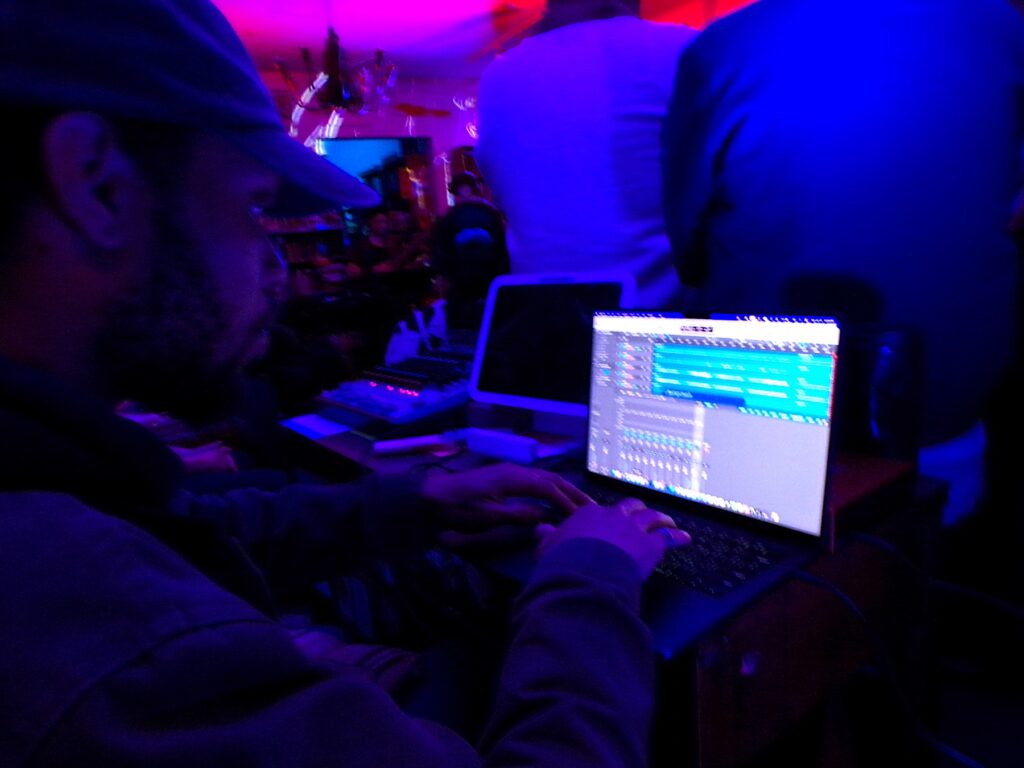
Córdova opened with an electronic set that was immersive and constantly in motion. Their music drew from EDM while moving through store abstract sounds. “What you witnessed at Adobe, it was, I would say, 99% improvised,” Córdova said. “I did not rehearse that.”
At one point, Córdova breathed melodically into the microphone. After turning a knob, the sound transformed into something resembling ocean waves. Elsewhere, they sang with an airy, almost operatic voice, moving between soft passages and powerful belts.
“Our voices are very expansive instruments,” Córdova said. “The things that have musical value within a voice for me are not just notes and holding notes and singing long, beautiful phrases, but the ‘k’ and the ‘sh’ and all these different sounds that we can make with our voice also have a musical value.”
Neon-colored projections covered the wall behind them, resembling glowing waves, computer signals, or veins pulsing beneath a surface. The visuals shifted with the music so closely that they seemed to give its electronic textures a physical form. A motorcycle started outside. Rather than interrupting the performance, the engine briefly sounded as though it belonged in the set.

“Some of what I do as a producer is go around and do field recordings, find sounds that I find interesting,” Córdova said. “When that just tends to happen naturally, without any intention to manufacture that encounter or that process, then I just think it’s absolutely magical.”
After a short break, Lopez took the stage with a full band for one of the first times he had performed a completely original set with the group. The performance began with slow, rumbling sounds from the entire band. The instruments created a strange, fragmented opening before everything suddenly stopped.
Then Lopez entered on the keys, and the drums immediately picked up. The first song moved through heavy saxophone lines and repeated breakdowns before returning to the same abstract sounds that opened it. From there, the set only became funkier.
Lopez started rapping. His microphone went silent for a moment. He rapped a quick comment about the volume, and when the sound came through clearly, someone in the audience let out a loud whoop. It was obvious he was freestyling.
Lopez’s delivery was smooth and relaxed, and he continued playing the keys while matching his own cadence. The band followed closely, blending jazz, funk, and hip-hop, moving freely. “It has to start with the word,” Lopez said. “If you’re just soloing instrumentally, you can just play a note. But then when it comes to the written word or spoken word, you’ve got to say something.
“Sometimes I just kind of let the hands honestly just let loose and see where they go, and then try and maintain some sort of word-processing element,” Lopez said. “It’s kind of hard to do both at the same time. I’m trying to solo with both sides of the brain.”
Lopez played across a double-decker keyboard setup, shifting among bright synth lines, warped effects, and video game noises. His solos took the music into its most unpredictable territory, while the rest of the band remained locked into the groove.
“I’m trying to merge my jazz and hip-hop backgrounds at the same time because it’s kind of hard for me to separate them,” Lopez said. “They’re different, but they’re still part of the same strain, I feel like, in some way, with improvisation and rhythm.”
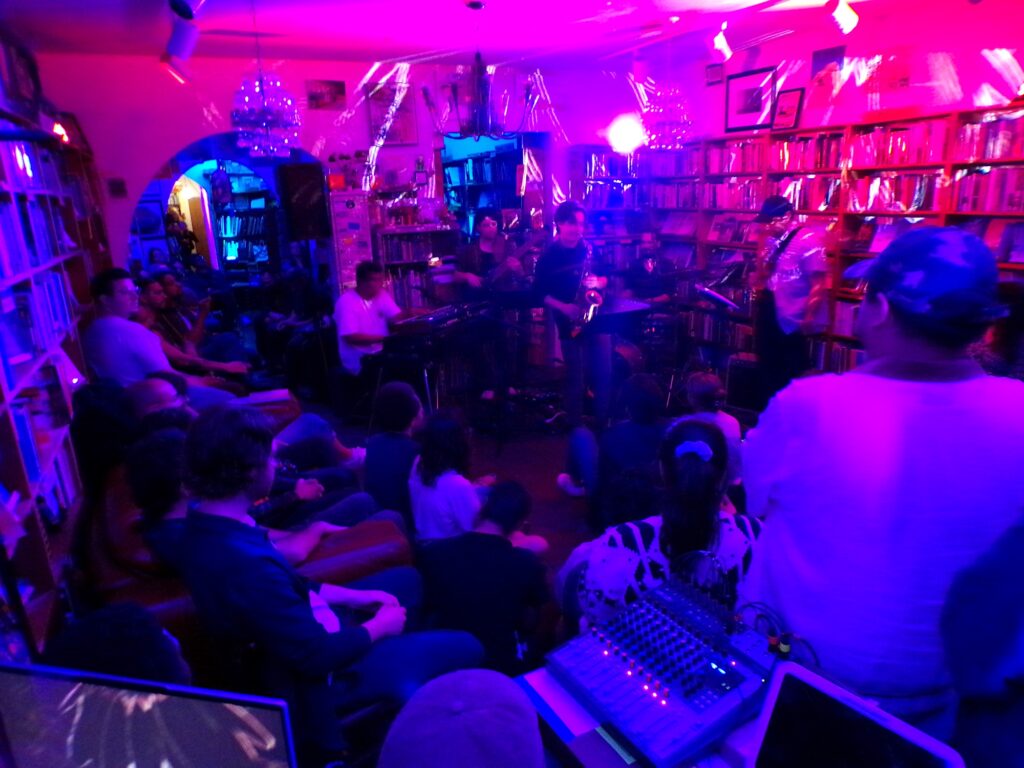
The drummer repeatedly broke into fast, intricate passages, smiling as he played. The bassist moved his shoulders with the rhythm and eventually began jumping slightly while playing. Musicians watched one another for cues, smiling as they shifted between solos, breaks, and new sections .
One of the set’s strongest transitions came when a slower song seemed to be ending. Just as the audience expected the music to stop, Lopez returned to the keys with sudden intensity and pushed the band directly into upbeat territory.
By the end, the band had moved far from the slow, abstract opening. The music became fast, rhythmic, and deeply funky, filled with rapid solos, drum breaks, and unexpected turns. When the performance ended, the room broke into applause. Tonko encouraged the audience to buy books and donate to Adobe Books, a reminder that the music series exists within a larger community space.
“When I’m doing these shows, I’m not focused on getting things right,” Tonko said. “I’m more focused on creating a space for the musicians and artists to express themselves and for people to listen.
“I want Adobe Books to feel very intentional, even in the unintentional parts of it,” Tonko said. “Failure is OK because we just want to put this on for the people. But at the same time, there’s a lot of intent that goes behind all the small parts.
“I want the musicians to just walk in and only think about the music and focus on the music and just relax,” Tonko said. “For me, it sets an example of what a venue or a place that cares about music should do, all the work that they should do to empower the musicians to perform and show them that they care.”
Tonko continued, “Adobe Books is a great room with a bunch of books, which makes the sound really dry and very easy to work with,” Tonko said. “The room is as important as the music.”
The shows operate on a pay-what-you-can model, allowing people to walk in and experience artists they may not otherwise encounter. Tonko said he wants the series to encourage curiosity about the musicians and creative communities already present in the Bay Area.
“I want people to just be able to walk in freely and be able to experience what their city has to offer,” he said.