Energy, inertia, gravity, wind, weightlessness, and other physical forces are woven throughout Maren Hassinger: Living Moving Growing, a major retrospective of the contemporary artist’s oeuvre. On view at Berkeley Art Museum and Pacific Film Archive through November 29, the exhibit displays a half-century of Hassinger’s large-scale sculptures, site-specific installations, video, and archival photographs.
A collaborative public art work located off-site at UC Berkeley Botanical Garden extends the exhibit’s reach beyond the confines of the museum. Made by BAMPFA staff and garden volunteers, redwood sticks from the site were used to recreate the artist’s work, “Monument (Pyramid).” Two related workshops in July and mid-August had participants twisting and knotting newspapers according to instructions from the New York-based artist. The newspapers, wrangled by local hands, were meant to be added to her piece “Wrenching News,” ensuring the installation would grow and evolve in real time.
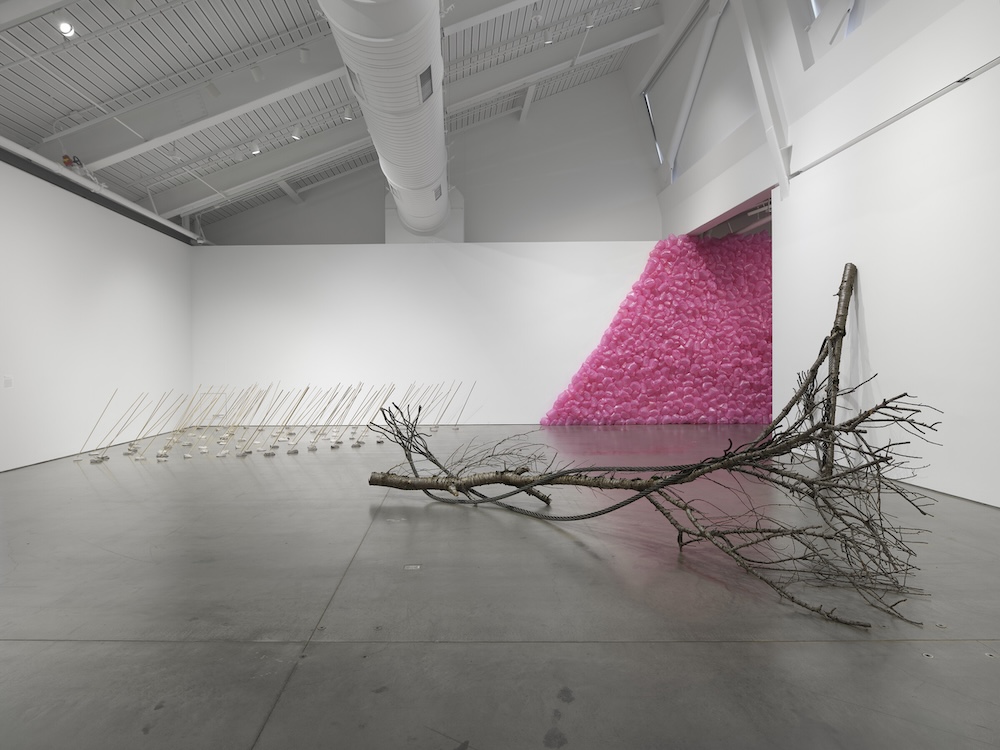
Hassinger is a difficult artist to pin down. Much of her work cannot be presented within a traditional frame nor perched on a pedestal. Her pieces beckons for interaction, and skip from one genre to the next with the abandon of a frolicking child. Often, the unpredictability of human nature and life found in the natural world serve as lead actors. Hassinger invites the viewer to climb aboard for the ride—or even, to hoist the sail themselves.
Born in Los Angeles in 1947, Hassinger studied dance and sculpture at Bennington College and received an MFA in fiber structure from UCLA. Ephemerality was embedded in her practices beginning early on. After relocating to the East Coast in 1984, she participated in various residencies her work was included in exhibitions at the Metropolitan Museum of Art, the Museum of Modern Art, and the Whitney Museum of American Art. An avid educator, Hassinger was director of the Rinehart School of Sculpture at the Maryland Institute College of Art for 20 years. Today, she lives and works in Harlem.
The retrospective makes terrific use of Basinger’s signature themes—among them, repetition, scale, allegorical storytelling, color, community—in determining its structure and flow. The show’s vigorous aliveness stems from the contrasts it presents. Dense proximity exposes empty space; community art-making is highlighted without erasing individual identity. Multiple works suggest rest, respite, yet contain warnings of discomfort found in letting down one’s guard. In Hassinger’s world, beauty exists amid decay, and darkness and humor are twisted twins. Flight may only be counted among the greatest of freedoms because it defies the downward pull of gravity.
Upon entering the exhibit, visitors first encounter works related to water. Hassinger made “Untitled Rope” (1972) as a graduate student at UCLA, and its four hemp lengths salvaged from a junkyard are as thick as a weightlifter’s arm, twisting in graceful, unfurling knots on the floor. Once used for construction or shipping, the ropes place a key role in Hassinger’s artistic vision of an interlaced world. On a nearby wall, the word “rivers” is hand-written repeatedly; each line almost touching its vertical neighbor. The script flicks like tiny waves on wind-tossed water.
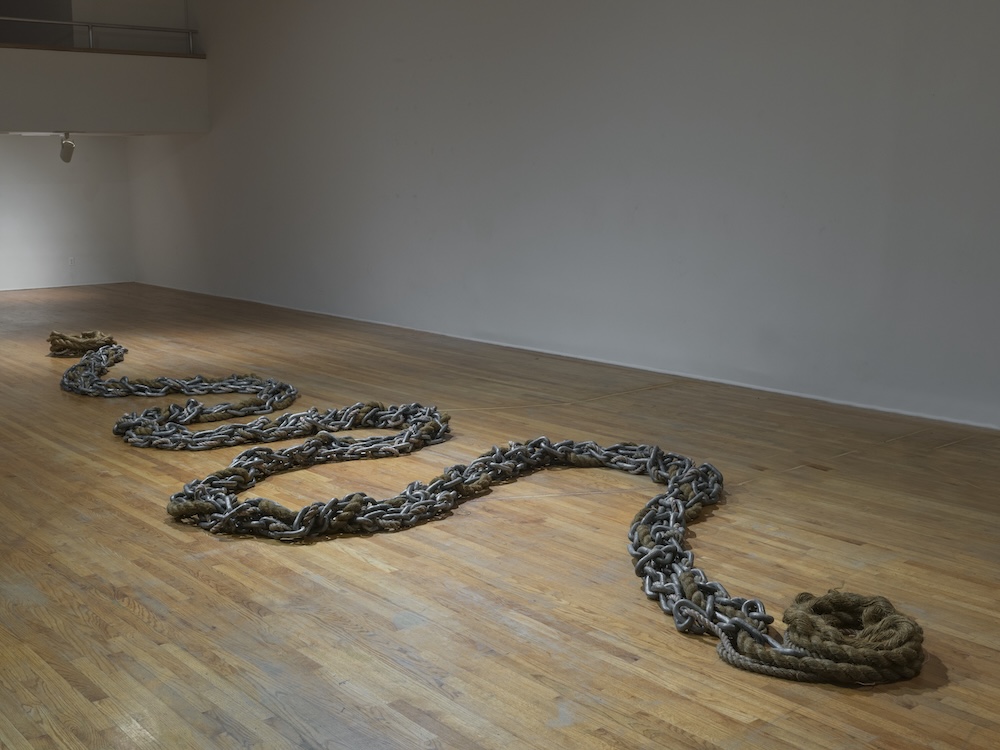
Coiling and interlocking macramé-style materials found in nature or created by human hands is an element in an adjoining gallery. “River” (1972-2011) snakes across the floor, the large-scale chain impressive in its voluptuous, graceful curves. An ecological and social statement expressed through steel chain and nautical rope, the sculpture is a tribute to landmark historic waterways that offered enslaved people freedom. Rivers are places of celebration, mourning, community, transformation.
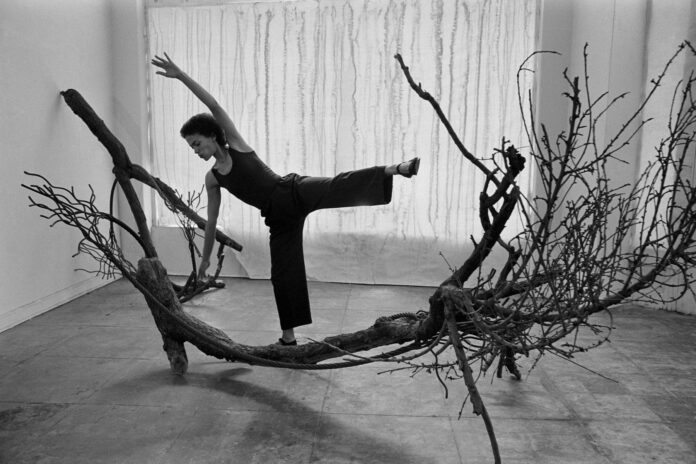
The artist’s fascination with upward reach is evident in contact photo sheets and framed photographs of Hassinger and other performers in the dance pieces she created. Photos of sculptures from her portfolio show actual tree branches or ropes crafted in steel spiral, like vines choking a pillar. Other pieces lay out macramé patterns that appear oddly organic. Literal or metaphorical arms stretching skyward unify the work.
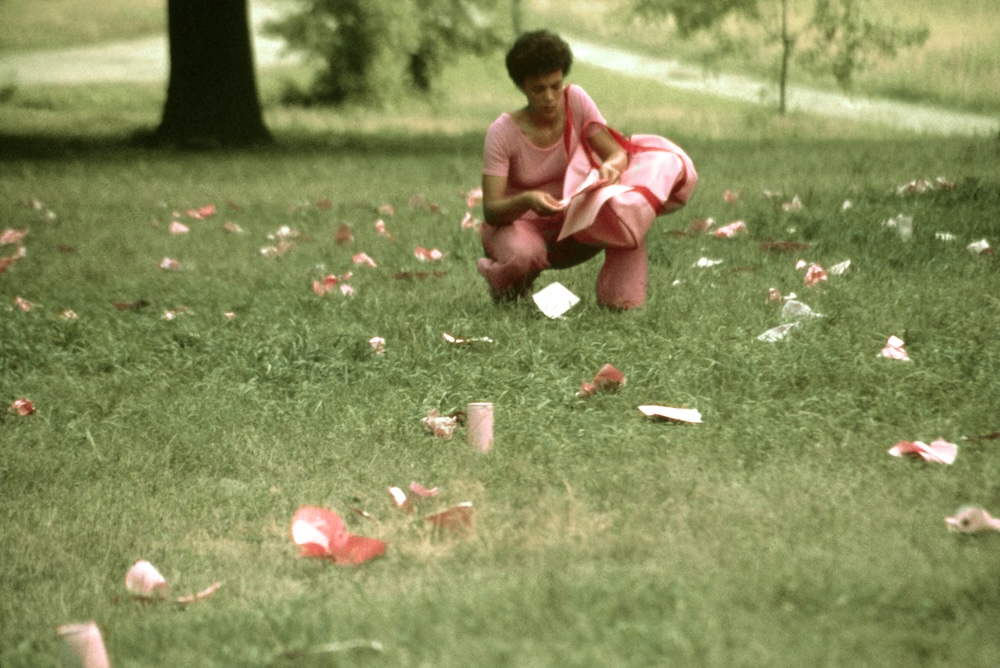
Blacks, whites, and browns are the retrospective’s dominate color palette. Exceptions pop. One series Hassinger has developed since 2008, “Love,” injects pink into site-specific installations and projects. (The artist has said she chose pink for the strong contrast it provides to the greens of nature.) Hundreds of pink plastic bags are push-pinned to a towering gallery wall, sweeping from the floor to dizzying heights. “Love” is a magic carpet. Each bag is inflated with the breath of actual people, and contains a tiny love note.
One of the most profound, evocative works in the show is “Daily Mask” (1997/2004), Hassinger’s only work shot on 16mm film. Transferred to single-channel video, the film addresses racism in the language of color and movement. The clip starts with Hassinger marking her face with black grease pencil. It appears to be an innocent act, abstract enough that one might think she is simply outlining contours. As the film progresses, the lines begin to resemble Indigenous face-painting legacies. But the marking does not stop and within the film’s mere 3:32 minutes, Hassinger blackens all but her lips. Suddenly opening her eyes wide and grinning, she has transformed herself into a reference to blackface minstrelsy. The brevity and force of the film is stunning.
A minor quibble: Despite public participation in “Wrenching News,” the exhibition lacks movement. Instead of photographs, videos of Hassinger dancing, working in her studio, or creating public artworks in communities would be wonderful. Happily, people craving a chance to see the artist in action do have recourse. Hassinger and six UC Berkeley students will perform a reimagining of her 1982 “Pink Trash” performance on UC Berkeley’s Crescent Lawn at 2pm on September 20. A cinematic screening of Hassinger’s video works—most involving dance—on November 2, plus a panel forum and a curator’s tour scheduled for this fall, will help to bring further dynamism and breadth.
MAREN HASSINGER: LIVING MOVING GROWING runs through November 29. Berkeley Art Museum and Pacific Film Archive. Tickets and more info here.