Lately it’s been challenging to write art reviews in San Francisco. As numerous journalists have reported, the closure of galleries and schools has made the arts landscape seem rather bleak. After Kadist, an international arts organization and collection, shuttered its Mission gallery earlier this year and a number of prominent galleries have vacated the gallery complex at Minnesota Street Projects (MSP), the two have teamed up for the exhilarating exhibition “Character Development” (through October 31).
Kadist’s inaugural director, Joseph del Pesco, is now its Americas director, guiding the organization’s programming from North to South America. In his first local curatorial project after returning to the Bay Area, del Pesco showcases six exceptional videos by national and international artists from Kadist’s own collection and, refreshingly, beyond its holdings. Installed at 1201 Minnesota Street, the large video projections capitalize on the dark cavernous project space, making it one of its most successful installs to date.
Within the works, many of the artists borrow elements from their lives as artists or everyday lives, while also pushing the parameters of self by adopting characters or personas. As the artists blur borders between fiction and reality, Korakrit Arunanondchai’s and Alex Da Corte’s videos captivatingly use strong references to horror films and ritual to push the emotional desire for emotional or psychic connection.
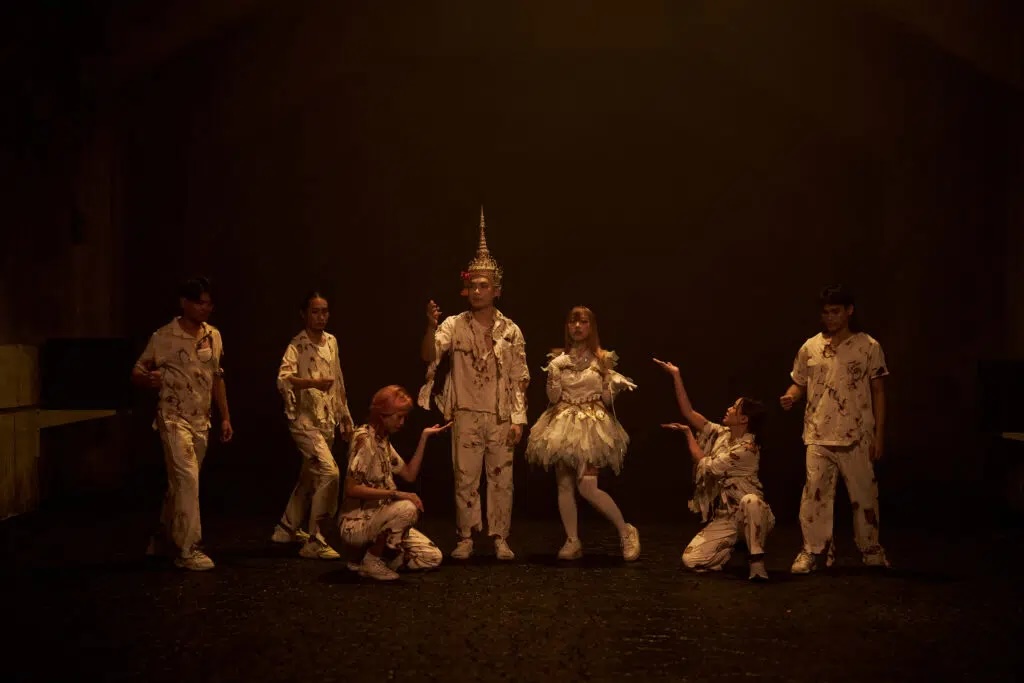
Based in Brooklyn and Bangkok, Korakrit Arunanondchai presents a two-channel video called “Unity for Nostalgia” (2025), which fuses traditional Thai references, horror films, and the global art world. Appearing as an artist with footage of a Thai contemporary art biennial, Arunanondchai also crosses over into a world where he attempts to conjure the ghost of a large monkey with five glowing green eyes.
In Arunanondchai’s dark film, orange filters, thermal imaging, the fire of candles, and a burning effigy radiate heat and evoke cycles of destruction and rebirth. The video dives into the macabre with a troop of macaques nibbling on a life-like replica of the artist’s face, and scenes of bloody, writhing bodies. As ritual moves between embracing Thai tradition and the visceral uncomfortableness of dark magic, Arunanondchai proposes a fluidity between the two.
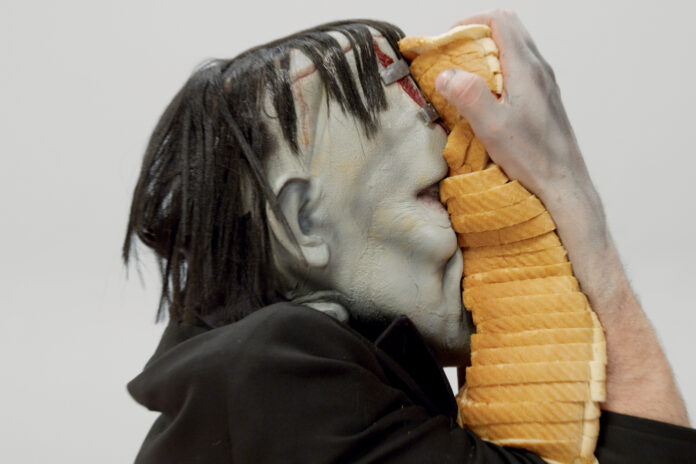
In contrast to Arunanondchai’s chiaroscuro world, Philadelphia-based Alex Da Corte slowly makes and unmakes himself as Frankenstein on an austere white set in “Slow Graffiti” (2017). With shot-by-shot references to Jørgen Leth’s quasi-anthropological black-and-white short “The Perfect Human” (1967), Da Corte’s transformation mirrors the ritual of Leth’s sartorial man and woman preening themself for the evening. In watching Da Corte slowly apply prosthetics, makeup, and clothes, the directness of his transformation imparts a vulnerability.
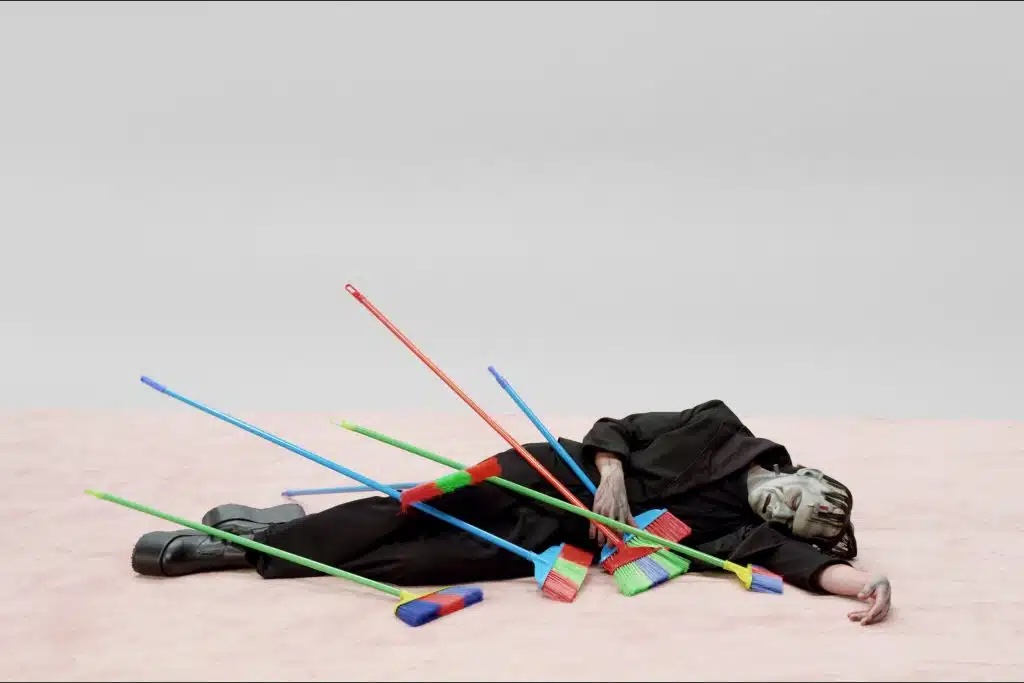
In contrast to the beautiful couple presented in Leth’s film, Frankenstein’s/Da Corte’s languid body lying on the floor, dancing to a silent song, and eating a solitary dinner, evoke deep empathy for the misunderstood and maladapted.
Additionally, Da Corte’s video strongly evokes the iconic monster movie actor and star of three Frankenstein films Boris Karloff. Born William Henry Pratt, the actor was split between the numerous horrifying cinematic characters that brought him fame; his expansive professional stage life as “Karloff,” which extended beyond the horror genre; and his off-stage “Pratt” life. As De Corte evokes Karloff’s many layers of self, image, and profession, the artist impart another level of mixed realities.
Embracing fiction and artifice, Arunanondchai’s and Da Corte’s works hold space for the incomprehensible and unresolved. Astutely, the artists use the horror genre as a guise to address the layers of contemporary global culture and the lines between beauty and the monstrous.
CHARACTER DEVELOPMENT through October 31 at 1201 Minnesota Street, SF. More info here.