It’s a big week for US filmmakers who rank among those few whose name alone can draw some people to the theater. There’s the Fincher-Tarantino collaboration The Further Mis-Adventures of Cliff Booth, a sequel to the latter’s Once Upon a Time in Hollywood. And Ava DuVernay is offering up documentary (with some dramatized elements) The 14th, about our Constitution’s suddenly contentious citizenship rights. We weren’t able to catch either in advance, alas. But we did see another two features also opening this holiday week, each from a foreign director of well-established international renown.
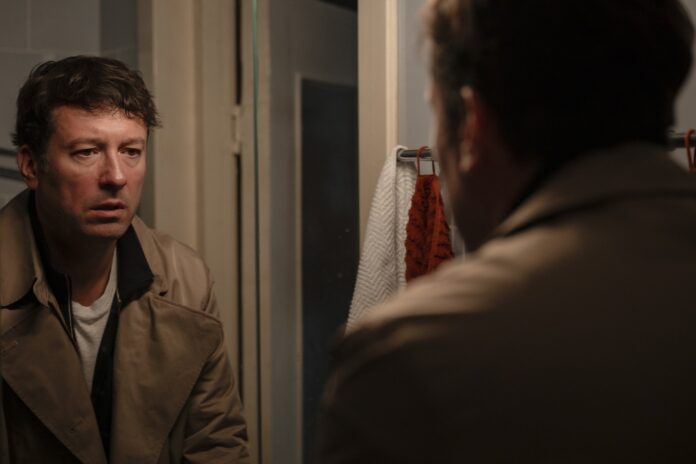
Andrey Zvyagintsev is one of the leading Russian screen talents of this century, though like several others, his films’ implicit political critique have not made him beloved by the Putin regime. It wasn’t politics, however, that kept him offscreen for nearly a decade: Minotaur is his first feature since 2017’s Loveless because he nearly died from COVID-related complications, and recovery was slow.
It’s rather surprising that the maker of Leviathan and The Return should choose rather pulpy foreign source material this time around. Namely, the screenplay for 1968 love triangle melodrama La Femme infidele, which was one of Claude Chabrol’s first breakthrough works outside France. (It was already remade once, as the 2002 US erotic thriller Unfaithful with Richard Gere and Diane Lane.) Zvyagintsev and co-writer Simon Lyashenko maintain the basic premise: The husband in a bourgeoise marriage gone stale realizes his wife is having an affair, something that rouses his jealousy and/or pride to impulsively violent results.
Here, Gleb (Dmitriy Maurov) is a middle-aged executive at a corporation based in a provincial Russian town. (Because the writer-director is no longer welcome at home, Minotaur is a multinational European production primarily shot in Latvia.) He lives in a sleekly moderne, forest-encircled home with wife Galina (Iris Lebedeva) and their only child Seryozha (Boris Kudrin). But the kid is something of a spoiled brat, his mother clearly unhappy with her life in general.
Which is not surprising—everyone seems to take her for granted, and apparently Gleb has strayed from the marital bed on more than one occasion. Nonetheless, there’s a new tone to her discontent that makes him suspect she’s now straying herself, an idea confirmed soon enough. When Gleb goes to confront his rival, things take an abrupt turn into noir-ish crime territory.
But Zvyagintsev isn’t interested in making a simple lurid thriller. What ultimately lends this 142-minute slow burn its real weight is what’s going on around and behind the protagonists: Though Gleb’s company is a private concern, it has no choice but to comply when the government flatly demands it provide a quota of low-ranking personnel as cannon fodder in the war against Ukraine.
Consumed by their own privileged problems, he and his family are exempt from such compulsory “service.” But without any such thing ever getting spelled out, we are very clear that their material comfort rests on a foundation of faceless hordes’ sacrifice—no less so than when an aristocratic elite relied upon the hard labor of serfs under centuries of Russian tsars.
The indictment is subtle, yet so stinging that it’s no wonder since this film’s release Zvyagintsev, who now lives in France, has been classified as a hostile “foreign agent” by Russia—Putin’s blanket designation for all his critics. Highly recommended, Minotaur opens in theaters including SF’s Metreon this Wed/25, then at the Roxie Theater Dec. 4.
Contrastingly prolific as ever at 77 is Pedro Almodóvar, who started out in the last days of the Franco regime as a subversively camp, underground gay filmmaker, and now has been long regarded as a (no less gay) international treasure. His films can be maddeningly inconsistent, though. Unless you’re one of those fans inclined to pronounce everything he does a “masterpiece,” part of what keeps him interesting is that you never know whether you’re going to get a new classic, a throwaway, or an interesting failure.
Falling pretty much into that last category is Bitter Christmas, which reprises elements from prior films—the verrrrry thinly veiled self-portrait and tricky multilayered narrative, for starters—to lesser effect than Almodovar has achieved before. It’s so self-conscious, it has characters discussing whether the fictive onscreen director within the film is past his best work, coasting on former glory. 2019’s Pain and Glory was thematically similar, but much richer, elevated not least by Antonio Banderas’ career-best performance. Here, by comparison, the navel-gazing seems sour, fussy, without much point—though it’s immaculately gift-wrapped in the real director’s usual aesthetic flair.
In 2004, Elsa (Barbara Lennie) is a former art-film director who’s turned to more lucrative advertising gigs. She is plagued by migraines soothed partly by the hunky younger lover (Patrick Criado) she’s already starting to tire of. She’s haunted by having been absent from her mother’s deathbed a year prior, as meanwhile friends are experiencing crises Elsa is too preoccupied to help them with.
After a point, however, we realize all this is just a screenplay being written in the present day by director Raul (Leonardo Sbaraglia), who has his own hot younger lover (Quim Gutierrez), and friends/colleagues whose serious problems he pays minimal lip service to. In both strands, there are suicidal figures, many weeping women (an Almodovar specialty), and a screenplay written by the protagonist that infuriates their intimates by exploiting their private lives.
One of Almodóvar’s early features was called Labyrinth of Passion. This is another labyrinth, but the passion has gone cold, with little humor en route or even much sense of arrival at the fadeout. Its structural complexities feel like empty filigree. Though the cast is able, the director doesn’t seem to like his own characters here, so we never grow invested in them.
He’s made worse films yet watchable as it is, Bitter Christmas (I’m not even sure where that holiday surfaced in the story) feels like a paint-by-numbers exercise—even if the picture being painted is an ersatz Escher. It opens in Bay Area theaters Wed/25; the Roxie is showing some PA golden oldies (including Women on the Verge of a Nervous Breakdown and Talk to Her) before its own run commences on Dec. 11.
Terror, Italian Style: ‘Plot of Fear,’ ‘Closed Circuit,’ ‘The Holy Boy’
Three Italian thrillers newly releasing to home formats over the next week—two vintage, one new—are each horror-adjacent in different ways, bringing some unexpected wrinkles to genre terrain.
Closest to a standard giallo (the violent murder mysteries that made directorial stars out of Dario Argento and Mario Bava) is Paolo Cavara’s 1976 Plot of Fear, with Michele Placido as a police detective investigating a series of slayings connected to a circle of wealthy hedonists who gather to observe and act out various kink fantasies. (At one point we see them watch excerpts from a “porno” cartoon by animator Gibba.)
Arriving fairly late in the giallo vogue, this film is well-produced, with an above-average cast—including newly-minted Story of O discovery Corinne Clery, scenery-chewing American character actor Eli Wallach, and an underutilized Tom Skerritt, the recently-deceased stalwart of M*A*S*H, Alien, Top Gun et al. It has some wit, with Placido playing his hero for sly comedy.
Yet the director-cowriter doesn’t seem very interested in suspense or thrills, and in too-typical giallo fashion, the mystery itself is a convoluted mess with an improbable resolution. The S&M stuff is handled in such stereotypical, touristy “look at what these decadent richies get up to!!” fashion, it plays as more silly than provocative. Worth a look for the genre’s fans, Plot (which Kino Lorber releases on Blu-ray and DVD on December 1) probably won’t make a convert of anyone else.
More successful is Closed Circuit, which came out two years later and rather surprisingly went straight to TV—surprising because it’s slicker and better than much home-grown product playing Italian cinemas at the time. A disparate crowd including amorous couples, cineaste nerds, a grandfather and bratty child, etc. turn up for the first matinee of the day at a repertory theater showing an old spaghetti western (1968’s poetically named A Sky Full of Stars For A Roof).
When that film-within-the-film’s antagonists face off for a shootout, however…someone in the audience actually gets shot dead. Once police arrive, they question everyone, keeping both staff and patrons on the premises until the crime is solved. Eventually all concerned re-take their original places for a reenactment, the film is played again, and…well, the mystery deepens as there’s a second real-world gunshot death.
This more sinister anticipation of The Purple Rose of Cairo is vividly cast, directed (by Giuliano Montaldo, best known for 1972’s Sacco & Vanzetti) and written (by Nicola Badalucco). The denouement may leave you with as many questions as ever. Still, Circuit manages to seem consistently fluid and intriguing within its single setting, ultimately pulling off a sort of existential enigma in crime-drama disguise. It begins streaming on arthouse platform OVID this Fri/27.
Arriving the same day on genre streamer Shudder is the new Italian film, The Holy Boy, whose original-language title translates as The Valley of Smiles—probably dropped because it suggests either something warm-’n’-fuzzy or another installment in the US Smile horror franchise. This is far from either, centering on 40-ish teacher Sergio (Michele Riondino) who’s relocated to a small village for a short-term gig as a substitute gym instructor at the high school. A surly loner, he’s gruff with both students and neighbors—because, we eventually learn, he recently suffered a devastating personal tragedy. But then, so has this entire community: A year prior, a nearby train crash killed nearly 50 people, most of them locals.
Sergio soon realizes one of his teenage charges, oddball Matteo (Giulio Feltri), is also a loner who’s shunned by his peers. It takes him longer to realize Matteo has apparent healing powers, and is treated as a sort of captive deity by the town’s adults. This can be a very good thing, especially for those with painful burdens like Sergio. But it can also be a bad thing—most obviously for Matteo himself, but sooner or later for everyone.
Rather low-key for a horror movie, director-cowriter Paolo Strippoli’s feature is probably better classified as a supernatural drama. Its relative lack of violent mayhem may frustrate some. Yet it works very well as something much more difficult to pull off than a basic horror flick: A disturbing, morally ambiguous religious parable. Strippoli sustains an eerie mood over 122 minutes that never grow slack, arriving at an impressive finale and lingering ambiance. One looks forward to his next film—and in fact The Spiral, which features one of my favorite European actors (Valeria Bruni Tedeschi), has already won some rave reviews at film festivals.